
Financial distress, county by county.
3,144 U.S. counties scored through the County Distress Index.
How stressed is your county?
943 counties score high, very high, or extreme for county distress. See all rankings →
County Stories
All 3,144 counties →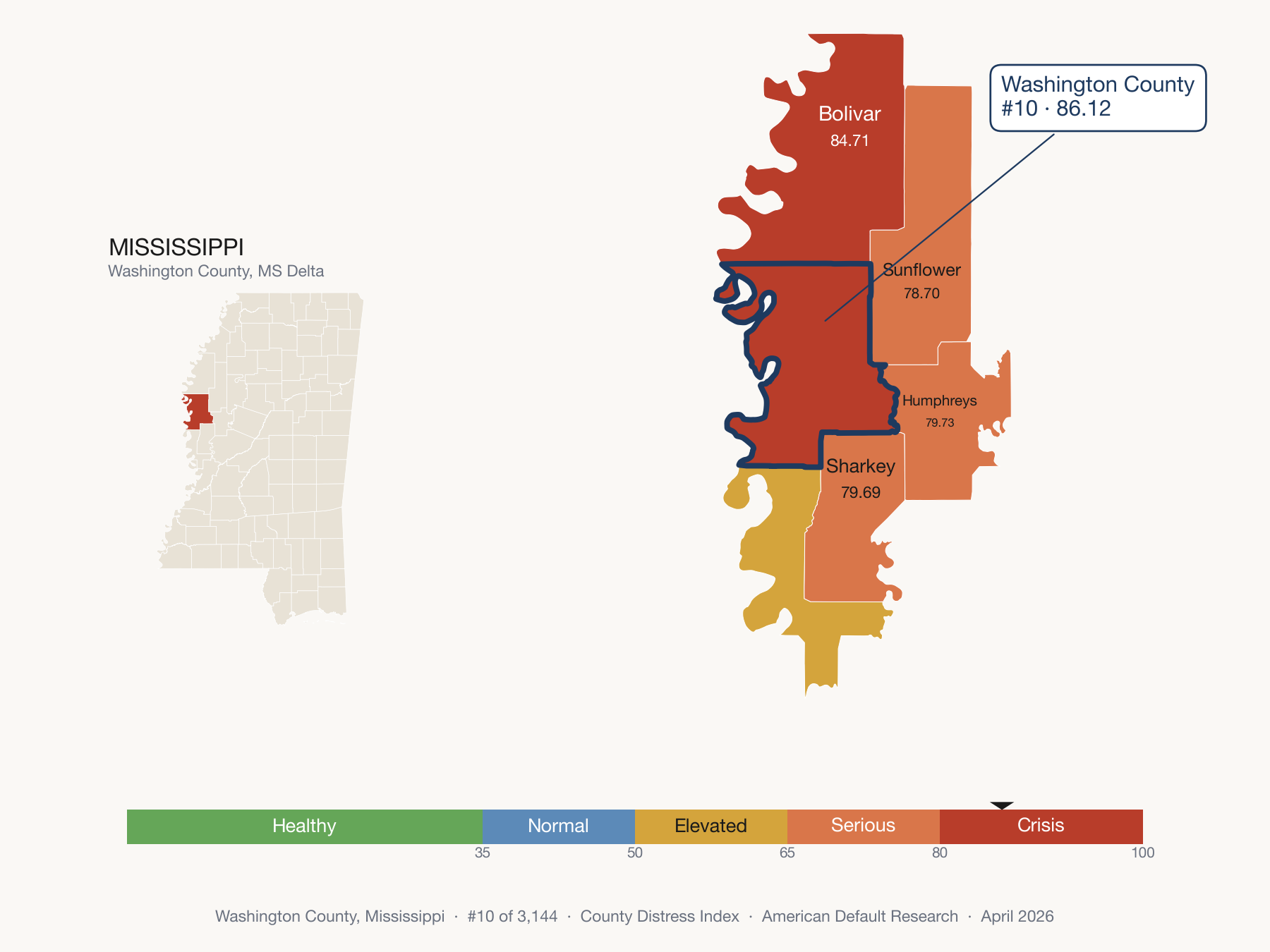
"The Note"
Extreme county distress · 2nd of 82 counties in Mississippi

"The Merger"
Extreme county distress · 4th of 159 counties in Georgia

"The Passage"
Extreme county distress · 1st of 159 counties in Georgia

"The Shade"
Extreme county distress · 1st of 67 counties in Florida

"The Drainage"
Extreme county distress · 1st of 115 counties in Missouri

"The Line"
Extreme county distress · 1st of 133 counties in Virginia

"The Green"
Extreme county distress · 5th of 159 counties in Georgia

"The Room"
Extreme county distress · 6th of 82 counties in Mississippi
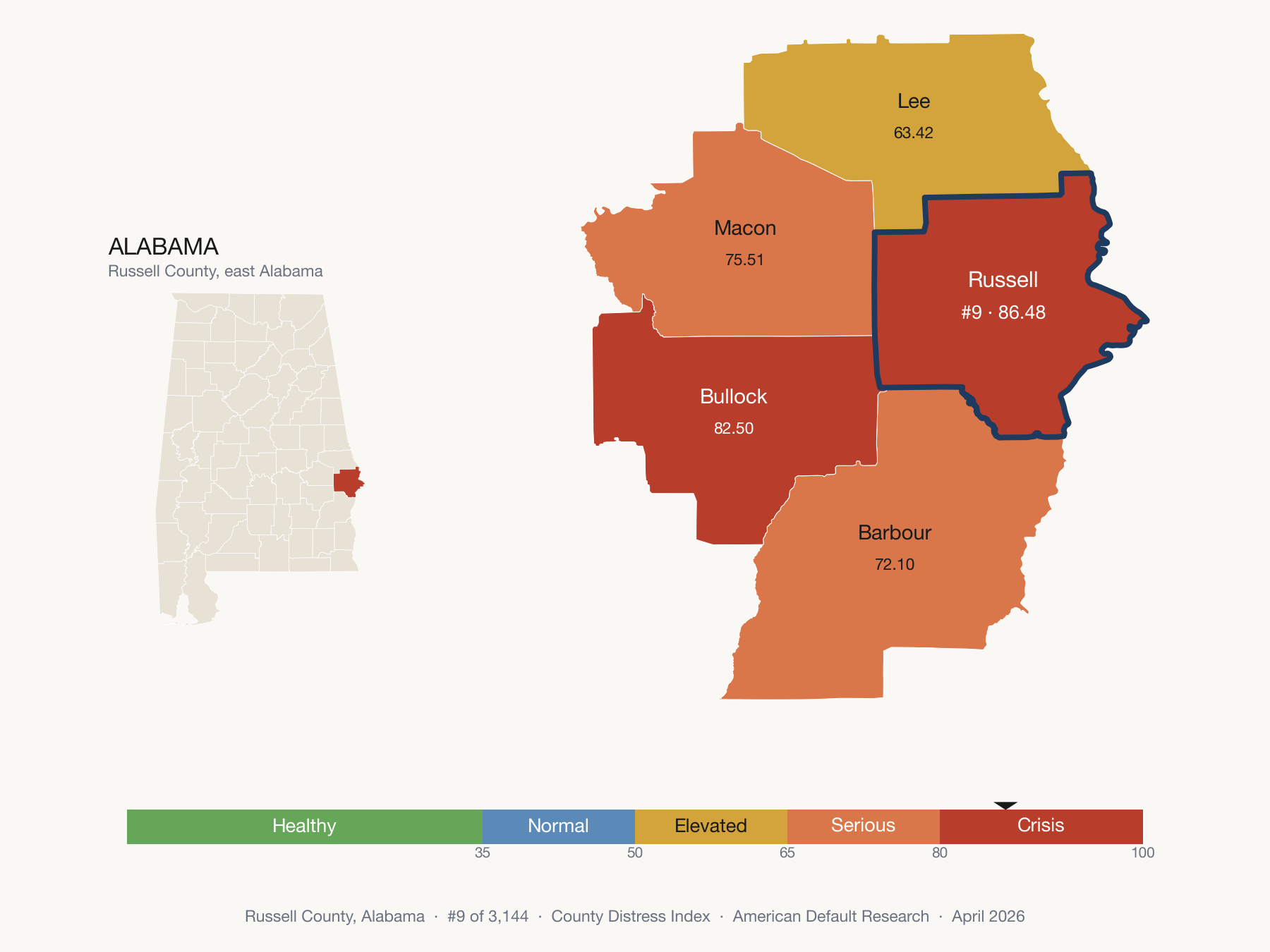
"The Filing"
Extreme county distress · 5th of 67 counties in Alabama

"The Yield"
Extreme county distress · 10th of 159 counties in Georgia

"The Record"
Extreme county distress · 6th of 120 counties in Kentucky

"The Gin"
Extreme county distress · 3rd of 115 counties in Missouri

"The Rebuilding County"
Extreme county distress · 4th of 115 counties in Missouri

"The Patron"
Extreme county distress · 10th of 254 counties in Texas

"The Extraction County"
Very high county distress · 20th of 67 counties in Florida

"The Runway"
Very high county distress · 15th of 100 counties in North Carolina

"The Irrigation"
Moderate-high county distress · 2nd of 39 counties in Washington

"The Bypass"
Moderate-high county distress · 22nd of 33 counties in New Mexico

"The Seat"
Moderate county distress · the only county-equivalent in District of Columbia

"The Arithmetic"
Moderate county distress · 2nd of 99 counties in Iowa

"The Residual"
Moderate county distress · 7th of 56 counties in Montana

"The Foundry"
Low-moderate county distress · 32nd of 36 counties in Oregon

"The Filter"
Low county distress · 37th of 39 counties in Washington

"The Hill"
Exceptionally low county distress · 33rd of 33 counties in New Mexico
Most Distressed Counties
Full rankings → 1
Holmes County, MS Default & Legal
100 2 Washington County, MS Delinquency
99 3 Dougherty County, GA Default & Legal
99 4 Dallas County, AL Delinquency
99 5 Pemiscot County, MO Default & Legal
99 6 Wilcox County, AL Default & Legal
99 7 Gadsden County, FL Debt Burden (housing basis)
99 8 Hancock County, GA Debt Burden (housing basis)
99 9 Leflore County, MS Delinquency
99 10 Coahoma County, MS Delinquency
99 Browse by State
All 51 states →Mississippi
85.9 mean score
72 of 82 counties score high, very high, or extreme
Louisiana
83.7 mean score
52 of 64 counties score high, very high, or extreme
Arkansas
78.3 mean score
54 of 75 counties score high, very high, or extreme
Alabama
77.5 mean score
45 of 67 counties score high, very high, or extreme
South Carolina
76.0 mean score
27 of 46 counties score high, very high, or extreme
Georgia
75.8 mean score
108 of 159 counties score high, very high, or extreme
Florida
74.9 mean score
46 of 67 counties score high, very high, or extreme
Kentucky
73.1 mean score
76 of 120 counties score high, very high, or extreme
Arizona
70.6 mean score
10 of 15 counties score high, very high, or extreme
New Mexico
68.7 mean score
19 of 33 counties score high, very high, or extreme
Oklahoma
66.3 mean score
41 of 77 counties score high, very high, or extreme
Tennessee
65.1 mean score
38 of 95 counties score high, very high, or extreme
West Virginia
64.6 mean score
22 of 55 counties score high, very high, or extreme
Texas
63.1 mean score
109 of 254 counties score high, very high, or extreme
North Carolina
59.8 mean score
35 of 100 counties score high, very high, or extreme
Latest Analysis
All articles →Research
What the Current Indicator-Pair Tests Show
Pair-specific results that survived every stage of the committed validation pipeline.
Analysis
The FHA Gap Measures Concentration, Not Timing
The borrower-split thesis asks whether distress appears first where cash buffers are thinnest. The level evidence is strong and stable. The timing evidence does not exist, and the gap's own history explains why.
Analysis
The Savings Rate Does Not Lead Delinquency
Testing whether the personal saving rate leads loan delinquency, and what the failure says about what the savings rate actually measures.
Analysis
The Two-Economy Problem in Credit Data
Same product, two lender channels, opposite readings against their own histories. What the disaggregated credit data supports, what it does not, and why the gap is not an early warning.
Analysis
How the Historical Lead-Relationship Pipeline Works
The methodology behind American Default's historical lead-relationship tests: FDR correction, first-differencing, multi-crisis validation, Granger testing, and out-of-sample replication.
Analysis
What Rising Hardship Withdrawals Can—and Cannot—Tell Us
What Vanguard hardship-withdrawal rates show about workplace-plan use, with limits on household-level, causal, tax, and leading-indicator claims.
For journalists & researchers
Use this data
Downloadable CSV, embeddable maps, full methodology, and story angles for all counties and states.
Press & data kit → Behind on payments?
Get help now
Free assessment of your situation. HUD-approved counselors. Foreclosure guides for all 50 states. Step-by-step options.
Free assessment →American Distress Index
47.0 TypicalThe composite itself sits higher than 44% of all published quarters since 2005.
The national composite tracking household financial distress across five dimensions.
Explore the index →County Distress Index
0 – 100 score per countyCounty ranks and score labels built from five equal-weighted distress domains.
Methodology →Quarterly data drops. No spam.
County scores, American Distress Index updates, and indicator alerts — delivered when the numbers move.
or Create an Account for full access
If this affects you, we can help. Get a free action plan ·
Call (888) 602-4161 Find help near you ·
Browse the Glossary
Prefer a nonprofit? HUD-approved housing counselors offer free foreclosure-prevention counseling (1-800-569-4287).