Summit County, Utah

Near the national median for severe rent burden (50%+).
Main Findings
Summit County, Utah ranks 3,050th most distressed in the United States on the County Distress Index. Summit sits near the national median across major distress indicators. Its highest-scoring domain is Debt Burden (housing basis) and its lowest is Delinquency.
- 3,050th of 3,144 counties on the County Distress Index — 2 · exceptionally low county distress, more distressed than 2% of U.S. counties; 27th in Utah.
- 17% of renter households pay 50%+ of income on rent (U.S. median 18%). Severe rent burden (50%+) at the 43rd percentile nationally. Source: U.S. Census Bureau, ACS 5-year (2024).
- Labor domain score 17 — weight 20.0% of the CDI composite. Source: American Default Research.
- Default & Legal domain score 16 — weight 20.0% of the CDI composite. Source: American Default Research.
- Safety Net & Buffer domain score 9 — weight 20.0% of the CDI composite. Source: American Default Research.
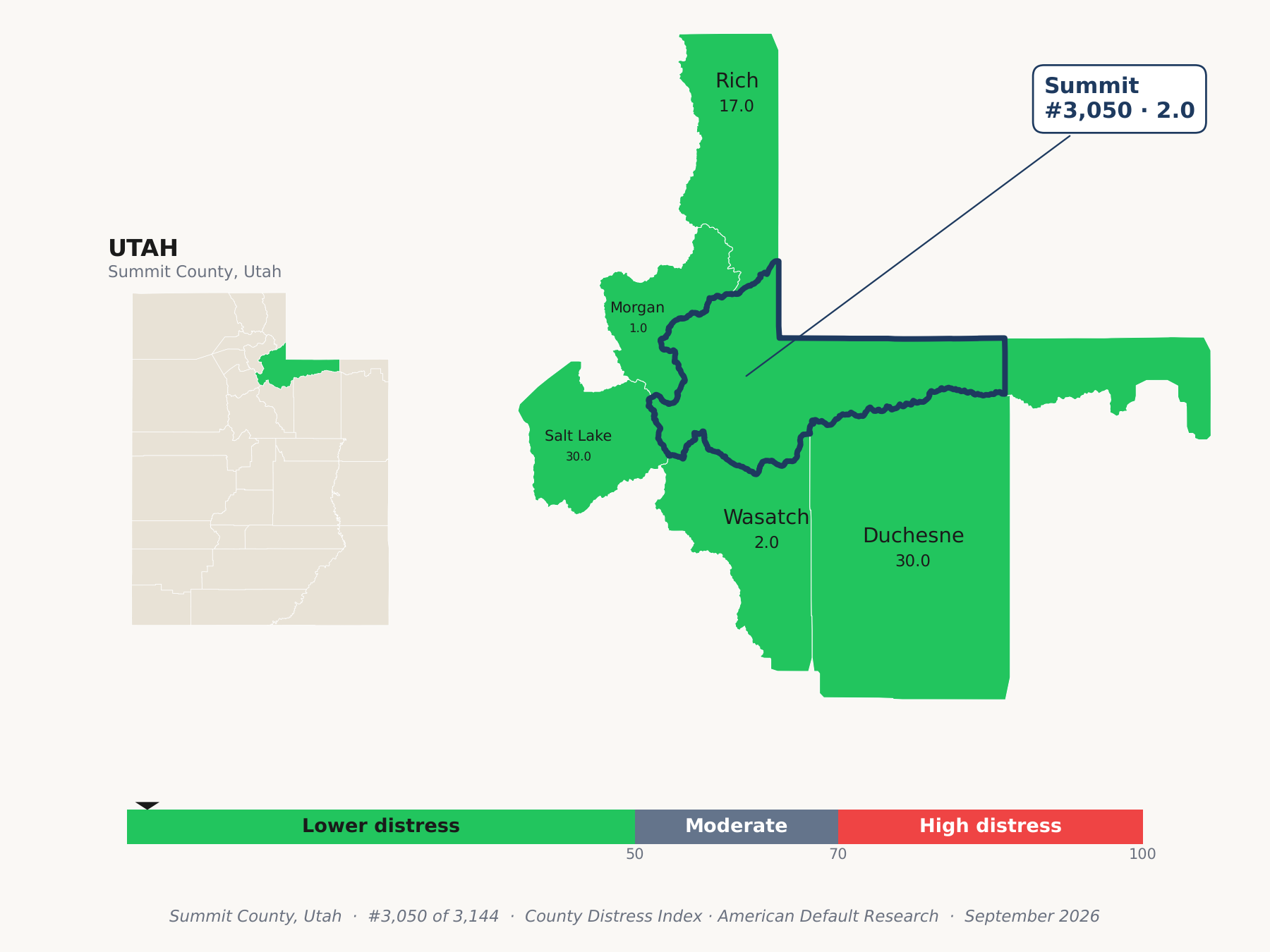
Summit County has an exceptionally low county distress score. The CDI reading is a county comparison, separate from national ADI bands.
The CDI gives this county an exceptionally low county distress label. The score label is not a national ADI band; it is a county CDI score range. Its highest-scoring domain is Debt Burden (housing basis).
Indicator History
Period-correct raw indicators from the county-history panel. The CDI composite is excluded because it is a current cross-sectional score.
Unemployment rate
Poverty rate
Transfer income share
Subprime credit population
The Indicators Behind Summit County's CDI Score
Every number traces to a public source. Summit County's value shown alongside UT's median and the U.S. median. Full CSV available for download.
| Indicator | Summit | UT median | U.S. median | Pctile | Source |
|---|---|---|---|---|---|
| Delinquency — domain score 2 · Rank 3,144 of 3,144 | |||||
| Auto loan delinquency Share of auto loan accounts 60+ days past due | 2% | 3% | 5% | 3rd | Urban Institute Debt in America (2025) |
| Credit card delinquency Share of credit card accounts 60+ days past due | 1% | 3% | 5% | 1st | Urban Institute Debt in America (2025) |
| Subprime credit share Share of residents with a credit score below 660 | 9% | 16% | 23% | 1st | Equifax data retrieved via FRED (2025) |
| Default & Legal — domain score 16 · Rank 2,896 of 3,144 | |||||
| Debt in collections Share of residents with a credit file who have debt in collections | 6% | 14% | 23% | 0th | Urban Institute Debt in America (2025) |
| Bankruptcy filing rate Personal bankruptcy filings per 100,000 residents | 89 | 138 | 126 | 31st | Administrative Office of the U.S. Courts, F-5A (2025) |
| Debt Burden (housing basis) — domain score 40 · Rank 1,997 of 3,144 | |||||
| Rent-to-income ratio Fair Market Rent (2BR) as share of median household income | 20% | 18% | 21% | 37th | U.S. Department of Housing and Urban Development Fair Market Rents (FY2027); U.S. Census Bureau, SAIPE (2024) |
| Severe rent burden (50%+) Share of renter households paying 50%+ of income on rent | 17% | 15% | 18% | 43rd | U.S. Census Bureau, ACS 5-year (2024) |
| Labor — domain score 17 · Rank 2,776 of 3,144 | |||||
| Adults 25-54 not working Share of adults aged 25 to 54 without a job, leaving out residents of prisons and other institutions (service members count as working) | 15% | 22% | 21% | 16th | U.S. Census Bureau, ACS 5-year (2024) |
| Unemployment (average of monthly rates) Share of labor force unemployed, averaged over the monthly rates published for September 2025 to August 2026 (no figures published for October 2025) | 3% | 4% | 4% | 18th | U.S. Bureau of Labor Statistics, LAUS (monthly rates averaged, September 2025 to August 2026; no figures published for October 2025) |
| Safety Net & Buffer — domain score 9 · Rank 3,024 of 3,144 | |||||
| Child poverty rate Share of children under 18 below the federal poverty line | 5% | 12% | 17% | 1st | U.S. Census Bureau, SAIPE (2024) |
| Disability rate Share of residents reporting a disability | 6% | 13% | 16% | 0th | U.S. Census Bureau, ACS 5-year (2024) |
| Poverty rate Share of population below the federal poverty line | 5% | 9% | 13% | 1st | U.S. Census Bureau, SAIPE (2024) |
| Uninsured rate Share of residents without health insurance coverage | 7% | 8% | 8% | 45th | U.S. Census Bureau, ACS 5-year (2024) |
Five-Domain Breakdown
The CDI is an equal-weight composite of five family-v1 distress domains. Each domain contributes 20% of the county score.
Methodology
The County Distress Index scores household financial distress from 0 to 100 for all 3,144 U.S. counties. A county's score is the share of U.S. counties it is more distressed than. The index is built from five equal-weighted domains: Delinquency, Default & Legal, Debt Burden, Labor, and Safety Net & Buffer. Each domain is the mean of distress-oriented indicator percentiles; the five domains are averaged, and that average is ranked against every other county to give the score.
Data sources include the Urban Institute Debt in America (Equifax consumer credit panel), Equifax data retrieved via FRED (subprime credit share), U.S. Census Bureau (American Community Survey 5-year, Small Area Income and Poverty Estimates), U.S. Bureau of Labor Statistics (Local Area Unemployment Statistics), Administrative Office of the U.S. Courts (F-5A bankruptcy filings), and U.S. Department of Housing and Urban Development Fair Market Rents. Data vintages range from 2024 to 2027 depending on source; full indicator-level vintage detail is in the methodology document.
For Press & Research
Everything you need to cite Summit County data.
Draft wire copy 134-word AP-style article — use freely with attribution
COALVILLE, Utah — Summit County ranks 3,050th among the nation's most financially distressed counties, according to the County Distress Index released this month by American Default Research.
Summit scores 2 out of 100, which means it is more distressed than 2% of U.S. counties; its score label is exceptionally low county distress. Among 3,144 U.S. counties scored, 3,049 counties rank more distressed. Within Utah, Summit ranks 27th of 29 counties.
The index, which draws on 14 source indicators from the U.S. Census Bureau, Bureau of Labor Statistics, Urban Institute and federal court filings, finds Summit sitting near the national median across major distress indicators, with no single domain emerging as a clear driver.
American Default Research founder Ross Kilburn is available for interview at press@americandefault.org.
Full methodology and county-by-county data are available at americandefault.org/methodology/cdi.
Frequently Asked Questions
What is Summit County's CDI score, and what does it mean?
What drives Summit County's distress score?
How does Summit County compare to its neighbors?
How is the County Distress Index calculated?
Summit County resident looking for help? HUD counselors, legal aid, and attorney referrals →