The Passage
Dougherty County, Georgia

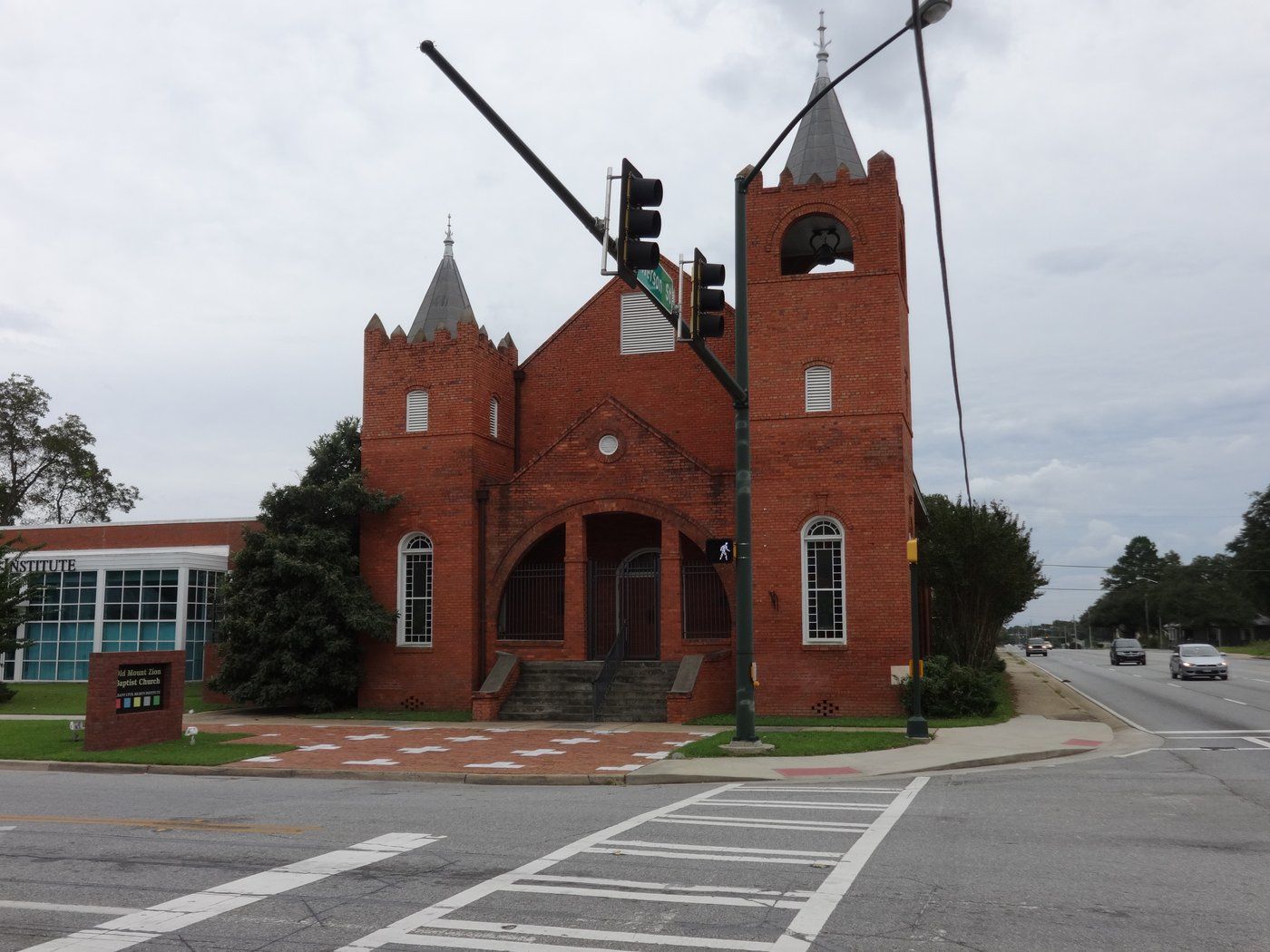
In 1903, W.E.B. Du Bois wrote a single sentence about Dougherty County — a pall of debt, a cascade from merchants to tenants to laborers. In July 2026, the County Distress Index scores Dougherty's Delinquency domain at 98.11, with two of its indicators at the 99th percentile. The passage hasn't ended.
A sentence on one desk, a scorecard on the other
Pastor Daniel Simmons ministers at Old Mt. Zion Baptist Church in Albany, the brick sanctuary where the Albany Movement held its mass meetings sixty-five years ago and where Bernice Johnson — later Bernice Johnson Reagon — and others who would form the Freedom Singers first sang the a cappella freedom songs that would become the national civil rights soundtrack. He told ProPublica’s reporting team in December of last year that the condition he sees around him was not inevitable. “It didn’t have to be this way,” he said. The health system could have been different. The city could have been different. The outcome would have been different.
I have been reading Simmons’s line against another sentence, written about the same county a hundred and twenty-three years earlier.
The passage
In 1903, W.E.B. Du Bois rode through Dougherty County in a Jim Crow car and devoted two chapters of The Souls of Black Folk — “Of the Black Belt” and “Of the Quest of the Golden Fleece” — to what he saw. In the middle of Chapter 7 he set down this sentence: “A pall of debt hangs over the beautiful land; the merchants are in debt to the wholesalers, the planters are in debt to the merchants, the tenants owe the planters, and laborers bow and bend beneath the burden of it all.”
That is not a general observation about the South. He named the county.
In July 2026, the County Distress Index scores Dougherty’s Delinquency domain at 98.11 — auto-loan delinquency at the 96th percentile nationally, credit card delinquency at the 99th percentile, subprime credit share at the 99th percentile. Debt in collections, the modern ledger entry, sits in the Default & Legal domain at the 99th percentile. Rank 7 of 3,144 counties scored.
The instruments changed. The cascade did not. What Du Bois wrote about as ledger debt to the cotton merchant now runs through credit bureaus, hospital billing departments, third-party collectors, and wage garnishment files. The sentence is still describing ground.
The current chain, and the modern merchant
Walk the 2026 chain the way Du Bois walked the 1903 one. A household in Albany gets a bill from the hospital it did not choose. About 16% of Albany residents are uninsured — almost double the national rate, in a state that has not expanded Medicaid. Phoebe Putney Memorial, licensed for 691 beds and southwest Georgia’s largest employer with more than 5,500 workers as of 2024 (ProPublica, Part 1), processes the bill. If the household cannot pay, the bill moves to collections. Phoebe’s bad debt grew from $16.5 million in 2012 to more than $121 million by 2018 (ProPublica, Part 3). The debt moves to a bureau. The credit score falls. The subprime auto loan carries a higher rate. The credit card goes delinquent. The collector sues. The household files.
ProPublica’s December 2025 series named the structure directly. Albany, they wrote, is one of a growing number of places whose survival is hitched to the fates of oligopoly health systems the way towns in West Virginia and Kentucky once were to coal. “They’ve become hospital towns.”
The merchant in Du Bois’s sentence is not gone. It has a 691-bed footprint.
One note the data does not fully explain. Every credit indicator in the Delinquency and Default & Legal domains sits at the 96th percentile or higher in July 2026, and the uninsured rate runs above the national median in a non-expansion state with a dominant hospital system. The hospital bad debt is enormous on Phoebe’s own books. How much of it shows up in the household credit file versus how Phoebe carries patient balances internally is not something the credit tracer alone can settle.
The city that cannot own and cannot rent
Dougherty’s population was 85,790 in the 2020 census and has since drifted down to an estimated 82,645 on the July 2026 County Distress Index. Albany is the regional hub for southwest Georgia, not a rural outpost. And yet the county’s Debt Burden domain scores 95.99 in July 2026, driven by a renter-dominant population where renters paying 50% or more of income for housing sit near the 97th percentile and rent-to-income runs high against low wages.
Two economies, one address.
The 650-plus homeless student count in the district this January is the housing story in its most direct form. The Emergency Housing Vouchers that more than 300 Dougherty families rely on sunset on June 30, 2026. The Default & Legal domain — debt in collections and the court filing rate — ranks 5 of 3,144 counties in July 2026. The filing input records cases per resident; it does not identify the circumstances, motive, or outcome of those cases.
And the county’s economy is not starting over. In a mid-size regional hub of 82,000-plus in July 2026, the household balance sheet is failing across every domain at once — not a small town with no resources but a city where the credit economy has largely stopped working for the people in it.
What the record says, and what the ground does
Albany is a place where the institutional record and the ground condition have a long history of disagreeing. The Albany Movement of 1961-62 was, by the national press’s count, a failure — Chief Laurie Pritchett studied King’s tactics in advance, arrested protesters without spectacle, and denied the campaign its Birmingham moment. The music that came out of Mt. Zion won. The legal campaign, locally, didn’t. Fifty years later, the FTC took the Phoebe merger to the Supreme Court and won unanimously, but the merger had already closed — Phoebe had paid HCA $195 million in 2011 for the only competing hospital and renamed it Phoebe North before the ruling arrived (ProPublica, Part 2). The paper outcome and the hospital outcome ran opposite.
Now the record is stirring again. Terron Hayes was sworn in on December 27, 2024 as the 19th sheriff, and the first Black sheriff, in Dougherty County’s history. In 2024 the county voted over 70% for Kamala Harris while the state went to Trump. In November 2025 the County Commission proposed $207,000 for Albany Civil Rights Institute repairs — the building next door to Mt. Zion (WALB). In April 2025 a Dougherty jury handed down a $70 million verdict against three Albany physicians in the Jessica Powell medical-malpractice case; Phoebe Putney had settled with the plaintiff before trial and was not a defendant at verdict (ProPublica, Part 5). None of that moves a 99th-percentile debt-in-collections reading in a quarter. It is the record trying to re-align with the ground.
What to watch, and what Du Bois still measures
What to watch over the next four quarters: the June 30 Emergency Housing Voucher expiration and whether the homeless-student count rises with it; the proposed sales tax bump from 8% to 9% on the May ballot, which would fall hardest on the households already at the 97th-percentile rent burden; and the credit-card delinquency indicator, already at the 99th percentile in July 2026, the most sensitive of the three credit signals in the Delinquency domain. The passage Du Bois set down is still running. It has been running for a hundred and twenty-three years. Simmons, who preaches inside the building where the freedom singers once sang, says it didn’t have to be this way. The scorecard does not contradict him.