The Merger
Bibb County, Georgia

· Annual refresh · next update early 2027
Macon and Bibb County merged their governments in 2014 after four failed attempts over eighty years. The promise was efficiency. A decade later the consolidated county ranks second in the nation for household financial distress. The administration unified. The condition it was supposed to address did not.
What the CDI Says About Bibb County
- 2nd most distressed county in America — Bibb's composite County Distress Index score of 88.71 lands in the Crisis zone, ranking 2 of 3,144 counties nationally and 2 of 159 in Georgia.
- Renters paying 50%+ of income on rent sit at the 99th percentile, while owners 30%+ burdened sit at the 47th — near median. Two economies at the same address, under one consolidated government.
- Debt in collections at the 99th percentile, bankruptcy filings at the 97th. Consumer Credit Distress scores 95.07 (rank 13 nationally); Legal Distress scores 96.95 (rank 58). The courthouse is where the math ends up.
- Business application rate at the 4th percentile nationally — near floor — while rent-to-income ratio sits at the 96th. Expensive to live in. Almost no one is starting a business.
- $435M of a $1B Atrium Health Navicent capital commitment deployed as of November 2025. Uninsured rate still at the 84th percentile. The capital is arriving at a campus a significant share of residents cannot access.
Macon-Bibb County ranks 2nd of 3,144 U.S. counties on the County Distress Index. Renter cost burden at the 99th percentile. Business formation at the 4th. The merger happened. The remedy has not.
The administration unified. The school district merged its budget categories until it lost track of them. The hospital merged and the uninsured rate held at the 84th percentile. A mid-size metro with this music heritage that cannot get new businesses to form is a county where the anchors are holding and nothing else is arriving behind them.
The jail the merger couldn't fix
Katrina Howell was in K-Block in 2025. She was one of the former inmates who described what was inside. "We were in K-Block with close to 93 other inmates," she told 13WMAZ. "There were no mats, no blankets. We didn't have food or water." At least six people died inside the Bibb County Law Enforcement Center in 2025. A grand jury described pools of unknown liquid on cell block floors, broken locks, overcrowding, lice. Senators Ossoff and Warnock asked the Department of Justice to open a federal investigation. The DOJ request is specific and public. The jail is a single building inside a consolidated city-county that was sold to voters as the solution to exactly this kind of institutional failure.
The residents of Bibb County pay for that jail. They also pay for the county courthouse, the school district, the police, and the trash pickup, through a single tax authority that has existed in its current form since January 1, 2014. The residents of Bibb County are also, per the numbers, less able to absorb those costs than almost anyone in America. For renter households at the edge of Macon paying more than half their paycheck to rent — a share at the 99th percentile nationally — food, transportation, and medical debt enter the calculation only after. That is the structural condition the consolidation did not touch.
Two economies at the same address
What the numbers measure is the friction between what households here earn and what creditors, landlords, and courts demand of them. Consumer Credit Distress, Housing Cost Burden, and Legal Distress all rank in the top decile of American distress — the three domains that measure the direct pressure points on household finances. Renters paying over half their income on housing sit at the 99th percentile nationally. Debt in collections, 99th. Bankruptcy filing rate, 97th. The specific indicators that anchor the composite are at or near the national ceiling.
The housing side is almost entirely a renter problem. Owners 30%+ burdened sits at the 47th percentile — near-median, unremarkable. This is not an owner-occupied county in collapse. It is a county where the people who do not own land are being pressed hardest, and the people who do are, on paper, managing. Two economies at the same address. The consolidated government levies on both.
Behind on your mortgage or facing eviction? Take a 2-minute assessment to see your options.
A decade of institutional consolidation
Macon voters approved the merger with the county on July 31, 2012 by a 57.8% margin in the city and 56.7% in the county. It was the fifth attempt — previous efforts failed in 1933, 1960, 1972, and 1976. The pitch each time was the same. Duplicate services. Wasted tax dollars. Inefficient politics. Consolidate the two bodies and you unlock savings, shared planning capacity, a single voice for economic development.
A decade in, the pattern extends beyond the government itself. In January 2026, the Bibb County School District discovered a $5.5 million discrepancy in its FY 2026 budget. Miscalculated transportation overtime. Unaccounted campus police costs at athletic events. Underestimated wages across the staff. The board voted 4-3 to patch it. The merged budget categories had blurred into a single line the district stopped watching. The district had already been placed on Georgia's lower-performing schools list. It is now simultaneously closing elementary schools and discovering it cannot account for what it is paying its own staff.
The hospital system followed the same arc. The local nonprofit merged with Charlotte-based Atrium Health in 2019 and was renamed Atrium Health Navicent in 2021. Atrium then became part of Advocate Health, headquartered in North Carolina. $435 million of a $1 billion capital commitment had been deployed in Macon as of November 2025. That is real money into a real campus — and the uninsured rate in Bibb County remains at the 84th percentile nationally, meaning the capital is going into a system that a significant share of residents still cannot access.
The cultural capital that didn't compound
Macon spent the back half of the twentieth century building a music economy out of one address book. Little Richard, born in Macon in 1932, was working the Macon club circuit in the 1950s before Specialty Records cut 'Tutti Frutti' with him in New Orleans. Otis Redding grew up in Tindall Heights, sang in the Vineville Baptist Church choir, and was recording for Phil Walden before he was twenty. Walden ran Capricorn Records from a building on Cotton Avenue. The Allman Brothers Band formed in Jacksonville in 1969, relocated to Macon within months to join Capricorn, and recorded At Fillmore East in 1971, the album that became the sound of Southern rock. Duane Allman died on a Macon street that October. Capricorn went bankrupt in 1979. The artists scattered.
The city kept the cherry trees and the festivals and the historic markers. The people who had been the labor of that economy — the engineers, the road managers, the second-shift session players, the printers, the studio assistants — were absorbed into whatever came next, which was mostly the absence of what had been there before. That is how it works in Macon. The institutions consolidate. What had been assembled around specific people and a specific geography disperses. A statue stays. A museum opens. The structural economy that produced those artists does not reassemble itself around the next generation.
The Capricorn arc is not decoration here. It is the pattern the CDI data traces out in a different register. A mid-size metro with two universities, a cherry blossom festival that draws hundreds of thousands of visitors, a restored music heritage district — and a business application rate at the 4th percentile nationally. Near floor. The cultural capital is real. The economic capital that should attend it is not forming. The rent-to-income ratio sits at the 96th percentile at the same time. Expensive to live in. Nearly no one is starting a business. A music city that once produced a generation of American recording artists now runs a formation rate that looks like a frontier town losing population.
The anchors hold, the households don't
Not everything in the data points one direction. Structural Poverty scores 71.46 — Serious, rank 686 nationally. Economic Vitality scores 64.08 — Elevated, rank 780. Those are not healthy numbers, but in the company Bibb keeps at the top of the distress ranking, they are noticeably softer than the credit and housing domains. Bibb is not a poverty-collapsed county. It is a credit-distressed county with real poverty, which is a distinct condition. Atrium Health Navicent is deploying capital. Mercer University (law, medicine, engineering) is present and producing graduates. Wesleyan College, founded in 1836, is still operating. Geico has a corporate presence. Amazon has a regional footprint. Fort Gordon is about two hours northeast and Robins Air Force Base is twenty minutes south.
The anchors are here. The CDI rank is second in the country anyway. The numbers that carry the weight are not the ones measuring absence. They are the ones measuring what happens to households who live near the anchors without the wages to absorb the cost of being near them. A renter at the 99th percentile for cost burden is not unemployed. She is working at a wage that does not close against the rent, in a county where the business formation rate cannot give her a second option, and where Georgia's 37-day non-judicial foreclosure timeline and the state's Chapter 13 bankruptcy bar are the main legal instruments available when the math stops working.
The Legal Distress domain at rank 58 nationally — the county courthouse still running at full capacity — is where that math ends up. A 97th-percentile bankruptcy filing rate is not collapse. It is households deploying the state's only effective shield against non-judicial foreclosure, which is the automatic stay triggered by a Chapter 13 filing. Rational defensive behavior inside a system with almost no other options. Whether that reads as distress or as adaptation depends on what question the reader is asking of the data. The honest answer is that it is both, and the ratio between the two is not knowable from the indicators alone.
The first mid-size metro in Crisis
Bibb is the corpus's first mid-size consolidated metro to land in the Crisis zone — 156,512 people (Census ACS) under one unified government, a music heritage that produced Little Richard and Otis Redding and the Allman Brothers, an Atrium Health campus drawing nine-figure capital, two universities, and still rank 2 of 3,144 for household financial distress. The administration unified. The school district merged its budget categories until it lost track of them. The hospital merged and the uninsured rate held at the 84th percentile. Watch the renter cost burden — at the 99th percentile, any rent increase converts into collections debt within quarters. Watch the business application rate at the 4th percentile, because a mid-size metro with this music heritage that cannot get new businesses to form is a county where the anchors are holding and nothing else is arriving behind them. The merger happened. The remedy has not.
Bibb County Across the CDI's Five Domains
The County Distress Index measures five domains of household financial stress. In Bibb County, three of the five score in or near the top 2% of national distress. Legal Distress leads at 96.95 (rank 58 nationally). Consumer Credit Distress follows at 95.07 (rank 13 — debt in collections, subprime share, auto and credit card delinquency, medical debt all at or above the 94th percentile). Housing Cost Burden scores 93.19 (rank 61 — driven almost entirely by the renter side; owners 30%+ burdened sit at the national midpoint). The two softer domains — Structural Poverty at 71.46 (Serious, rank 686) and Economic Vitality at 64.08 (Elevated, rank 780) — are the reason Bibb is a credit-distressed county rather than a poverty-collapsed one.
Methodology & Weights
The County Distress Index uses principal component analysis to derive five factors from 21 indicators across 3,144 U.S. counties. Weights are proportional to each factor's share of explained variance.
For Press & Research
Everything you need to cite Bibb County data — in under 60 seconds.
The Indicators Behind Bibb County's CDI Score
Every number on this page traces to a public source. Full dataset available for download. Hover any metric name for its definition.
| Metric | Value | Source |
|---|---|---|
| CDI Scoreⓘ | 88.71 (Crisis) | American Default Research CDI |
| National Rankⓘ | 2nd of 3,144 | American Default Research CDI |
| Georgia Rankⓘ | 2nd of 159 | American Default Research CDI |
| Populationⓘ | 156,512 | Census ACS 2023 |
| Consumer Credit Distressⓘ | 95.07 (rank 13 nationally) | American Default Research CDI |
| Housing Cost Burdenⓘ | 93.19 (rank 61 nationally) | American Default Research CDI |
| Legal Distressⓘ | 96.95 (rank 58 nationally) | American Default Research CDI |
| Renters 50%+ cost burdened | 99th percentile | American Default Research CDI |
| Debt in Collectionsⓘ | 99th percentile | American Default Research CDI |
| Bankruptcy Filing Rateⓘ | 97th percentile | American Default Research CDI |
| Business application rate | 4th percentile (near floor) | American Default Research CDI |
| Atrium Health Navicent capital deployed | $435M of $1B pledged (Nov 2025) | Macon Chamber of Commerce |
Questions About Bibb County's CDI Score
Why is Bibb County ranked so high for distress?
Bibb County scores 88.71 (Crisis) on the County Distress Index, ranking 2nd of 3,144 U.S. counties. Three of its five CDI domains score in the top 2% of national distress: Legal Distress at 96.95 (rank 58), Consumer Credit Distress at 95.07 (rank 13), and Housing Cost Burden at 93.19 (rank 61). Debt in collections, subprime share, auto and credit card delinquency, and renter cost burden all sit at or above the 94th percentile. The two softer domains — Structural Poverty (rank 686) and Economic Vitality (rank 780) — mean Bibb is a credit-distressed county rather than a poverty-collapsed one.
Didn't Macon and Bibb County merge governments to fix this?
Macon-Bibb consolidated on January 1, 2014, after voters approved the merger on July 31, 2012. It was the fifth attempt — earlier efforts failed in 1933, 1960, 1972, and 1976. The merger unified the administration (single commission, single mayor, single tax authority). It did not alter the underlying household balance sheet. More than a decade later the consolidated county ranks 2nd nationally for distress, with renter cost burden and consumer credit distress at or above the 99th percentile.
What's driving Bibb County's housing distress?
The Housing Cost Burden score is driven almost entirely by renters. Renters paying 50%+ of income on housing sit at the 99th percentile. Renters paying 30%+ of income sit at the 99th percentile. But owners paying 30%+ of income sit at the 47th percentile — near the national median. Bibb's housing distress is a renter problem, not an owner crisis. The homeownership rate itself is low (99th percentile within the domain, meaning high distress on that measure).
What happened at the Bibb County jail in 2025?
At least six inmates died at the Bibb County Law Enforcement Center in 2025. A Bibb County grand jury documented conditions including pools of unknown liquid on cell block floors, broken locks, overcrowding, lice outbreaks, and violence. U.S. Senators Jon Ossoff and Raphael Warnock asked the Department of Justice to open a federal investigation (reported by 13WMAZ, July 2025). The jail sits inside a county where the legal system is the most frequent point of institutional contact for households in severe financial distress.
How does Bibb County compare to its neighbors?
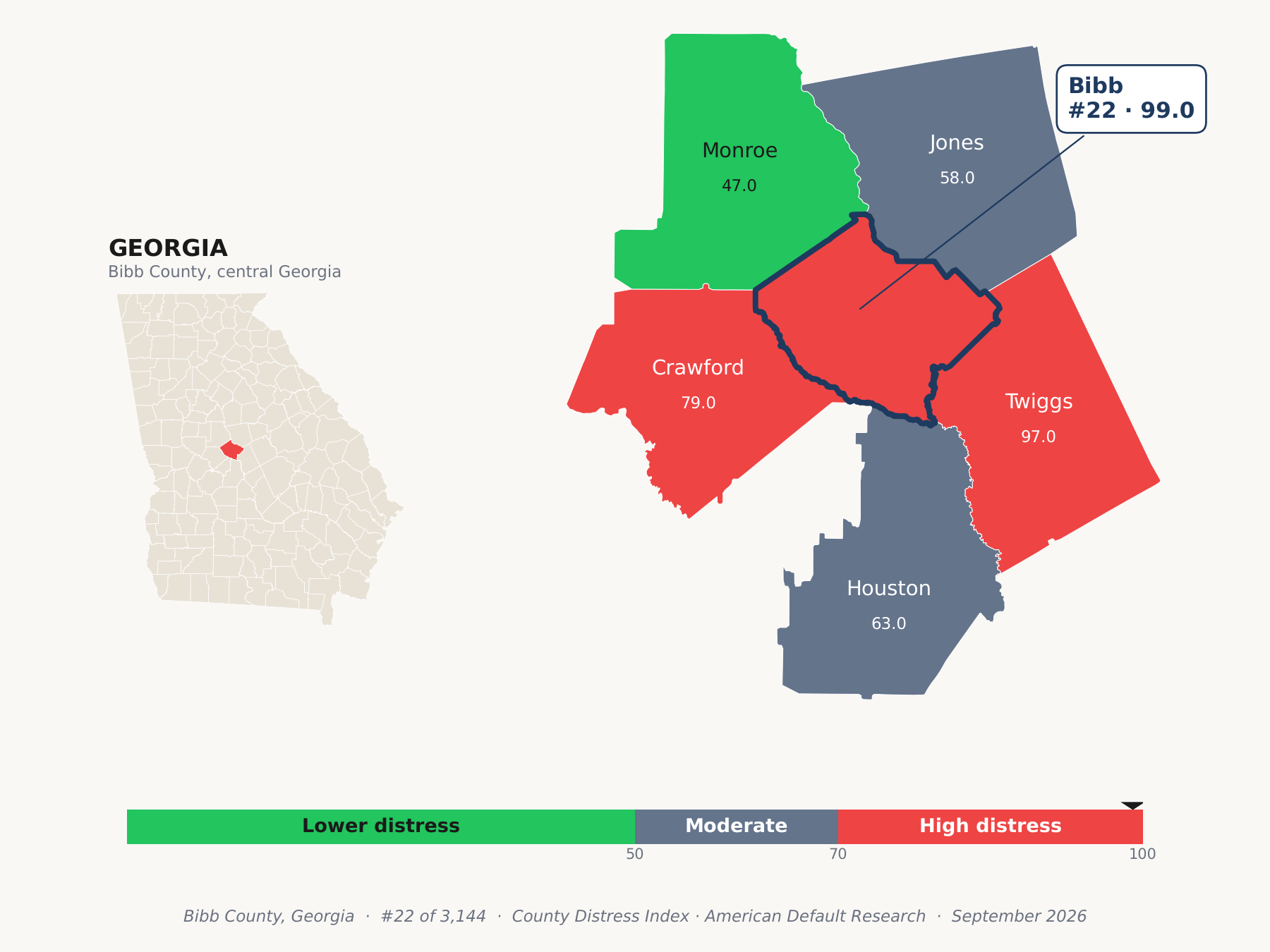
All five counties bordering Bibb score lower on the CDI. The sharpest gap is with Monroe County (55.16, Elevated), which sits just over the county line to the north. Jones County scores 62.44 (Elevated). Houston County (Warner Robins, anchored by Robins Air Force Base) scores 68.61 (Serious). Crawford County 67.81 (Serious), Twiggs County 67.62 (Serious). Bibb sits at the center of a Middle Georgia cluster where no neighbor is close to Crisis — the distress concentration is local to the consolidated county itself, not a regional pattern.
What is the distress score for Bibb County, Georgia?
Bibb County has a County Distress Index score of 88.7 out of 100, placing it in the Crisis zone. It ranks 2nd nationally out of 3,144 counties and 2nd in Georgia out of 159 counties.
What drives financial distress in Bibb County?
The primary driver of distress in Bibb County is Legal Distress, where the county scores 97.0 out of 100. This domain is measured by indicators including Bankruptcy Filing Rate.
How does Bibb County compare to neighboring counties?
Bibb County (88.7) can be compared to its 5 neighboring counties: Houston County, GA (68.6); Crawford County, GA (67.8); Twiggs County, GA (67.6).
Find Help in Bibb County
HUD-Approved Housing Counselors
Free foreclosure prevention and financial counseling near Bibb County.
Find an Attorney
State Bar of Georgia Lawyer Referral Service offers a lawyer referral service for bankruptcy, foreclosure defense, and consumer rights.
Free Legal Aid
Legal aid organizations serving Bibb County residents at no cost.
Self-Help Resources
American Default Research does not endorse, rate, or rank any provider. Verify attorney credentials with your state bar.