Home Counties Montana Lincoln County
Montana · County Distress Index · 2026

The Residual

Lincoln County, Montana

Normal CDI Score 42.81 · 2,025th of 3,144 nationally · 21,895 people How the CDI is calculated →

· Annual refresh · next update early 2027

Aerial view of Libby, Montana nestled in the Kootenai River valley, surrounded by the Cabinet Mountains.
Libby in the Kootenai River valley. The town that looks picturesque from above is the only place in America where the EPA declared a Public Health Emergency. U.S. Environmental Protection Agency

A clinic screened thousands of patients for the disease a mine left in their lungs. The clinic just closed.

What the CDI Says About Lincoln County

  • Ranks 2025 of 3,144 nationally on the American Default Research County Distress Index (CDI), 15th of 56 in Montana. Composite score 42.81, Normal zone. The composite reads ordinary. Every indicator underneath it does not.
  • Structural Poverty score of 82.73, the dominant domain, sits fifty-five points above Consumer Credit Distress at 27.55. The widest domain gap in the state. A measure of a population that has exited the consumer credit economy, not of financial health.
  • 24.3% disability rate — 95th percentile nationally. One in four residents. The physical residual of a vermiculite mining economy where a 2017 peer-reviewed study documented 694 asbestos-related deaths between 1979 and 2011, a mortality rate 40 to 60 times the national average.
  • The clinic that screened 8,900 patients closed in May 2025. The Center for Asbestos Related Disease operated for 25 years on a $3 million annual federal grant. BNSF Railway sued under the False Claims Act, a jury found 337 false claims, and the Lincoln County sheriff served a $3.1 million writ of execution.
  • $600 million Superfund, $18.5 million settlement. The Libby Asbestos site is the most expensive Superfund in the nation. W.R. Grace's 2023 settlement pays out over ten years. The 10,000-acre mine itself still has no proposed cleanup plan; EPA anticipates one in 2027.
Lincoln County, Montana ranks 2025 of 3,144 U.S. counties on the County Distress Index. Structural Poverty score 82.73. Consumer Credit Distress 27.55. Fifty-five points apart. Not borrowing is its own kind of distress.
American Default Research · americandefault.org/counties/montana/lincoln-county-mt/
Ross Kilburn

The concept that organizes Lincoln County is the residual. What remains after extraction. The ore shipped out. The timber shipped out. The electricity flows out. What stayed is the tremolite in the lung tissue, a disability rate at the 95th percentile, and a credit economy people have largely exited. The composite reads Normal. That number is not a measure of stability. It's a measure of absence.

Ross Kilburn, Founder & Lead Analyst
American Default Research · 1,000+ short sales negotiated · Author, The Ark Law Group Complete Guide to Short Sales (Auroch Press, 2013)

The clinic that screened 8,900 patients

For twenty-five years, a clinic in Libby, Montana screened residents for the disease that was killing them. The Center for Asbestos Related Disease tested 8,900 people for the lung scarring, the pleural thickening, the mesothelioma that has taken at least 400 lives in Lincoln County since the vermiculite mine closed in 1990. It was funded by a $3 million annual federal grant. The only facility in the country that specialized in what W.R. Grace left behind.

In May 2025, the Lincoln County sheriff padlocked the door. BNSF Railway had sued under the False Claims Act. A jury found 337 false claims. The sheriff served a $3.1 million writ of execution and seized nearly all clinic property. The U.S. Attorney is contesting the seizure, arguing the building was purchased with federal funds. The administration has placed the grant itself on a list of potential cuts.

Gayla Benefield is 81. Her father died of asbestosis. Her mother died of asbestosis. Her husband died of asbestosis. She told KFF Health News: "Eventually, that scarring will fully surround your lungs... and slowly strangle you." The clinic that understood what was strangling her neighbors is dark.

A century of producing for somewhere else

Lincoln County has been producing things for people who live somewhere else for over a century.

The W.R. Grace vermiculite mine, seven miles northeast of Libby, supplied as much as 80% of the world's vermiculite from 1963 to 1990. The ore was contaminated with tremolite asbestos. An estimated 35 million homes still contain it as attic insulation. A 2017 peer-reviewed study documented 694 asbestos-related deaths in the county between 1979 and 2011, a mortality rate 40 to 60 times the national average.

In June 2009, the EPA declared a Public Health Emergency, the only one in the agency's history, calling it "the worst case of industrial poisoning of a whole community in American history." The cleanup has cost federal taxpayers approximately $600 million, making it the most expensive Superfund site in the nation. Seven of eight operable units are remediated. The mine itself, 10,000 acres of contaminated ground, still has no proposed cleanup plan. EPA anticipates releasing one in 2027. A 2023 settlement required W.R. Grace to pay $18.5 million over ten years. For a disaster that killed hundreds of people and contaminated 35 million homes.

Stimson Lumber operated for nearly a century, peaking at 400 employees with a $15 million payroll. It closed in 2002. Unemployment went from 6.7% to 15.8% in six months. And Libby Dam, 422 feet tall, five turbines, 600 megawatts, flooded the Kootenai River Valley in 1975 to generate $127 million worth of electricity per year for eight states. The Army Corps relocated the town of Rexford. The Great Northern Railway, formerly the county's largest taxpayer, rerouted south. Lincoln County has never been compensated.

The concept that organizes all of this is the residual. What remains after extraction. The ore shipped out. The timber shipped out. The electricity flows out. What stayed is the tremolite in the lung tissue, the disability rate in the 95th percentile nationally, the unemployment rate in the 97th. The county produced extraordinary value. The county did not keep it.

Behind on your mortgage or facing eviction? Take a 2-minute assessment to see your options.

The fifty-five point gap

The CDI's dominant domain for Lincoln County is Structural Poverty, at 82.73 out of 100. One in four residents, 24.3%, has a disability. The 95th percentile nationally. The national median is 15.9%. Montana's is essentially the same. Lincoln County is 53% above both. Unemployment runs in the 97th percentile. Transfer income, the share of household income coming from Social Security, SSI, and disability payments, lands in the 88th.

Decades in the mine and the mill show up in the body. And when bodies break, they need care in a county where 14.2% of residents have no health insurance, the 86th percentile, nearly double Montana's 7.5% median. Cabinet Peaks Medical Center in Libby has 25 beds. The nearest trauma center is Logan Health in Kalispell, 65 miles south over mountain roads. Veterans make up 12.4% of the population, double the national average. SNAP participation runs 13.1%.

Here's where Lincoln County breaks from the pattern. Consumer Credit Distress scores 27.55. Fifty-five points below Structural Poverty, and the weight of the domain that decides the composite. Credit card delinquency is 3.15%, the 13th percentile. Auto loan delinquency, 2.38%, the 7th. Bankruptcy filings: 14 in all of 2025, a rate of 63.9 per 100,000, half the national median.

People aren't falling behind on payments. They aren't borrowing. The fifty-five point gap between Structural Poverty (82.73) and Consumer Credit Distress (27.55) measures the distance between a place that participates in the consumer credit economy and a place that has exited it. You don't default on a credit card you never opened. And because Consumer Credit Distress carries almost half the weight of the CDI formula, Lincoln County's exit from the credit system drags the whole score down to 42.81. Normal zone. Fifteenth of fifty-six in Montana. That number is not a measure of stability. It's a measure of absence.

Growth on top of the contamination

The number that complicates the residual is the population growth. Lincoln County added 2,824 people between 2020 and 2025, a 14% increase, more than triple Montana's rate. Home values nearly doubled in four years, from $177,000 in 2020 to $324,000 in 2024. Every cost metric — owner burden, rent-to-income, uninsured rates — runs in the 85th-to-89th percentile range.

This is a county with 79% homeownership where the owners are burdened. Not because a $324,000 house is expensive by national standards. Because a $324,000 house on a $51,941 income is a different equation. Weekly wages run $915, below both the state and national medians.

The school district is shrinking even as the population grows. Libby is the fourth-smallest Class A school in Montana, with about 1,146 students and projected enrollment declines. The newcomers are older. The median age is 52.8. The people arriving have equity from somewhere else. The people who stayed have a disability rate of one in four.

The counterforce and the flood

The counterforce sits on top of the contamination. Nomad GCS, a manufacturer of mobile command centers for the military, opened a 100,000-square-foot facility in 2023 on the same 400-acre industrial park where Stimson Lumber once employed 400 people and the EPA removed a million cubic yards of asbestos-contaminated waste. The park was partially delisted from the Superfund in August 2024. Nomad plans to hire up to 200 employees. A Comfort Inn broke ground in March 2025. Business applications hit 376 in 2024, up 79% from 210 in 2019 and 165% from the 2015 trough of 142.

Former commissioner Jerry Bennett told the Flathead Beacon: "When the mill left, it employed 400 people but if we can develop numerous businesses that employ 10 to 20 people with that diversity, it's far better for Libby than having one industry." Diversify, so no single closure sends unemployment to 15.8% again. That logic is being tested now.

Then, in December 2025, an atmospheric river dropped 12 inches of rain on the Cabinet Mountains. At least seven bridges were damaged or destroyed. Tens of millions in damage. But the detail that connected it to everything before: the floodwater overlapped with the Superfund boundary. Officials worried about buried vermiculite resurfacing, asbestos-contaminated waste that, once dry, becomes airborne. EPA said it was "not aware of any impacts."

A line, not a gradient

Lincoln County scores 42.81 on the County Distress Index. Normal zone. Fifteenth most distressed in Montana out of fifty-six counties. Nationally, rank 2025 of 3,144. The composite says ordinary. Every indicator underneath it says anything but.

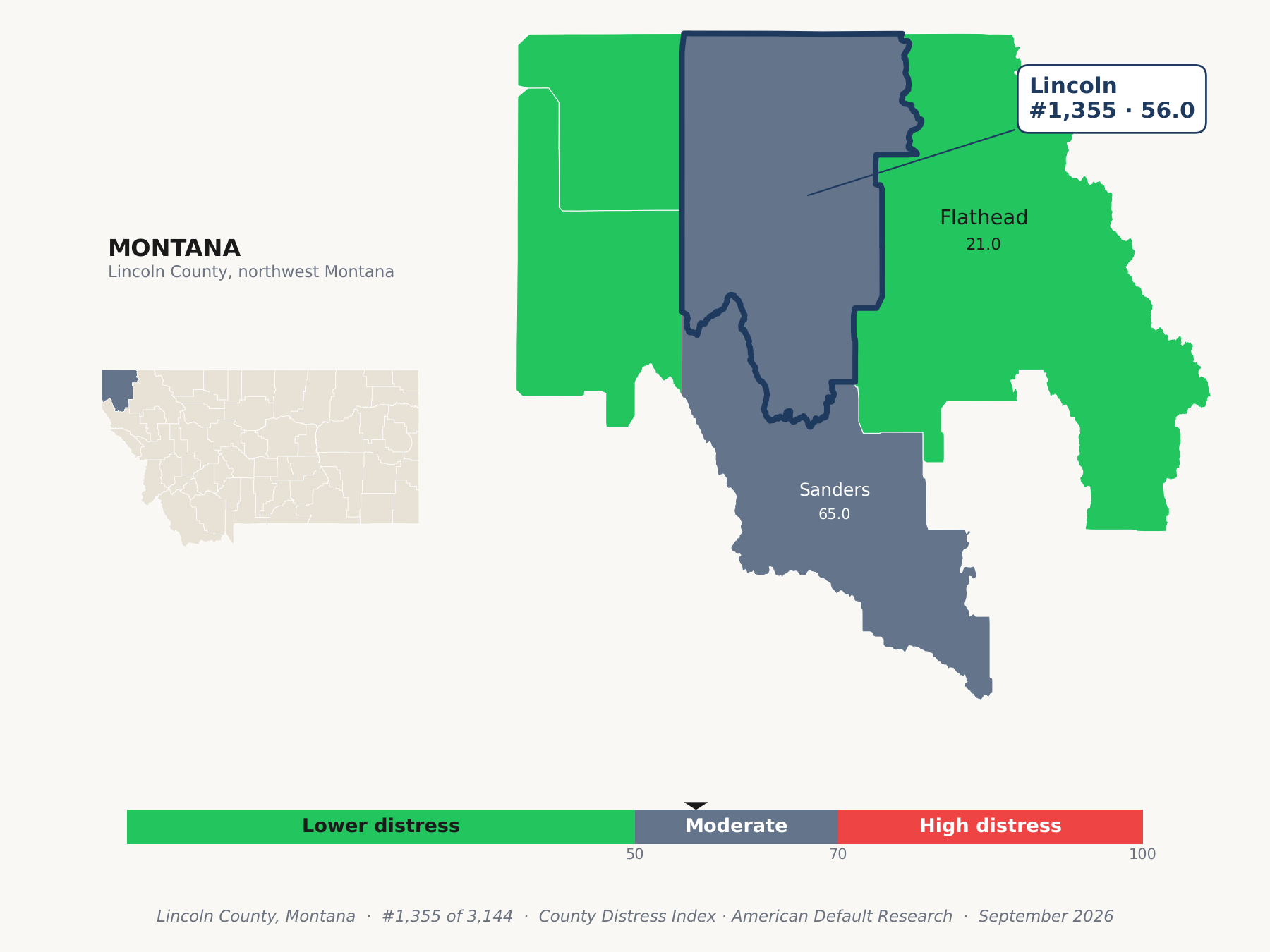
The neighbors are a split screen. Flathead County, one mountain range south, sits at 38.30. Four points healthier, and still Normal. Bonner and Boundary counties across the Idaho panhandle score 33.66 and 25.73, both Healthy. Sanders County, to the east, scores 50.15. Elevated. The regional pattern is not a gradient. It's a line Lincoln sits on the wrong side of, near its western neighbors who look cleaner by every composite measure, and the wrong side of a structural inheritance that Sanders shares.

The indicators to watch are the gap between Structural Poverty and Consumer Credit Distress. If the business park jobs, the population influx, and the flood recovery investment translate into insured residents and accessible care, that 82.73 domain starts to move. If the growth flows around the people who were here before, the way the electricity flows around the dam, Lincoln County keeps producing value for people who live somewhere else. The composite will keep reading Normal. The clinic stays dark. The scarring continues.

Lincoln County Across the CDI's Five Domains

The CDI measures five domains of financial distress. Lincoln County's dominant driver is Structural Poverty at 82.73 — disability in the 95th percentile, unemployment in the 97th. Consumer Credit Distress, at 27.55, is the lowest domain by fifty-five points.

Structural Poverty Primary driver 82.7
Weight 13.6% · Rank 296 of 3,144 · Percentile 90.6
Economic Vitality 62.3
Weight 9.2% · Rank 872 of 3,144 · Percentile 72.3
Housing Cost Burden 51.5
Weight 22.3% · Rank 1,480 of 3,144 · Percentile 52.9
Consumer Credit Distress 27.6
Weight 47.5% · Rank 2,378 of 3,144 · Percentile 24.4
Legal Distress 16.7
Weight 7.4% · Rank 2,620 of 3,144 · Percentile 16.7
Methodology & Weights

The County Distress Index uses principal component analysis to derive five factors from 21 indicators across 3,144 U.S. counties. Weights are proportional to each factor's share of explained variance.

Consumer Credit Distress 47.5%
Housing Cost Burden 22.3%
Structural Poverty 13.6%
Economic Vitality 9.2%
Legal Distress 7.4%

For Press & Research

Everything you need to cite Lincoln County data — in under 60 seconds.

Embed preview <iframe src="https://americandefault.org/embed/counties/montana/lincoln-county-mt/" width="100%" height="620" frameborder="0"></iframe>

The Indicators Behind Lincoln County's CDI Score

Every number on this page traces to a public source. Full dataset available for download. Hover any metric name for its definition.

Metric Value Source
CDI Score 42.81 / 100 (Normal) CDI v2
Montana rank 15th of 56 (national rank 2025 / 3,144) CDI v2
Structural Poverty 82.73 / 100 (dominant elevated domain) CDI v2
Consumer Credit Distress 27.55 / 100 (lowest by 55 points) CDI v2
Disability Rate 24.3% (95th percentile) ACS 2023
Uninsured Rate 14.2% (86th percentile) ACS 2023
CARD clinic screenings (1999-2025) 8,900 patients CARD / KFF
Asbestos-related deaths (1979-2011) 694 documented JESEE 2017
Debt in Collections 17.5% of population Urban Institute 2024
Credit Card Delinquency 3.15% (13th percentile) Urban Institute 2024
Unemployment Rate 7.2% (97th percentile) BLS LAUS Dec 2025
Median Household Income $51,941 (87% of MT median) Census SAIPE 2023
Median home value (2024) $324,000 (up from $177K in 2020) Zillow
Owner cost burden 28.9% (85th percentile) ACS 2023
Superfund cleanup cost ~$600 million EPA
W.R. Grace settlement (2023) $18.5 million over 10 years MT DOJ
Business applications (2024) 376 (+79% from 2019) Census BFS
Data compiled April 17, 2026 from Urban Institute (Equifax debt panel), U.S. Census Bureau (ACS, SAIPE), Bureau of Labor Statistics (LAUS, QCEW), U.S. Courts Administrative Office (F-5A bankruptcy filings), and HUD Fair Market Rents.

Questions About Lincoln County's CDI Score

What is Lincoln County's CDI score?

Lincoln County scores 42.81 (Normal zone) on the County Distress Index, ranking 2,025th most distressed of 3,144 U.S. counties and 15th of 56 counties in Montana.

What drives distress in Lincoln County?

Lincoln County's primary driver is Structural Poverty, where the county scores 82.7 out of 100. The CDI uses PCA-weighted composite scoring across five domains; see the CDI methodology for the full factor weights and indicator list.

Where does Lincoln County sit on the national percentile?

Lincoln County's CDI score of 42.81 puts it at the 35.6th percentile nationally — more distressed than roughly 36% of U.S. counties. See the full CDI methodology for how percentile ranks translate into the Normal zone.

How often is Lincoln County's CDI score updated?

Annually, aligned to Census American Community Survey and Urban Institute Debt in America release windows. Current data was compiled from releases in early 2026; next refresh is scheduled for early 2027.

What is the distress score for Lincoln County, Montana?

Lincoln County has a County Distress Index score of 42.8 out of 100, placing it in the Normal zone. It ranks 2,025th nationally out of 3,144 counties and 15th in Montana out of 56 counties.

What drives financial distress in Lincoln County?

The primary driver of distress in Lincoln County is Structural Poverty, where the county scores 82.7 out of 100. This domain is measured by indicators including Unemployment Rate, Poverty Rate, Income vs. State Median.

How does Lincoln County compare to neighboring counties?

Lincoln County (42.8) can be compared to its 4 neighboring counties: Sanders County, MT (50.1); Flathead County, MT (38.3); Bonner County, ID (33.7).

How is the County Distress Index calculated?

The County Distress Index uses PCA-weighted percentile scoring across five statistically derived factors: Consumer Credit Distress (47.5%), Housing Cost Burden (22.3%), Structural Poverty (13.6%), Economic Vitality (9.2%), and Legal Distress (7.4%). Each county's indicators are ranked against all 3,144 U.S. counties. A score of 50 means the county is at the national median; higher scores indicate greater distress.

Ross Kilburn
Written by

Ross Kilburn, Founder

American Default Research · Seattle, Washington

Two decades working directly with financially distressed American households — from property preservation in 2003, to negotiating over 1,000 short sales during the Great Recession, to foreclosure defense marketing today. Author, The Ark Law Group Complete Guide to Short Sales (Auroch Press, 2013). Twice named to Puget Sound Business Journal Fast 50 for Ark Law Group. B.A., University of California, Berkeley, 1992. Founded American Default Research in 2026 to fill a gap in public data that had been empty since 2013.

Read more
from Ross →

Find Help in Lincoln County

Find an Attorney

State Bar of Montana Lawyer Referral Service offers a lawyer referral service for bankruptcy, foreclosure defense, and consumer rights.

Free Legal Aid

Legal aid organizations serving Lincoln County residents at no cost.

American Default Research does not endorse, rate, or rank any provider. Verify attorney credentials with your state bar.