The Rebuilding County
Wayne County, Missouri

Wayne County keeps being unmade. The town was drowned for a dam. The courthouse burned three times. A tornado killed six people in 2025. Each time, people rebuilt. The foundation underneath — a 29% disability rate in 2023, government transfers, wages that don't close the gap — never does.
A county rebuilt three times
On the night of March 14, 2025, a tornado tore through Wayne County, Missouri. Six people died. Matt and Mary McFadden were killed in their home near Piedmont. Their daughter Malarie Littles came back to find the house gone. “All that’s left,” she told KFVS12, “is a concrete step and the concrete it sits on.”
Three uncracked eggs sat in what had been the kitchen.
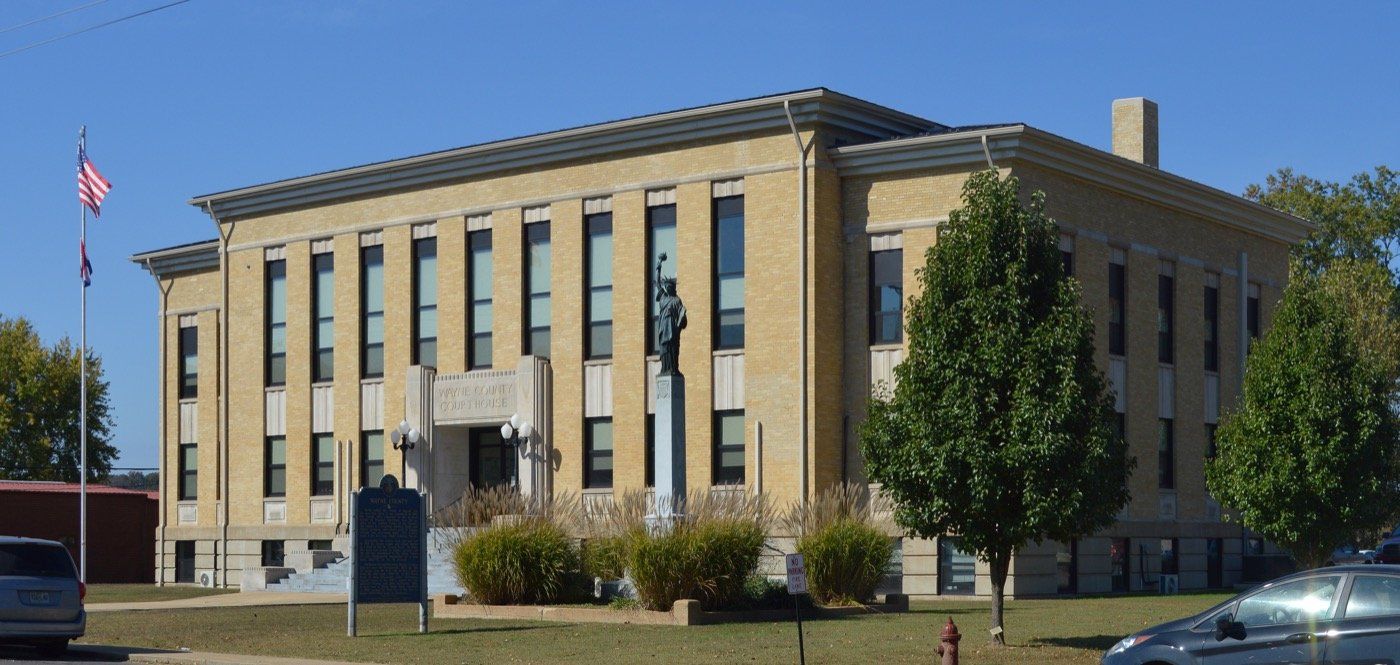
Wayne County has been here before. Not the tornado specifically. The rebuilding. The county seat of Greenville was physically relocated two miles in 1941 when the Army Corps of Engineers dammed the St. Francis River and drowned the original town. The courthouse burned three times in the nineteenth century — 1854, 1866, 1892. Each time, the records were lost. Each time, the county rebuilt.
The rebuilding is the pattern. What never rebuilds is the foundation underneath it.
Every domain distressed at once
Wayne County scores 80.79 on the July 2026 County Distress Index — very high county distress, 129th of 3,144, 4th most distressed in Missouri, behind Pemiscot and Dunklin in the Bootheel and Mississippi County in the Delta. Missouri’s median county records moderate-low county distress. Wayne County is invisible in the state aggregate the way a stress fracture is invisible in an X-ray of the whole skeleton.
What defines the place is the simultaneity. Every dimension of financial distress runs high at once. Safety Net & Buffer leads at 91.92 in July 2026 — 28th of 3,144 nationally, first of all 115 Missouri counties. Labor sits at 77.48. Default & Legal at 82.44. Delinquency at 77.07. Even Debt Burden, the lowest domain, scores 75.04 — well above the national median. There is no sector pulling the average down. There is no domain holding the line.
Median household income is $41,315 in 2023. The poverty rate is 22.4%. One in three children — 32.2% — lives below the poverty line. The poverty rate was 27.5% in 1989. The tornado didn’t create the distress. It landed on top of it.
Disability as the primary story
Safety Net & Buffer — at 91.92 in July 2026, first of all 115 Missouri counties and 28th of 3,144 nationally — is where Wayne County separates from most other distressed counties. Four of its five direct-need indicators sit above the 90th percentile of distress: disability, poverty, child poverty, and median household income. The uninsured rate is also elevated. The disability rate is 29.1% in 2023. Nearly one in three residents.
Across the county narratives I’ve written so far, I keep expecting disability to be a secondary indicator, a footnote below the debt numbers or the poverty rate. In Wayne County it’s the primary story. Our reading: an economy where 29% of the population has a disability is shaped by that fact at every level — what jobs exist, what healthcare infrastructure is required, what public assistance programs carry the weight.
Healthcare is the county’s largest employment sector. 803 of 3,913 employed people. The sector is the largest employer because the body load it carries is the heaviest demand the county generates. There is no general hospital within the county — the nearest facility is in Poplar Bluff, roughly 30 miles south. Wayne County is a Health Professional Shortage Area.
SNAP participation: 18.0% in 2023. Uninsured: 13.9%. The safety net exists. It’s also at capacity.
Collections, bankruptcy, and $732 a week
The debt picture is less extreme than Pemiscot County’s, but the mechanism is the same. 34.4% of Wayne County residents have debt in collections in 2025 Urban Institute data. Median debt in collections: $2,479. Credit card delinquency: 8.16%. Auto loan delinquency: 8.19%. Residents with medical debt in collections: 6.41%.
The bankruptcy rate is 222 per 100,000 residents in 2025, and ninety-two percent of recorded filings are Chapter 7. The filing rate and chapter composition do not establish filers’ income, assets, motives, eligibility, home retention, or case outcomes.
Average weekly wage: $732 in 2024. That’s $38,066 annualized. The county has 388 employers. Business applications: 90 in 2024.
Here’s what I don’t know about Wayne County. The employment numbers look functional. Unemployment is 4.6% in May 2026 — elevated but not catastrophic. People are working. They’re earning $732 a week. And one in three of their neighbors has a disability, one in three of their children is in poverty, and a third of the county has debt in collections. Whether this is an economy that’s failing slowly or one that stabilized at a level most Americans wouldn’t recognize as stability — I can’t tell from the data alone.
Gads Hill to the UFO Capital
In January 1874, Jesse James and his gang robbed a train at Gads Hill, in northwestern Wayne County. They checked every passenger’s hands for calluses. The ones with rough hands — the working people — they let keep their money. The story became myth. A historical marker along Highway 49 is all that remains.
One hundred and fifty years later, Wayne County’s working people live under very high county distress, and 28th of 3,144 for the direct-need load in July 2026 — disability, poverty, child poverty, and household income that does not reach the state median. The calluses didn’t help.
What the county still has: Sam A. Baker State Park, 5,323 acres in the St. Francois Mountains, celebrating its centennial in 2026. CCC crews built the stone-and-wood dining lodge and most of the park’s cabins in the 1930s, and they’ve outlasted the county’s population, which peaked at 15,309 in 1900 and has fallen 29% since. Clearwater Lake draws weekend tourism at 90-95% campground occupancy. But Ken Schultheis, who owns Clearwater Lake Resort, puts it plainly: “We are completely booked on weekends, but during the week, bookings are on the decline.”
What the county has lost: Centerville R-I School District — 34 students, $19,900 per pupil, a million-dollar budget for a school that couldn’t stay open. The consolidation vote failed. The educational services agreement failed. Eventually the district sent its students to Ellington, 15 miles away, because the alternative was dissolution. The tax rate in Centerville was $4.55. In Ellington, $3.86. The parents got a tax cut. Their children lost their school.
In 2023, the Missouri General Assembly designated Wayne County the “UFO Capital of Missouri,” citing decades of sightings near Piedmont that began in 1973. The bill, sponsored by Representative Chris Dinkins, was framed as economic development through tourism.
A county with a 29.1% disability rate in 2023. A 22.4% poverty rate. A CDI score of 80.79 in July 2026, very high county distress, and a Safety Net & Buffer domain in the top 2% of all U.S. counties. And the state legislature’s economic development contribution was a UFO park.
The park is sincere. Tourism brings weekend revenue. It doesn’t bring a hospital or employers who pay more than $732 a week. The math is still wrong.
The distress is regional
Every one of Wayne County’s neighbors records moderate county distress or worse, and Butler and Ripley sit in the higher distress ranges alongside Wayne. Wayne is the highest of the set. The same pattern — disability, below-median household income, child poverty — defines this whole stretch of the Ozarks. Wayne County keeps rebuilding. The courthouse burned three times. They rebuilt it. The town was drowned for a dam. They moved it. The tornado took six lives and left concrete steps where houses stood, and FEMA sent $3.8 million across 18 counties. Sheriff Kyle Shearrer, three months into his job, stood in the debris and said what the data already showed: “You get so many warnings, nothing ever happens. And this time it happened.” The Safety Net & Buffer domain scores 91.92 in July 2026. The distress rests on a fixed base: disability, poverty, child poverty, the uninsured rate, and below-median household income, the same pattern across the whole stretch of the Ozarks. The rebuilding keeps happening. The foundation stays the same.