Revolving Credit Utilization (75th Percentile)
Credit card utilization at the 75th percentile of active large-bank card accounts
What is the current Revolving Credit Utilization (75th Percentile) reading?
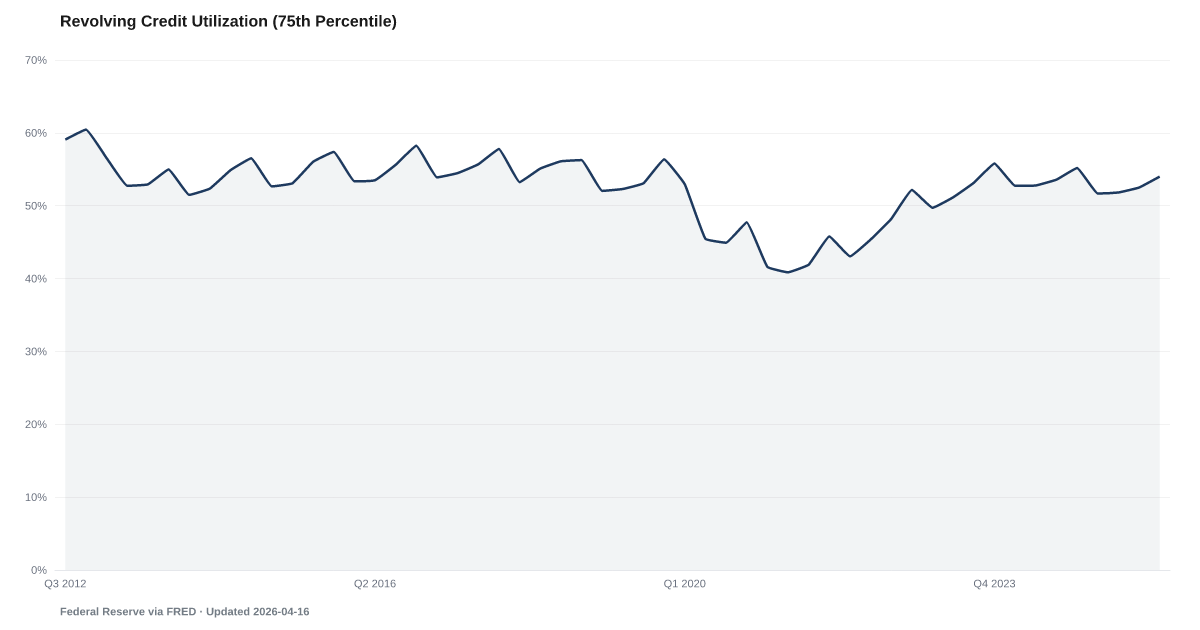
The credit card account at the 75th percentile of utilization was using 50.5% of its limit in Q1 2026, according to the Federal Reserve Bank of Philadelphia's data on large-bank credit cards. That is down 1.2 percentage points from 51.7% in Q1 2025. That means a quarter of active card accounts at those banks were above that level. Source: Federal Reserve Bank of Philadelphia, data retrieved via FRED (series RCCCBACTIVEUTILPCT75).
In Q1 2026, one in four active credit card accounts at the largest banks had used more than 50.5% of its credit limit, down 1.2 percentage points from the same quarter a year earlier.
The Philadelphia Fed sorts active consumer credit card accounts at large banks by how much of each card's limit is in use at quarter end. The account three-quarters of the way up that list was at 50.5% in Q1 2026. That is down 1.2 percentage points from 51.7% in Q1 2025. It was down from 54% in Q4 2025, but that is largely seasonal: this series usually runs highest in the fourth quarter and lowest in the first.
It has been lower than a year earlier for six quarters in a row.
Utilization is the card's balance divided by its credit limit. This is not an average: the Philadelphia Fed's overall figure, total balances over total limits, is a different statistic, and a quarter of accounts sit above the 75th-percentile line. The balance counts everything on the statement, including charges that will be paid in full, so it is not the same as debt carried from month to month.
The data come from monthly reports that the largest U.S. bank holding companies file with the Board of Governors of the Federal Reserve System. They cover consumer bank cards, not store charge cards or business cards, and count accounts, not people. The Philadelphia Fed revises past quarters as banks join or leave the reporting group, so older figures in articles may not match the current series.
Credit bureaus advise keeping utilization low, often below 30%, for credit scores. That guidance comes from the bureaus, not from this data. The share of all household debt balances that are behind is tracked in the total delinquency rate.
Explore Further
Revolving Credit Utilization (75th Percentile) over time: what has changed?

Counties with the highest safety net and buffer scores
These are safety net and buffer scores from our County Distress Index, not county readings of Revolving Credit Utilization (75th Percentile).
Explore all 3,144 counties →| Period | Value | YoY Change |
|---|---|---|
| Q1 2026 | 50.5% | -1.2 pp |
| Q4 2025 | 54% | -1.2 pp |
| Q3 2025 | 52.5% | -1.1 pp |
| Q2 2025 | 51.8% | -1 pp |
| Q1 2025 | 51.7% | -1 pp |
| Q4 2024 | 55.2% | -0.6 pp |
| Q3 2024 | 53.6% | +0.4 pp |
| Q2 2024 | 52.8% | +1.6 pp |
| Q1 2024 | 52.7% | +3 pp |
| Q4 2023 | 55.8% | +3.6 pp |
| Q3 2023 | 53.2% | +5 pp |
| Q2 2023 | 51.2% | +5.8 pp |
Frequently Asked Questions
What does this utilization percentile mean?
Line up every active credit card account at the large banks in the data by how much of its limit is used. The account three-quarters of the way up was at 50.5% in Q1 2026, so a quarter of accounts were above that. It describes accounts, not people, and it is not an average.
Is credit card utilization going up?
Compare the same quarter across years, because this series is not seasonally adjusted and usually peaks in the fourth quarter. In Q1 2026 the 75th-percentile account was at 50.5%. That is down 1.2 percentage points from 51.7% in Q1 2025. It has been lower than a year earlier for six quarters in a row.
Is there a utilization level lenders flag?
The 30% figure is consumer guidance from credit bureaus about credit scores, and Experian says there is no specific cut-off. It does not come from the Federal Reserve or from this data.
Where does the data come from?
The Federal Reserve Bank of Philadelphia builds it from account-level data that bank holding companies with $100 billion or more in assets report to the Federal Reserve. It is published quarterly, a little over three months after the quarter ends, and carried on FRED as RCCCBACTIVEUTILPCT75.


Quick poll
Is this affecting you or your household?
Discussion
Get the numbers when they move.
New data drops, indicator updates, and American Distress Index changes — delivered when it matters. No spam.
or Create an Account for full access
Loading comments…