Total Credit Card Debt Outstanding
Also tracked as Plastic Ceiling
Credit card balances owed by U.S. consumers
What is the current Total Credit Card Debt Outstanding reading?
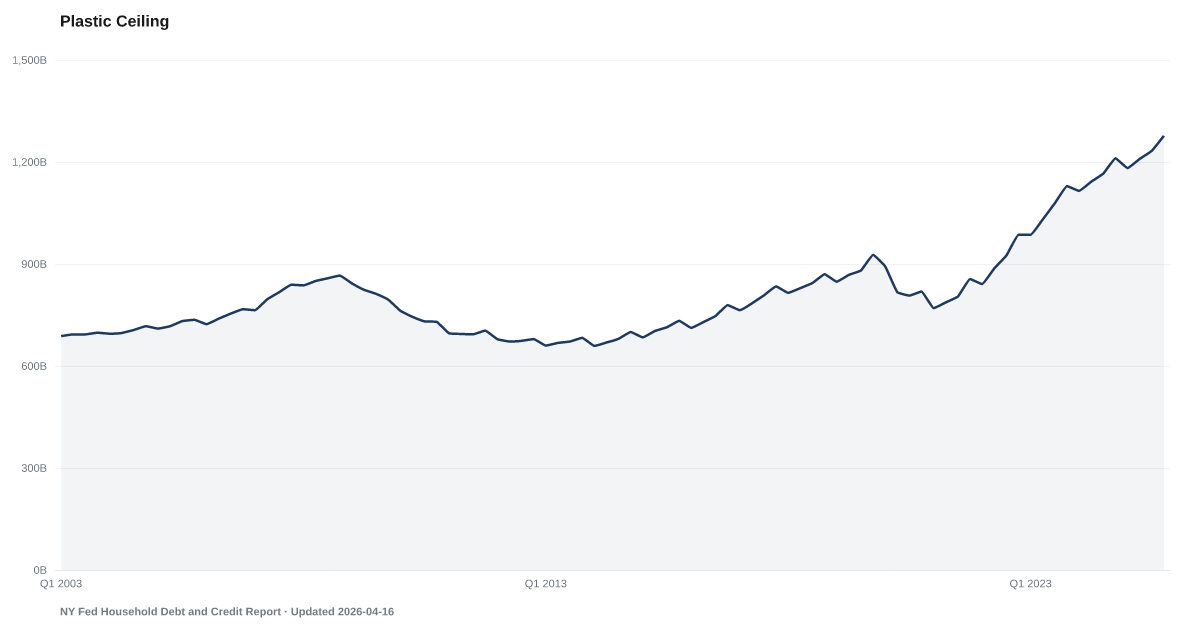
Total U.S. credit card debt was $1.26 trillion in Q2 2026, according to the New York Fed's Household Debt and Credit Report, up $54 billion from a year earlier. Source: Federal Reserve Bank of New York Household Debt and Credit Report (Q2 2026).
Credit card balances were $1.26 trillion in Q2 2026, up $54 billion from a year earlier.
The New York Fed's Household Debt and Credit Report put credit card balances at $1.26 trillion in Q2 2026, up $54 billion from $1.21 trillion a year earlier. They also rose from $1.24 trillion in Q1 2026, but quarter-to-quarter moves in this series are mostly seasonal: balances climb with holiday spending in the fourth quarter and fall back in the first.
Balances have been higher than a year earlier for 19 quarters in a row.
This report revised Q1 2026 down by $10 billion, to $1.24 trillion. The newest quarter can be revised the same way at the next release.
The total is the statement balance on general-purpose credit cards from banks, card companies and credit unions, from a random sample of Equifax credit reports. It includes charges people pay off in full each month, so it is not the same as debt that carries interest. Store-only cards are counted elsewhere in the report.
What it costs to carry a balance is tracked in the average card interest rate. The share of all household debt balances that are behind is tracked in the total delinquency rate, and savings in the personal saving rate.
Explore Further
Is this happening to you?
Is your total credit card balance higher than it was a year ago?
Total Credit Card Debt Outstanding over time: what has changed?

Counties with the highest safety net and buffer scores
These are safety net and buffer scores from our County Distress Index, not county readings of Total Credit Card Debt Outstanding.
Explore all 3,144 counties →| Period | Value | YoY Change |
|---|---|---|
| Q2 2026 | $1.26T | +$0.05T |
| Q1 2026 | $1.24T | +$0.06T |
| Q4 2025 | $1.28T | +$0.07T |
| Q3 2025 | $1.23T | +$0.06T |
| Q2 2025 | $1.21T | +$0.07T |
| Q1 2025 | $1.18T | +$0.06T |
| Q4 2024 | $1.21T | +$0.08T |
| Q3 2024 | $1.17T | +$0.09T |
| Q2 2024 | $1.14T | +$0.11T |
| Q1 2024 | $1.12T | +$129B |
| Q4 2023 | $1.13T | +$143B |
| Q3 2023 | $1.08T | +$154B |
Frequently Asked Questions
How much credit card debt do Americans owe?
Americans owed $1.26 trillion on credit cards in Q2 2026, according to the New York Fed's Household Debt and Credit Report, up $54 billion from a year earlier.
How fast is credit card debt growing?
In the latest quarter balances were 4.5% higher than a year earlier, an increase of $54 billion. They have been higher than a year earlier for 19 quarters in a row.
What does it cost to carry a card balance?
The average interest rate on credit card accounts is tracked on our credit card interest rate page, from the Board of Governors of the Federal Reserve System. Interest is charged on the balance you carry past the due date, so a balance paid in full each month costs nothing in interest.
How much of credit card debt is delinquent?
At commercial banks, 2.85% of credit card balances were 30 or more days past due in Q2 2026, according to the Federal Reserve. Across all household debt, the New York Fed counts 4.73% of balances as delinquent in Q2 2026.
Where does the credit card debt data come from?
The New York Fed's Quarterly Report on Household Debt and Credit, built from a nationally representative sample of Equifax consumer credit reports. It comes out about six weeks after each quarter ends.


Quick poll
Is this affecting you or your household?
Discussion
Get the numbers when they move.
New data drops, indicator updates, and American Distress Index changes — delivered when it matters. No spam.
or Create an Account for full access
Loading comments…