Bankcard Balances 60+ Days Past Due (Equifax)
Also tracked as The 60-Day Line
Credit card balances 60+ days delinquent
What is the current Bankcard Balances 60+ Days Past Due (Equifax) reading?
In August 2026, 2.71% of general-purpose credit card balances on Equifax credit files were 60 or more days past due or in collections. It is a share of balances, not of cardholders or accounts, and it excludes store cards and charged-off debt. Source: Equifax monthly press release, from its U.S. National Consumer Credit Trends Portfolio report.
Measurement basis: Share of bankcard balances that are 60 or more days past due in Equifax's monthly U.S. National Consumer Credit Trends Portfolio report. This is a share of card balances, not a share of accounts or borrowers.
2.71% of bankcard balances were 60 or more days past due in August 2026, on Equifax data.
At 30 days late, one payment has been missed. At 60 days, a second has gone unpaid, and some of these balances are already with collectors.
Equifax counts the share of general-purpose credit card balances on its U.S. credit files that are 60 or more days past due or in collections. It leaves out store cards and debts already charged off or in bankruptcy. In August 2026 that share was 2.71%.
The data are not seasonally adjusted, meaning they keep the calendar's regular swings. Equifax says card delinquency usually dips in the spring as tax refunds arrive. So this page sets a month only against the same month a year earlier, never against the month before.
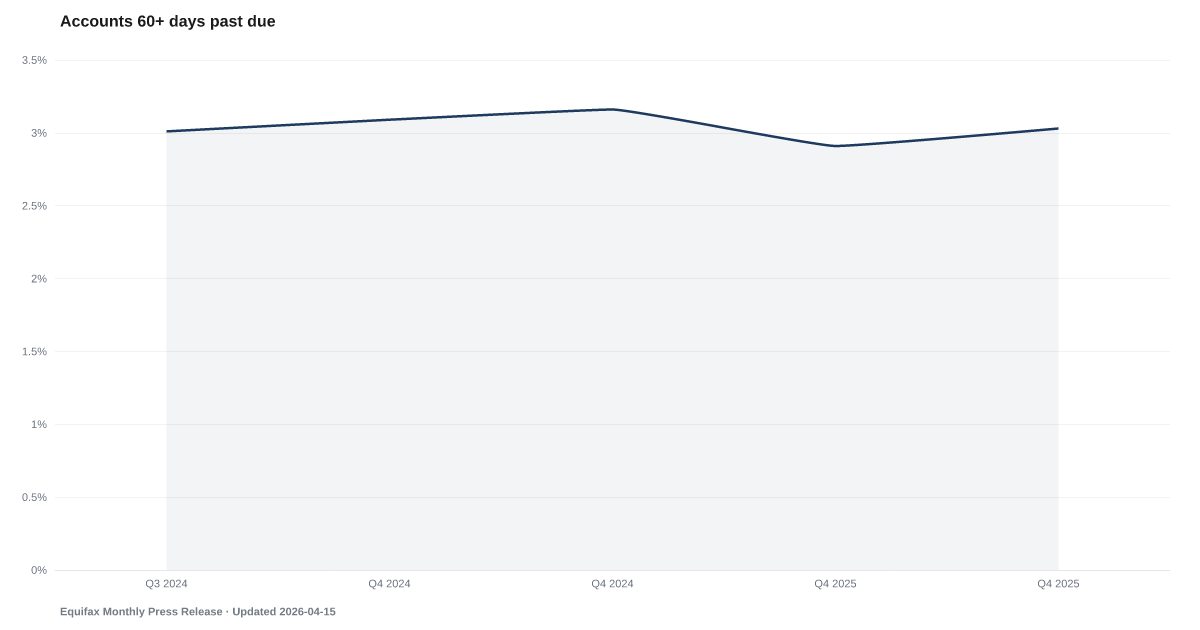
Equifax publishes this rate every month, but the record on this page holds only a few months, with gaps. That is too few readings to describe a trend. Longer card-delinquency history comes from the Board of Governors of the Federal Reserve System series behind Credit Card Delinquency, which covers card loans held by banks, counts debt 30 or more days late and is seasonally adjusted. It cannot be joined to this one.
Debt a card issuer has written off as a loss is not counted in this rate. Write-offs are tracked on Credit Card Charge-Offs.
Explore Further
Is this happening to you?
Have any of your accounts gone 60 or more days past due?
Bankcard Balances 60+ Days Past Due (Equifax) over time: what has changed?

Counties with the highest delinquency scores
These are delinquency scores from our County Distress Index, not county readings of Bankcard Balances 60+ Days Past Due (Equifax).
Explore all 3,144 counties →| Period | Value | YoY Change |
|---|---|---|
| Aug 2026 | 2.71% | — |
| Jul 2026 | 2.7% | — |
| Jun 2026 | 2.71% | — |
| Dec 2025 | 3.03% | -0.13 pp |
| Oct 2025 | 2.91% | -0.18 pp |
| Dec 2024 | 3.16% | — |
| Oct 2024 | 3.09% | — |
| Sep 2024 | 3.01% | — |
Frequently Asked Questions
What does the 60-day delinquency line measure?
It is the share of dollars owed on general-purpose credit cards that are 60 or more days late or in collections. Equifax put it at 2.71% for August 2026. Store cards are a separate category and are not included.
Is this the share of people behind on their credit cards?
No. It is a share of card balances, so one large late balance counts for more than several small ones. Equifax reports the share of consumers with a late payment, and the share of card accounts that are late, as separate figures.
Why compare with the same month a year earlier?
The rate is not seasonally adjusted. Card delinquency follows a yearly pattern, and Equifax says it usually dips as tax refunds arrive, so a change from one month to the next can be the calendar rather than a change in how people are paying.
Where does this data come from?
Equifax's U.S. National Consumer Credit Trends Portfolio report. Each edition is named for the month it comes out and carries the previous month's data, so the August edition reports July. Equifax says the figures cover its whole credit database, not a sample.


Quick poll
Is this affecting you or your household?
Discussion
Get the numbers when they move.
New data drops, indicator updates, and American Distress Index changes — delivered when it matters. No spam.
or Create an Account for full access
Loading comments…