Auto Loans 90+ Days Past Due
Also tracked as The Repo Line
Auto loans 90+ days past due as share of total auto debt
What is the current Auto Loans 90+ Days Past Due reading?
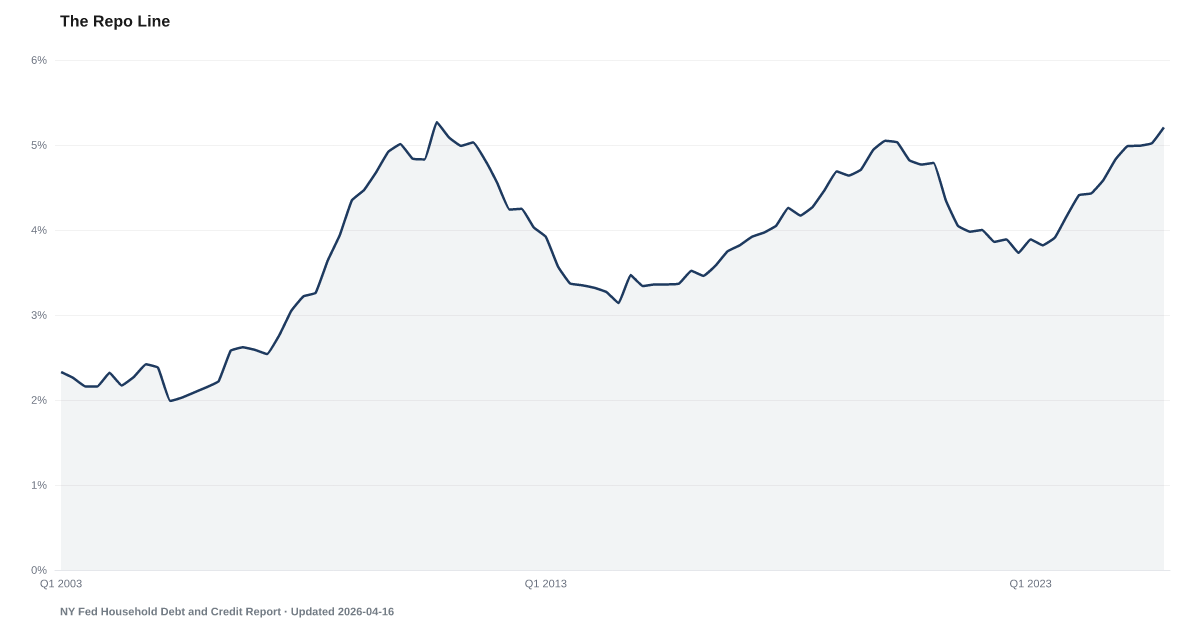
In Q2 2026, 5.49% of outstanding auto loan and lease balances were 90 or more days past due, according to the Federal Reserve Bank of New York, up from 4.99% a year earlier. The rate is a share of balances, not of borrowers, and it does not say why payments went late. Source: Federal Reserve Bank of New York Household Debt and Credit Report (Q2 2026).
Measurement basis: Percent of outstanding auto loan balances that are 90 or more days delinquent, using the "AUTO" series in the New York Fed table "Percent of Balance 90+ Days Delinquent by Loan Type" (unit: Percent; source: New York Fed Consumer Credit Panel/Equifax). This is a balance-level rate, not a share of borrowers.
The share of auto loan balances 90 or more days late was 5.49% in Q2 2026, up from 4.99% a year earlier.
The New York Fed's Household Debt and Credit Report put the share of auto loan and lease balances 90 or more days late at 5.49% in Q2 2026, up from 4.99% a year earlier. The share fell from 5.6% in Q1 2026, but the series is not seasonally adjusted, so a one-quarter move is partly seasonal.
The share has been higher than a year earlier for 12 quarters in a row. In Q4 2010, after the Great Recession, the share was 5.27%.
This is a share of balances, not of people. It covers auto loans and leases on the Equifax credit reports of people with a credit report and a Social Security number, from a New York Fed sample. A balance counts once it is 90 or more days late, sent to a collector, or marked severely derogatory: repossessed or charged off, even when the lender keeps reporting it. So the share is a stock of old and new late debt. The report's separate transition rate tracks balances that newly became 90 days late.
In 2020 the New York Fed said accounts in a payment pause, or forbearance, typically showed as current on credit reports, and it linked lower rates of auto loans going late to government stimulus and lender forbearance. Readings from 2020 through 2022 partly reflect those programs. The series is not seasonally adjusted; in most years the share dips from the first quarter to the second.
Other measures of late auto debt count borrowers or loans instead of balances, use a 60-day line, or leave out charged-off debt, so their numbers differ from this one. The total delinquency rate tracks late payments across all household debt, and the average card interest rate tracks what credit card borrowing costs.
Explore Further
Is this happening to you?
Are you worried about making your next car payment?
Auto Loans 90+ Days Past Due over time: what has changed?

Counties with the highest delinquency scores
These are delinquency scores from our County Distress Index, not county readings of Auto Loans 90+ Days Past Due.
Explore all 3,144 counties →| Period | Value | YoY Change |
|---|---|---|
| Q2 2026 | 5.49% | +0.5 pp |
| Q1 2026 | 5.6% | +0.61 pp |
| Q4 2025 | 5.21% | +0.38 pp |
| Q3 2025 | 5.02% | +0.43 pp |
| Q2 2025 | 4.99% | +0.56 pp |
| Q1 2025 | 4.99% | +0.58 pp |
| Q4 2024 | 4.83% | +0.66 pp |
| Q3 2024 | 4.59% | +0.68 pp |
| Q2 2024 | 4.43% | +0.61 pp |
| Q1 2024 | 4.41% | +0.52 pp |
| Q4 2023 | 4.17% | +0.44 pp |
| Q3 2023 | 3.91% | +0.02 pp |
Frequently Asked Questions
What is the current auto loan delinquency rate?
In Q2 2026, 5.49% of auto loan and lease balances were 90 or more days past due, according to the Federal Reserve Bank of New York, up from 4.99% a year earlier.
Is auto loan delinquency at a record high?
At 5.49% in Q2 2026, it is the second highest of 94 quarterly readings since 2003, so not a record.
What does the auto loan delinquency rate measure?
The share of outstanding auto loan and lease balances that are 90 or more days past due or severely derogatory. It does not measure the share of borrowers, a household's other debts, or why a payment went late.
Where does auto loan delinquency data come from?
The Federal Reserve Bank of New York reports it every quarter in its Household Debt and Credit Report, built from a random sample of Equifax credit reports. The series measures the share of outstanding auto loan balances 90 or more days past due.


Quick poll
Is this affecting you or your household?
Discussion
Get the numbers when they move.
New data drops, indicator updates, and American Distress Index changes — delivered when it matters. No spam.
or Create an Account for full access
Loading comments…