Commercial Bank Interest Rate on Credit Card Plans
Also tracked as The Card Tax
Average interest rate on credit card plans
What is the current Commercial Bank Interest Rate on Credit Card Plans reading?
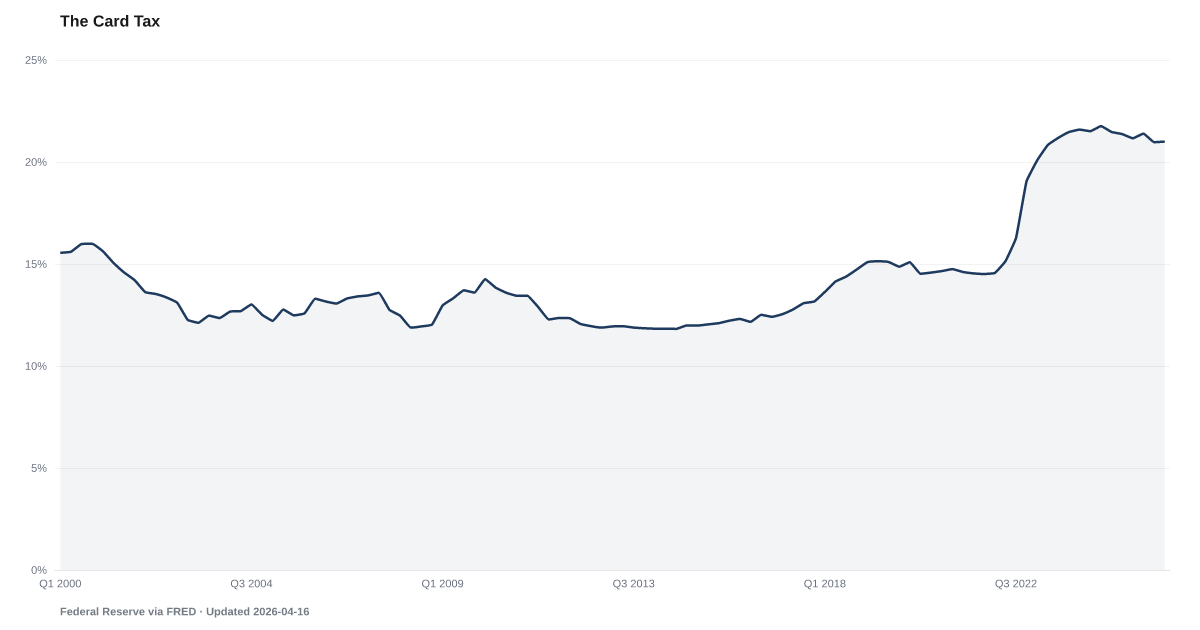
The average interest rate on credit card accounts at U.S. commercial banks was 20.94% in Q2 2026, down from 21.16% a year earlier, according to the Board of Governors of the Federal Reserve System's G.19 consumer credit release. It averages the stated APR across all general-purpose card accounts at a panel of card-issuing banks, including accounts that pay no interest. Source: Federal Reserve G.19 data retrieved via FRED (TERMCBCCALLNS).
The average APR on bank credit card accounts was 20.94% in Q2 2026, down from 21.16% a year earlier, the lowest since Q2 2023.
The Federal Reserve's quarterly survey of card-issuing banks put the average interest rate on credit card accounts at 20.94% in Q2 2026. That is lower than a year earlier, when it was 21.16%. It is the lowest rate since Q2 2023. The rate has been lower than a year earlier for six quarters in a row.
The newest reading is preliminary and can be revised in later releases.
This is the average stated purchase APR across all general-purpose card accounts at the reporting banks, whether or not an account carries a balance. People who pay in full each month pay no interest, so it is not the rate paid by people carrying a balance; the Fed publishes that separately, as the rate on accounts assessed interest. Store cards, credit unions and nonbank lenders are outside the survey.
For reference, the rate was 14.87% in the fourth quarter of 2019 and 14.51% in the fourth quarter of 2021.
The series starts in November 1994. Banks report voluntarily, and the panel has changed over time: the Fed cut the authorized panel from 150 banks to 50 by 2006, and 27 banks were on it as of May 2023. A separate page tracks total credit card balances, and Credit Card Delinquency tracks the share of card balances past due.
Explore Further
Commercial Bank Interest Rate on Credit Card Plans over time: what has changed?

Counties with the highest debt burden scores
These are debt burden scores from our County Distress Index, not county readings of Commercial Bank Interest Rate on Credit Card Plans.
Explore all 3,144 counties →| Period | Value | YoY Change |
|---|---|---|
| Q2 2026 | 20.94% | -0.22 pp |
| Q1 2026 | 21% | -0.37 pp |
| Q4 2025 | 20.97% | -0.5 pp |
| Q3 2025 | 21.39% | -0.37 pp |
| Q2 2025 | 21.16% | -0.35 pp |
| Q1 2025 | 21.37% | -0.22 pp |
| Q4 2024 | 21.47% | 0 pp |
| Q3 2024 | 21.76% | +0.57 pp |
| Q2 2024 | 21.51% | +0.67 pp |
| Q1 2024 | 21.59% | +1.5 pp |
| Q4 2023 | 21.47% | +2.4 pp |
| Q3 2023 | 21.19% | +4.92 pp |
Frequently Asked Questions
What is the current average credit card interest rate?
The average interest rate on credit card accounts at U.S. commercial banks was 20.94% in Q2 2026, down from 21.16% a year earlier, according to the Federal Reserve's G.19 consumer credit release. It averages the stated APR across all general-purpose card accounts at a panel of card-issuing banks, including accounts that pay no interest. Source: Federal Reserve G.19 data retrieved via FRED (TERMCBCCALLNS).
Is this the rate people carrying a balance pay?
No. It averages the stated APR across all card accounts at reporting banks, including inactive accounts and people who pay in full, who pay no interest. The Fed publishes a separate rate on accounts assessed interest for that. Neither series includes fees.
Can I use this rate to work out what Americans pay in interest?
No. It is a rate averaged across accounts, not the rate actually paid, so multiplying it by total card balances does not give a dollar figure. People who pay their statement in full each month pay no interest.
Where does the credit card APR data come from?
The Federal Reserve publishes it in its monthly G.19 consumer credit release, one reading per quarter, from a voluntary survey of card-issuing commercial banks. FRED republishes it as TERMCBCCALLNS.


Quick poll
Is this affecting you or your household?
Discussion
Get the numbers when they move.
New data drops, indicator updates, and American Distress Index changes — delivered when it matters. No spam.
or Create an Account for full access
Loading comments…