TransUnion Credit Card Borrower Delinquency
Also tracked as The Risk Reset
TransUnion's share of credit card borrowers 90 or more days past due is higher than a year earlier
What is the current TransUnion Credit Card Borrower Delinquency reading?
According to TransUnion, 2.3% of credit card borrowers were 90 or more days past due in Q2 2026, up from 2.2% a year earlier. The rate counts consumers, not the share of balances past due. Source: TransUnion Credit Industry Insights Report.
Measurement basis: Borrower-level share of consumers with a bankcard account 90 or more days past due
TransUnion counted 2.3% of credit card borrowers 90 or more days past due in Q2 2026, up from 2.2% a year earlier.
In TransUnion's credit data, the share of consumers with a credit card who were 90 or more days behind on it was 2.3% in Q2 2026, up from 2.2% a year earlier. It fell from 2.5% in Q1 2026, but TransUnion does not adjust for the season, so a one-quarter move is partly seasonal.
This rate counts people, not dollars: it is the share of consumers with a bankcard, TransUnion's term for a credit card, who are 90 or more days past due. TransUnion also publishes a separate rate based on card balances, and the two can move in opposite directions. It is TransUnion's rate for credit card borrowers at every credit score, not only those with low scores, and it covers only people with a card in TransUnion's credit files, not all adults.
TransUnion is a private credit bureau, and this is its own statistic, released each quarter in its Credit Industry Insights Report. It does not publish its sample or revision policy. Figures on this page start in the second quarter of 2022, though TransUnion has published the rate for longer. TransUnion tied its 2020 readings partly to pandemic payment accommodation programs, so those years are not a like-for-like baseline.
Two related pages measure card trouble with money, not people, and from a different source: Credit Card Delinquency is the Board of Governors of the Federal Reserve System's share of bank card balances 30 or more days late, and Credit Card Charge-Offs records the balances banks write off. Their levels are not comparable with this rate.
Explore Further
Is this happening to you?
Have you fallen behind on a credit card payment?
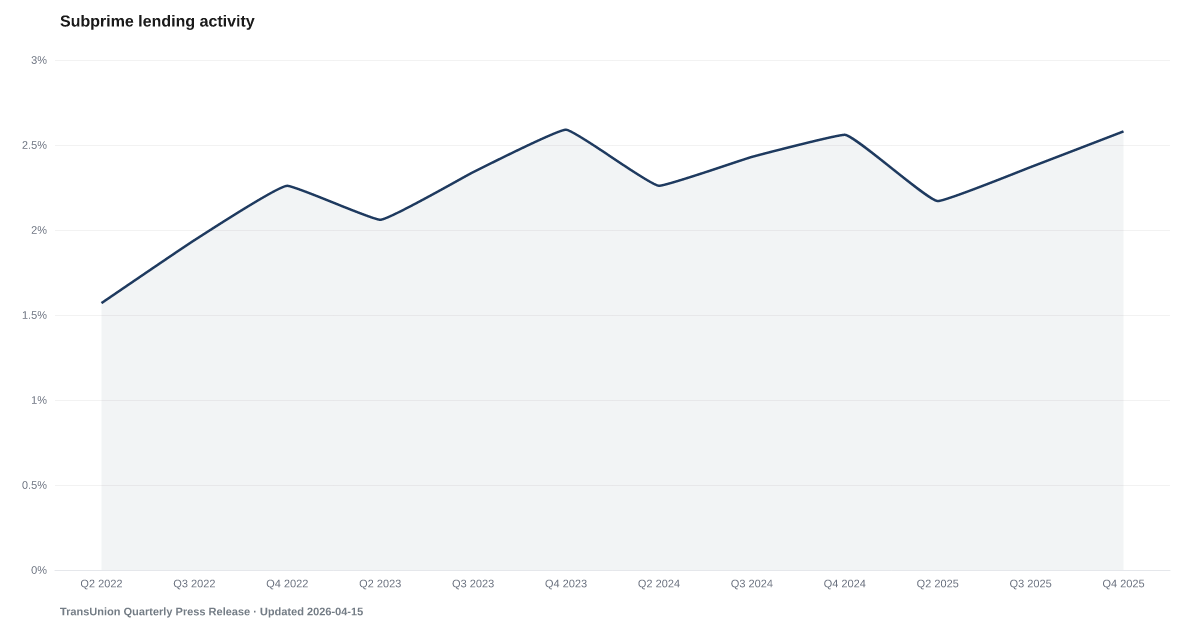
TransUnion Credit Card Borrower Delinquency over time: what has changed?

Counties with the highest delinquency scores
These are delinquency scores from our County Distress Index, not county readings of TransUnion Credit Card Borrower Delinquency.
Explore all 3,144 counties →| Period | Value | YoY Change |
|---|---|---|
| Q2 2026 | 2.3% | +0.1 pp |
| Q1 2026 | 2.5% | +0.1 pp |
| Q4 2025 | 2.6% | 0 pp |
| Q3 2025 | 2.4% | 0 pp |
| Q2 2025 | 2.2% | -0.1 pp |
| Q1 2025 | 2.4% | -0.2 pp |
| Q4 2024 | 2.6% | 0 pp |
| Q3 2024 | 2.4% | +0.1 pp |
| Q2 2024 | 2.3% | +0.2 pp |
| Q1 2024 | 2.6% | +0.3 pp |
| Q4 2023 | 2.6% | +0.3 pp |
| Q3 2023 | 2.3% | +0.4 pp |
Frequently Asked Questions
What share of credit card borrowers are seriously delinquent?
TransUnion put the share of credit card borrowers 90 or more days past due at 2.3% in Q2 2026, up from 2.2% a year earlier. TransUnion compares each quarter with the same quarter a year before, because the rate follows a seasonal pattern.
Is this the share of credit card debt that is past due?
No. It is a share of borrowers. TransUnion reports a separate balance-level rate, and the Federal Reserve Board and the New York Fed publish balance-based card delinquency rates from other data. Those measure a different thing and are not interchangeable with this one.
Is this a delinquency rate for borrowers with low credit scores only?
No. It covers all credit card borrowers in TransUnion's data. TransUnion sometimes names borrowers with low credit scores as one reason the rate changed, but they are not the group being measured.
Where does this credit card delinquency data come from?
TransUnion publishes it in its quarterly Credit Industry Insights Report, built from its U.S. consumer credit database. Recent releases came out between one and two months after the quarter ended.


Quick poll
Is this affecting you or your household?
Discussion
Get the numbers when they move.
New data drops, indicator updates, and American Distress Index changes — delivered when it matters. No spam.
or Create an Account for full access
Loading comments…