Multiple Jobholders Share of Employment
Also tracked as The Second Job
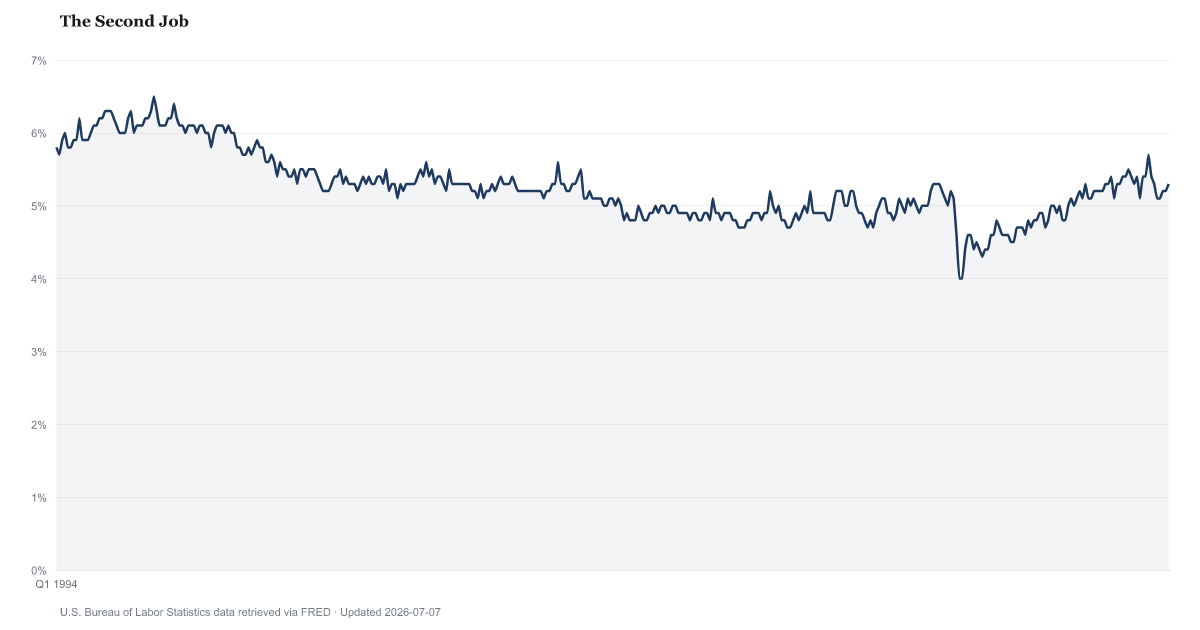
Multiple jobholders share of employment
What is the current Multiple Jobholders Share of Employment reading?
In August 2026, 5.4% of employed people in the U.S. held two or more jobs, the same as in July 2026, according to the U.S. Bureau of Labor Statistics. At least one of the jobs must be a wage or salary job. The share is of employed people 16 and older, not of all adults. Source: BLS Current Population Survey data retrieved via FRED (LNS12026620).
In August 2026, 5.4% of U.S. workers held more than one job, the same share as a year earlier.
The Bureau of Labor Statistics estimates that 5.4% of employed people 16 and older had two or more jobs in the survey week in August 2026, the same share as in July 2026.
To be counted, at least one of a person's jobs has to be a wage or salary job. Someone who is self-employed with several businesses, or who drives for several apps with no paid job on a payroll, is not a multiple jobholder in this survey. The share is of employed people, not of all adults or households, and the survey does not ask why people hold a second job. In August 2026, more than half of multiple jobholders had a full-time main job and a part-time second one; about 1 in 20 held two full-time jobs.
BLS also publishes the number of multiple jobholders. The number and the share can reach their highs in different years, because the number grows as total employment grows. News stories about the number of people with more than one job are about the count, not this share. The Total Nonfarm Payrolls series counts jobs rather than people, so a person with two payroll jobs appears there twice.
BLS publishes no margin of error for this share. For the unemployment rate, a share of similar size from the same survey, it says a one-month change needs to exceed about 0.3 percentage point (points on the percent scale, not a percent of the rate) to stand out from sampling error, so smaller moves are described here as little changed. The survey did not run in October 2025, during the federal government shutdown, so there is no figure for that month and November 2025 is not compared with September as a one-month change. Related pages: Unemployment Rate and Part-Time for Economic Reasons.
Multiple Jobholders Share of Employment over time: what has changed?

Counties with the highest labor scores
These are labor scores from our County Distress Index, not county readings of Multiple Jobholders Share of Employment.
Explore all 3,144 counties →| Period | Value | YoY Change |
|---|---|---|
| Aug 2026 | 5.4% | 0 pp |
| Jul 2026 | 5.4% | +0.3 pp |
| Jun 2026 | 5.3% | -0.1 pp |
| May 2026 | 5.2% | -0.1 pp |
| Apr 2026 | 5.2% | -0.2 pp |
| Mar 2026 | 5.1% | -0.4 pp |
| Feb 2026 | 5.1% | -0.3 pp |
| Jan 2026 | 5.3% | -0.1 pp |
| Dec 2025 | 5.4% | +0.1 pp |
| Nov 2025 | 5.7% | +0.4 pp |
| Sep 2025 | 5.4% | 0 pp |
| Aug 2025 | 5.4% | +0.1 pp |
Frequently Asked Questions
What share of workers have more than one job?
BLS put it at 5.4% of employed people for August 2026, a share of workers rather than of all Americans. A year earlier the share was the same.
Are gig workers counted as multiple jobholders?
Only if one of their jobs is a wage or salary job. A self-employed person with several businesses or apps and no paid job on a payroll is not counted, and neither is someone whose jobs are all unpaid family work.
How many people work two full-time jobs?
Relatively few. In August 2026, about 452,000 of the 8.5 million multiple jobholders had two full-time jobs, before seasonal adjustment. The largest group, about 4.8 million, had a full-time main job and a part-time second job.
Where does this data come from?
The Bureau of Labor Statistics estimates it from the Current Population Survey, a monthly survey of about 60,000 households that the Census Bureau runs for BLS. It appears in Table A-9 of the Employment Situation report, early in the month after the survey month, and on FRED as series LNS12026620.

Quick poll
Is this affecting you or your household?
Discussion
Get the numbers when they move.
New data drops, indicator updates, and American Distress Index changes — delivered when it matters. No spam.
or Create an Account for full access
Loading comments…