Total Nonfarm Payrolls
Total employment in the U.S. nonfarm economy
What is the current Total Nonfarm Payrolls reading?
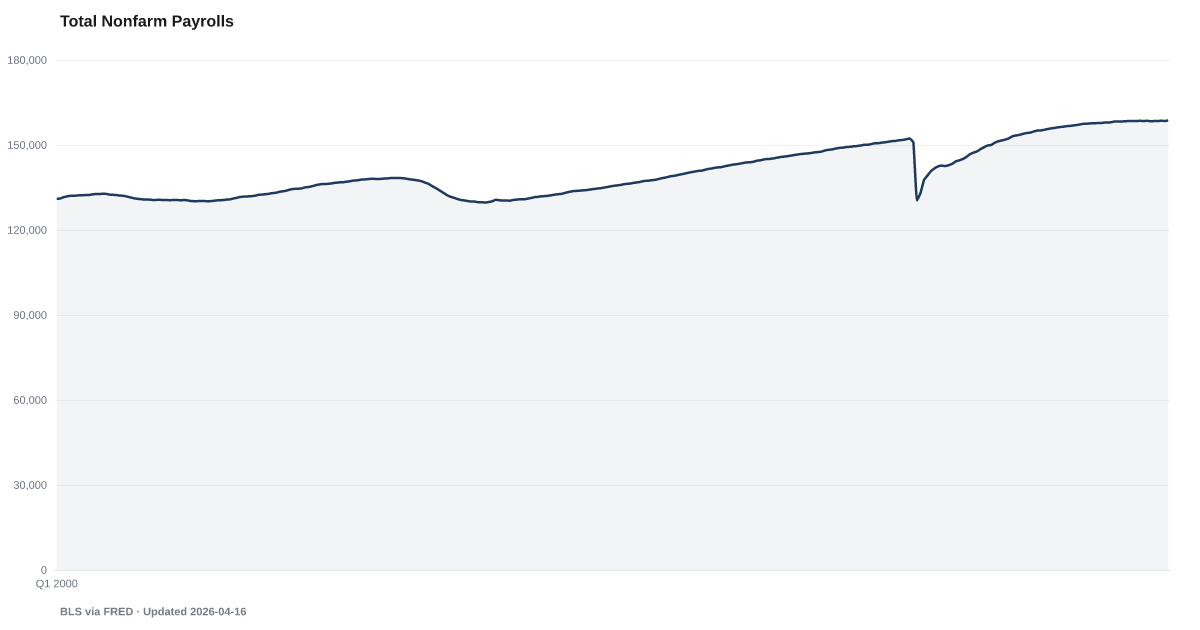
U.S. payrolls rose by 162,000 in August 2026, to 159.08 million jobs. The current July 2026 estimate is 158.91 million. The Current Employment Statistics survey of employers counts jobs, not people, so someone paid by two employers is counted twice. It excludes farm workers, household workers, the self-employed and unpaid family workers. The latest two months are preliminary and will be revised. Source: U.S. Bureau of Labor Statistics data retrieved via FRED (PAYEMS).
U.S. nonfarm payrolls stood at 159.08 million jobs in August 2026, the most in BLS's current estimates, which go back to 1939.
The Bureau of Labor Statistics' first estimate for August 2026 puts 159.08 million jobs on the payrolls of U.S. businesses and government agencies. That is 162,000 more than BLS's current estimate for July 2026. Over the past year the count grew by 603,000 jobs, from 158.47 million in August 2025.
The count is of jobs, not people. Someone on two payrolls is counted twice. It covers private businesses and federal, state and local government, and leaves out farm workers, household workers, the self-employed, unpaid family workers and the military. The number of people with jobs comes from a separate household survey, and a separate page tracks the share of those workers who hold more than one.
Payroll numbers are estimates from a sample of employers, and they change after they first appear. BLS revises each month twice, one and two months later, then again each February, when it lines the March level up with unemployment insurance tax records. In February 2026 that step cut its March 2025 level by 898,000 jobs. BLS says a one-month change needs to be larger than about 122,000 jobs to stand out from sampling error, so smaller moves are described here as little changed. BLS also applied temporary adjustments from March 2020 to October 2021, so comparisons with those months carry that caveat.
The monthly change is a net figure: jobs added minus jobs lost at the pay period that includes the 12th. It is not a count of hires, and it says nothing about pay, hours or job quality. The JOLTS Quits Rate, the Indeed Job Postings Index, Continued Unemployment Claims and Youth Unemployment each measure a different part of the job market.
Explore Further
Total Nonfarm Payrolls over time: what has changed?

Counties with the highest labor scores
These are labor scores from our County Distress Index, not county readings of Total Nonfarm Payrolls.
Explore all 3,144 counties →| Period | Value | YoY Change |
|---|---|---|
| Aug 2026 | 159.075M | +0.603M |
| Jul 2026 | 158.913M | +0.371M |
| Jun 2026 | 158.892M | +0.414M |
| May 2026 | 158.861M | +0.363M |
| Apr 2026 | 158.798M | +0.313M |
| Mar 2026 | 158.65M | +0.273M |
| Feb 2026 | 158.436M | +0.126M |
| Jan 2026 | 158.592M | +0.324M |
| Dec 2025 | 158.432M | +0.116M |
| Nov 2025 | 158.449M | +0.37M |
| Oct 2025 | 158.408M | +0.463M |
| Sep 2025 | 158.548M | +0.636M |
Frequently Asked Questions
How many jobs are on U.S. payrolls?
BLS counted 159.08 million nonfarm payroll jobs in August 2026, 603,000 more than in August 2025. That is a first estimate, and BLS will revise it at least twice.
Is this the number of Americans with jobs?
No. The payroll survey counts jobs, so a person on two payrolls appears twice, and it leaves out the self-employed, farm workers and household workers. The number of employed people comes from the Current Population Survey, a separate household survey, and the two counts are not meant to match.
How much do payroll numbers get revised?
Each month is revised twice, one and two months after it first appears, and again each February. The changes can be large. BLS first reported that June 2025 added 147,000 jobs; its third estimate showed a loss of 13,000. The benchmark published in February 2026 cut the March 2025 level by 898,000 jobs.
Where does this data come from?
The Bureau of Labor Statistics publishes it in The Employment Situation report, usually early in the month after the reference month, though the day of the week varies. It comes from the Current Employment Statistics survey of about 119,000 businesses and government agencies covering about 622,000 worksites. FRED carries it as series PAYEMS.


Quick poll
Is this affecting you or your household?
Discussion
Get the numbers when they move.
New data drops, indicator updates, and American Distress Index changes — delivered when it matters. No spam.
or Create an Account for full access
Loading comments…