Unemployment Rate
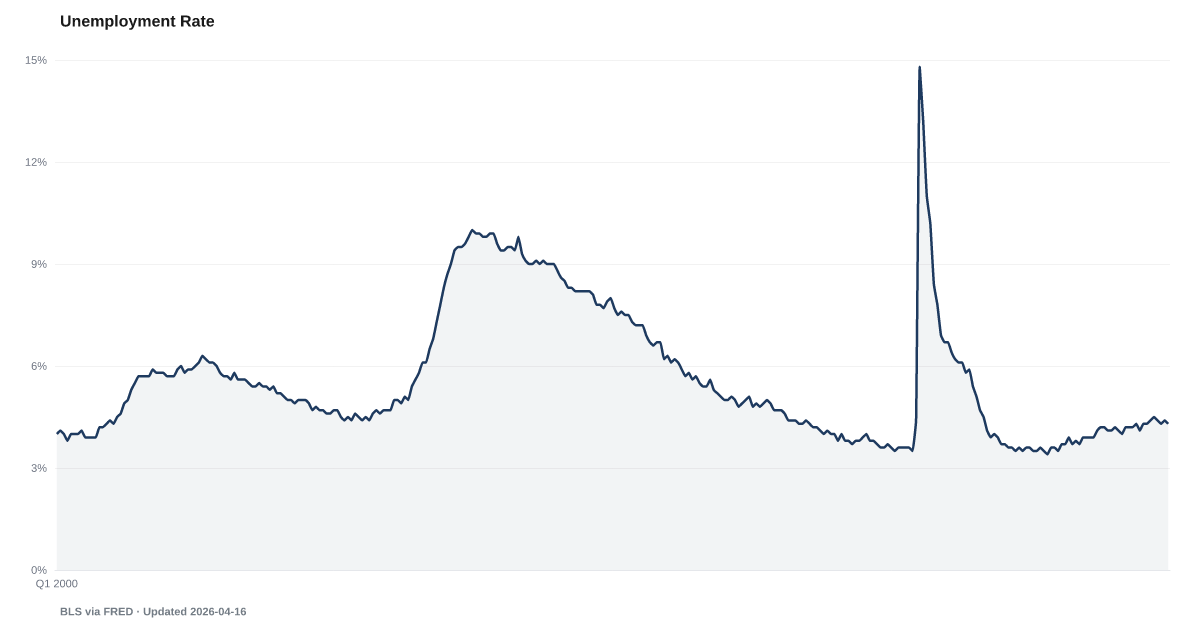
Share of the labor force that is unemployed
In our research, changes in Initial Unemployment Claims (SA) have tended to show up in this measure about one quarter later. How we tested this
What is the current Unemployment Rate reading?
The U.S. unemployment rate was 4.1% in August 2026, the same as in July 2026, according to the U.S. Bureau of Labor Statistics. It is the share of the labor force, everyone working or looking for work, that is jobless and looking for work or on temporary layoff. Source: BLS Current Population Survey.
U.S. unemployment was 4.1% in August 2026, the lowest since June 2025.
The Bureau of Labor Statistics put the unemployment rate at 4.1% in August 2026, the same as in July 2026. That is little changed from a year earlier, when it was 4.3%. It is the lowest rate since June 2025.
The rate counts people without a job who looked for one in the past four weeks, or who are waiting to be called back from a temporary layoff, as a share of everyone working or looking. BLS calls a one-month move a change only when it is too large to be survey noise. Smaller moves it calls little changed, and so do we.
People who want a job but haven't looked in the past four weeks are outside the count. The broader U-6 Underemployment rate adds those of them who looked in the past year and could start work, plus part-time workers who want full-time hours, so by definition it runs higher. Youth Unemployment, Part-Time for Economic Reasons, the JOLTS Quits Rate and Continued Unemployment Claims each track a part of the job market this rate leaves out.
The household survey did not run in October 2025, during the federal government shutdown, so the series has no figure for that month.
Explore Further
Unemployment Rate over time: what has changed?

Counties with the highest labor scores
These are labor scores from our County Distress Index, not county readings of Unemployment Rate.
Explore all 3,144 counties →| Period | Value | YoY Change |
|---|---|---|
| Aug 2026 | 4.1% | -0.2 pp |
| Jul 2026 | 4.1% | -0.2 pp |
| Jun 2026 | 4.2% | +0.1 pp |
| May 2026 | 4.3% | 0 pp |
| Apr 2026 | 4.3% | +0.1 pp |
| Mar 2026 | 4.3% | +0.1 pp |
| Feb 2026 | 4.4% | +0.2 pp |
| Jan 2026 | 4.3% | +0.3 pp |
| Dec 2025 | 4.4% | +0.3 pp |
| Nov 2025 | 4.5% | +0.3 pp |
| Sep 2025 | 4.4% | +0.3 pp |
| Aug 2025 | 4.3% | +0.1 pp |
Frequently Asked Questions
What is the current U.S. unemployment rate?
It was 4.1% in August 2026, the same as in July 2026, according to the Bureau of Labor Statistics. That is little changed from a year earlier, when it was 4.3%.
Why does the unemployment rate understate labor market weakness?
The U-3 rate counts only people who are jobless and looked for work in the past four weeks, or are on temporary layoff. It leaves out people who want a job but haven't looked recently, and people working part-time who want full-time hours. The broader U-6 measure adds the part-timers and the people who looked in the past year and could start work, so it is always higher.
Where does unemployment data come from?
The Bureau of Labor Statistics publishes the rate monthly in The Employment Situation report. It comes from the Current Population Survey, a monthly survey of about 60,000 households run by the Census Bureau for BLS.


Quick poll
Is this affecting you or your household?
Discussion
Get the numbers when they move.
New data drops, indicator updates, and American Distress Index changes — delivered when it matters. No spam.
or Create an Account for full access
Loading comments…