Part-Time for Economic Reasons
People with jobs working part time who want full-time work
What is the current Part-Time for Economic Reasons reading?
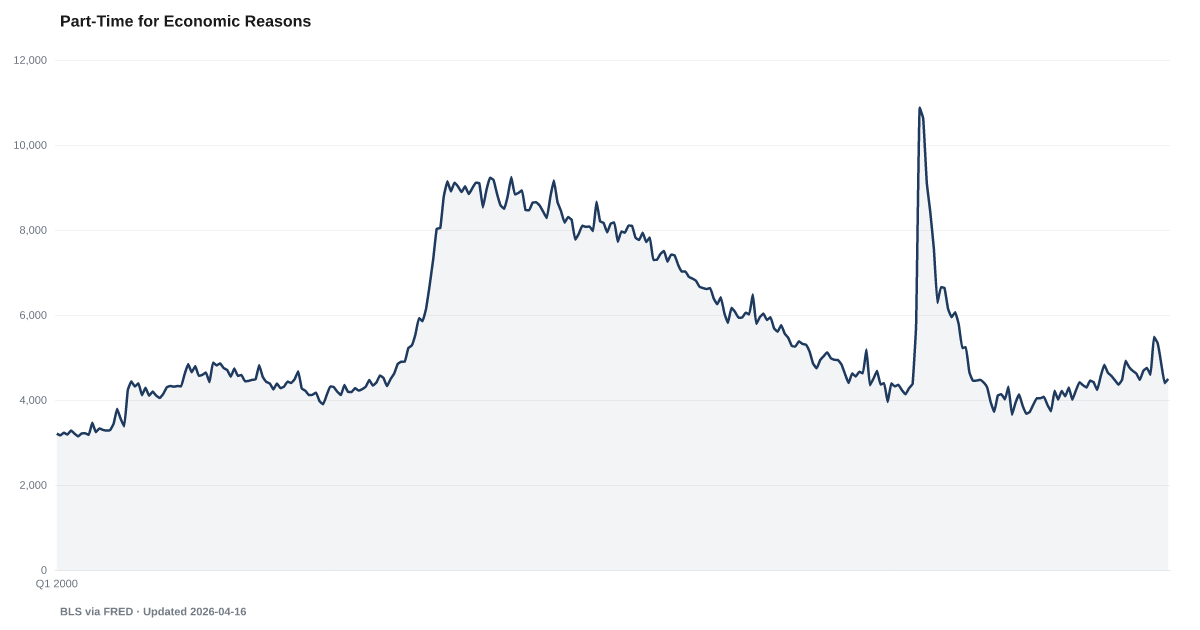
In August 2026, 4.4 million people in the U.S. worked part time for economic reasons, down from 4.8 million in July 2026, according to the U.S. Bureau of Labor Statistics. They had jobs but wanted full-time work, and worked fewer than 35 hours in the survey week because of slack business, no full-time openings or a seasonal slowdown. The figure is a count of people, not a share of workers. Source: BLS Current Population Survey data retrieved via FRED (LNS12032194).
In August 2026, 4.4 million people with jobs worked part time because of cut hours, no full-time openings or a seasonal slowdown, the fewest since December 2024.
The Bureau of Labor Statistics estimates that 4.4 million people worked part time for economic reasons in August 2026, down from 4.8 million in July 2026. Over 12 months the count is down from 4.8 million in August 2025.
BLS counts someone here when they worked 1 to 34 hours in the survey week and gave an economic reason: slack work or poor business conditions, only being able to find part-time work, or a seasonal drop in demand. Their usual hours can be full time, so a full-time worker whose hours were cut that week is included. People who usually work part time must also say they want and are available for full-time work. Everyone in the count has a job, so none of them are unemployed; the broader U-6 Underemployment Rate adds them to the jobless and the marginally attached.
For a worker paid by the hour, fewer hours means a smaller paycheck, while bills such as rent, a car loan or insurance stay the same. The count does not say how many hours each person lost or how long they have been part time. It is a count of people, not a share of workers, so it can grow as total employment grows. The headline Unemployment Rate leaves this group out, because it counts them as employed.
The count is seasonally adjusted: BLS removes the swings that repeat every year, so one month can be compared with the next. It comes from a household survey, and BLS publishes no margin of error for it. This page calls a one-month move under about 280,000 people, or a 12-month move under about 350,000, little changed; that cutoff is our estimate scaled from BLS's margin for the number of unemployed people, not a BLS figure. BLS tightened the definition in January 1994, so comparisons on this page start there. The survey did not run in October 2025, during the federal government shutdown, so there is no figure for that month.
Explore Further
Part-Time for Economic Reasons over time: what has changed?

Counties with the highest labor scores
These are labor scores from our County Distress Index, not county readings of Part-Time for Economic Reasons.
Explore all 3,144 counties →| Period | Value | YoY Change |
|---|---|---|
| Aug 2026 | 4.39M | -0.365M |
| Jul 2026 | 4.804M | +0.115M |
| Jun 2026 | 4.681M | +0.208M |
| May 2026 | 4.805M | +0.181M |
| Apr 2026 | 4.942M | +0.256M |
| Mar 2026 | 4.497M | -0.274M |
| Feb 2026 | 4.396M | -0.527M |
| Jan 2026 | 4.873M | +0.395M |
| Dec 2025 | 5.341M | +0.98M |
| Nov 2025 | 5.487M | +1.024M |
| Sep 2025 | 4.594M | -0.049M |
| Aug 2025 | 4.755M | -0.073M |
How to read this series
The source changed how it measures this in Jan 1994. In January 1994 BLS redesigned the Current Population Survey and began requiring people who usually work part time to say they want and are available for full-time work, so counts before and after are not comparable. Readings on either side are not directly comparable, so the year-over-year column stays blank where a comparison would cross that date. Source documentation.
Frequently Asked Questions
How many people work part time for economic reasons?
BLS counted 4.4 million for August 2026. That is down from 4.8 million a year earlier.
Is this the number of underemployed Americans?
No. It counts only people with jobs who worked part time for economic reasons. BLS's broadest measure, U-6, also includes unemployed people and people marginally attached to the labor force, and U-6 is a rate, not a count. This series is not a share of workers either.
Where does this data come from?
BLS publishes the count monthly in Table A-8 of The Employment Situation report. It comes from the Current Population Survey, a monthly survey of about 60,000 households run by the Census Bureau for BLS. This is the all-industries total; BLS also prints a smaller nonagricultural line. Seasonally adjusted figures for the past five years are revised each January.


Quick poll
Is this affecting you or your household?
Discussion
Get the numbers when they move.
New data drops, indicator updates, and American Distress Index changes — delivered when it matters. No spam.
or Create an Account for full access
Loading comments…