Bankruptcy Chapter 7 to Chapter 13 Filing Ratio
Also tracked as The Wipeout Ratio
Ratio of Chapter 7 liquidation to Chapter 13 repayment-plan filings
What is the current Bankruptcy Chapter 7 to Chapter 13 Filing Ratio reading?
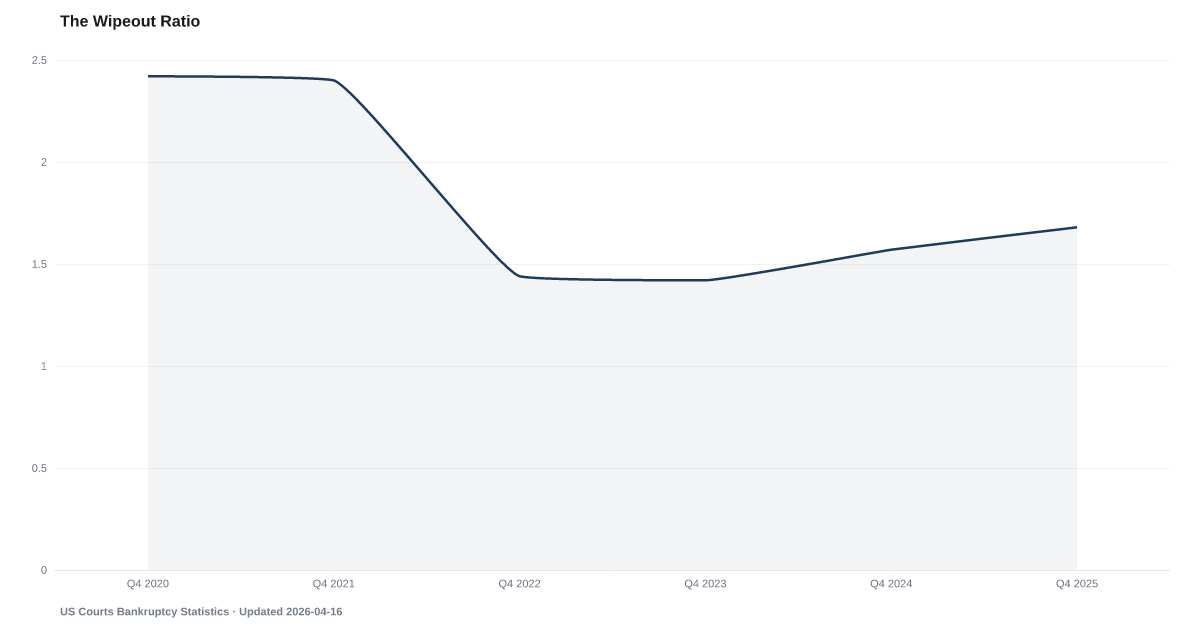
In the 12 months through Q2 2026, U.S. bankruptcy courts logged 1.77 times as many Chapter 7 cases as Chapter 13 cases, by our calculation from Administrative Office of the U.S. Courts counts. That is up from 1.66 times for the 12 months through Q2 2025. Both counts include business cases and count cases, not people. The ratio describes filing composition from rolling-year U.S. Courts totals; it is descriptive, not a prediction, and does not establish why a filer chose a chapter. Source: U.S. Courts, Table F-2.
Bankruptcy courts took in 1.77 times as many Chapter 7 cases as Chapter 13 cases over the 12 months through Q2 2026, up from 1.66 times a year earlier, in Q2 2025.
The Chapter 7 to Chapter 13 filing ratio divides the Chapter 7 cases filed in U.S. bankruptcy courts over 12 months by the Chapter 13 cases filed over the same 12 months. The Administrative Office of the U.S. Courts publishes both counts in Table F-2; the ratio is our calculation. For the 12 months through Q2 2026 it was 1.77 times. It is up from 1.75 times in Q1 2026, the reading a quarter earlier. That is the highest ratio since Q1 2022.
The ratio has been above its year-earlier level for 10 quarters in a row.
Chapter 7 is liquidation: a trustee can sell property the law does not protect and pay creditors from the proceeds. Chapter 13 lets an individual with regular income repay debts under a court-supervised plan. Both counts are taken when a case is filed. A Chapter 7 filing is not a discharge, and a Chapter 13 filing is not a completed plan; the court can dismiss a case or convert it to another chapter. Chapter 7 also includes cases filed by corporations and partnerships.
The ratio shows the mix of filings; it does not establish why people chose a chapter. Eligibility rules also sort filers: a means test applies to Chapter 7 filers with above-median income, and Chapter 13 has debt limits. The figure is national. Ratios in individual court districts differ widely.
Our series starts in mid-2023. The Courts' older counts give a longer view: 1,346,201 Chapter 7 and 429,316 Chapter 13 cases in fiscal year 2005, and 310,597 and 117,784 in the 12 months ending September 30, 2021. The 2005 bankruptcy law (BAPCPA) added the Chapter 7 means test that October, and the Courts say their counts before 2015 may not match earlier tables because of a change in method.
Explore Further
Is this happening to you?
If you had to file bankruptcy, would you want to keep your assets or start fresh?
Bankruptcy Chapter 7 to Chapter 13 Filing Ratio over time: what has changed?

Counties with the highest default and legal scores
These are default and legal scores from our County Distress Index, not county readings of Bankruptcy Chapter 7 to Chapter 13 Filing Ratio.
Explore all 3,144 counties →| Period | Value | YoY Change |
|---|---|---|
| Q2 2026 | 1.77x | +0.11x |
| Q1 2026 | 1.75x | +0.14x |
| Q4 2025 | 1.72x | +0.15x |
| Q3 2025 | 1.7x | +0.18x |
| Q2 2025 | 1.66x | +0.18x |
| Q1 2025 | 1.61x | +0.16x |
| Q4 2024 | 1.57x | +0.15x |
| Q3 2024 | 1.52x | +0.12x |
| Q2 2024 | 1.48x | +0.1x |
| Q1 2024 | 1.45x | +0.06x |
| Q4 2023 | 1.42x | -0.02x |
| Q3 2023 | 1.4x | -0.14x |
Frequently Asked Questions
What is the Chapter 7 to Chapter 13 bankruptcy ratio?
It is the number of Chapter 7 cases filed over 12 months divided by the number of Chapter 13 cases filed over the same 12 months. For the 12 months through Q2 2026 it was 1.77 times, up from 1.66 times a year earlier, in Q2 2025.
What is the difference between Chapter 7 and Chapter 13 bankruptcy?
Chapter 7 is liquidation: a trustee can sell property the law does not protect, and eligible debts can be discharged. Individuals and businesses can file under it. Chapter 13 is for individuals with regular income, who repay debts under a court-supervised plan. Who can use each chapter depends on facts Table F-2 does not contain.
Does a change in the ratio show why people chose a chapter?
No. A change in the ratio shows that the mix of Chapter 7 and Chapter 13 cases changed. It does not show filers' income, debts, assets or reasons. The Courts count cases, not people, and state no cause for the mix. The ratio is descriptive, not a prediction.
Where does the Chapter 7 vs. Chapter 13 data come from?
The Administrative Office of the U.S. Courts publishes Table F-2 each quarter, with 12-month case counts by chapter for periods ending March 31, June 30, September 30 and December 31. American Default divides the Chapter 7 total by the Chapter 13 total. The Courts do not publish the ratio themselves.


Quick poll
Is this affecting you or your household?
Discussion
Get the numbers when they move.
New data drops, indicator updates, and American Distress Index changes — delivered when it matters. No spam.
or Create an Account for full access
Loading comments…