Share of Adults Who Would Use Savings for a $1,000 Emergency
Also tracked as The Safety Net
How U.S. adults say they would pay a $1,000 emergency
What is the current Share of Adults Who Would Use Savings for a $1,000 Emergency reading?
In Bankrate's 2026 Emergency Savings Report, 30% of U.S. adults said they would use savings to pay a $1,000 emergency. Bankrate added a new answer option and switched pollster and panel type in its 2026 report, so readings from 2026 on cannot be compared with earlier years. This is a stated choice in a national opinion poll, not a measure of account balances or a forecast. Source: Bankrate Emergency Savings Report.
In Bankrate's 2026 report, 30% of U.S. adults said they would use savings to pay a $1,000 emergency.
Bankrate's annual Emergency Savings Report asks adults which one option best describes how they would deal with a major unexpected expense, such as $1,000 for an emergency room visit or car repair. In the 2026 report, 30% picked paying from savings.
Bankrate changed this survey in its 2026 report. It added a new answer, paying from regular income or cash flow, and it switched from an SSRS probability panel to a YouGov opt-in online panel, fielded December 2 to 8, 2025, with no published margin of error. Readings from 2026 on cannot be compared with earlier years, and Bankrate does not say how much of the difference is a real change. An earlier switch, from telephone interviews to a mostly online panel in the January 2023 report, also changed how the survey was taken.
The survey records a stated choice about a hypothetical expense. It does not measure account balances. Not choosing savings is not the same as being unable to pay: the other answers include paying from regular income, cutting other spending and borrowing. The $1,000 amount has stayed the same since 2018 and is not adjusted for inflation.
Read this survey alongside hardship withdrawals from retirement plans, the personal saving rate, and the paycheck-to-paycheck rate as separate household-finance measures. They use different populations and methods, and none of them shows that one measure caused or predicts another.
Explore Further
Share of Adults Who Would Use Savings for a $1,000 Emergency over time: what has changed?

Counties with the highest safety net and buffer scores
These are safety net and buffer scores from our County Distress Index, not county readings of Share of Adults Who Would Use Savings for a $1,000 Emergency.
Explore all 3,144 counties →| Period | Value | YoY Change |
|---|---|---|
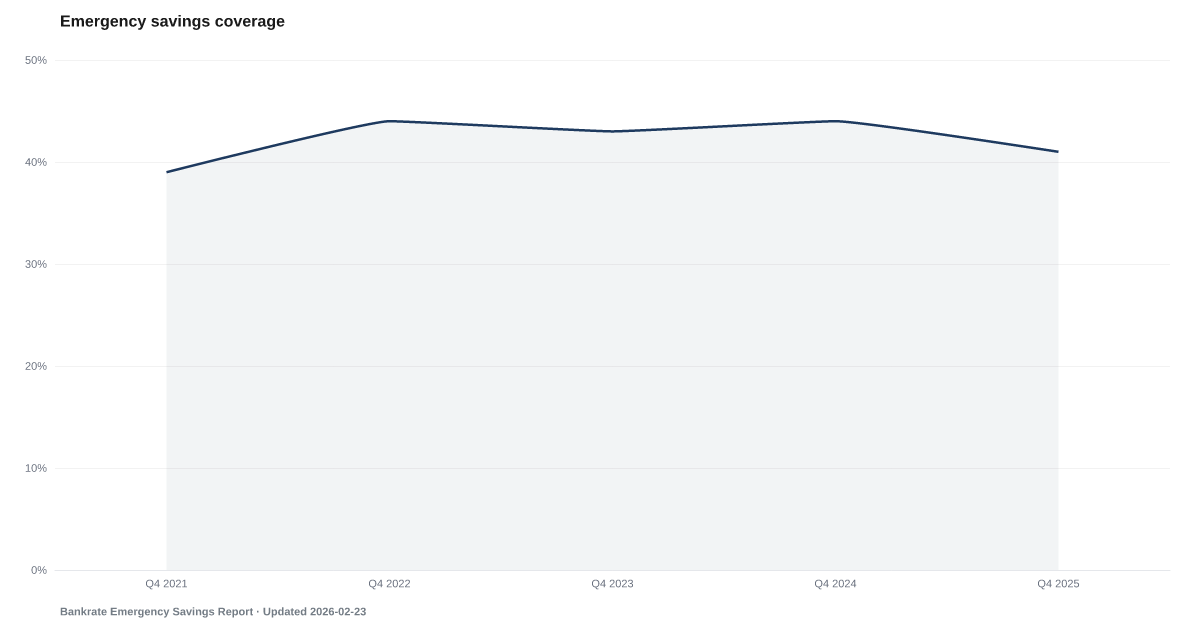
| 2026 | 30% | — |
| 2025 | 41% | -3 pp |
| 2024 | 44% | +1 pp |
| 2023 | 43% | — |
| 2022 | 44% | +5 pp |
| 2021 | 39% | — |
How to read this series
The source changed how it measures this in 2023. Bankrate's January 2023 report was the first taken on the SSRS Opinion Panel, a probability-based panel answered mostly online, while earlier reports used SSRS's telephone survey, so readings before and after it were collected in different ways. Readings on either side are not directly comparable, so the year-over-year column stays blank where a comparison would cross that date. Source documentation.
The source changed how it measures this in 2026. Bankrate’s 2026 report added a separate “regular income or cash flow” answer that earlier years did not offer, and moved from an SSRS probability panel to a YouGov non-probability online panel. Bankrate’s own 2026 net for savings plus income or cash flow is 47 percent — 30 percent from savings plus 17 percent from income or cash flow — and Bankrate does not describe it as comparable with earlier years. Readings on either side are not directly comparable, so the year-over-year column stays blank where a comparison would cross that date. Source documentation.
Frequently Asked Questions
What share of U.S. adults said they would use savings for a $1,000 emergency?
In Bankrate's 2026 Emergency Savings Report, 30% of U.S. adults said they would use savings to pay a $1,000 emergency.
What does this survey measure?
It records which one option adults say best describes how they would deal with a hypothetical $1,000 expense. It does not measure account balances or the share with no savings, and it counts adults, not households. It is a different question from the Board of Governors of the Federal Reserve System's $400 emergency-expense question, so the two should not be set side by side.
Can the latest reading be compared with earlier years?
Not with years before 2026. In its 2026 report Bankrate added a 'regular income or cash flow' answer and switched from an SSRS probability panel to a YouGov opt-in online panel at the same time. Bankrate does not describe the new reading as comparable, and it does not say how much of the difference is a real change.
Does the survey predict loan defaults?
No. The survey records how respondents said they would pay for one hypothetical emergency. It does not establish a quantified or validated relationship with later loan defaults.


Quick poll
Is this affecting you or your household?
Discussion
Get the numbers when they move.
New data drops, indicator updates, and American Distress Index changes — delivered when it matters. No spam.
or Create an Account for full access
Loading comments…