Total Consumer Credit Outstanding
Total consumer credit outstanding, excluding mortgages
What is the current Total Consumer Credit Outstanding reading?
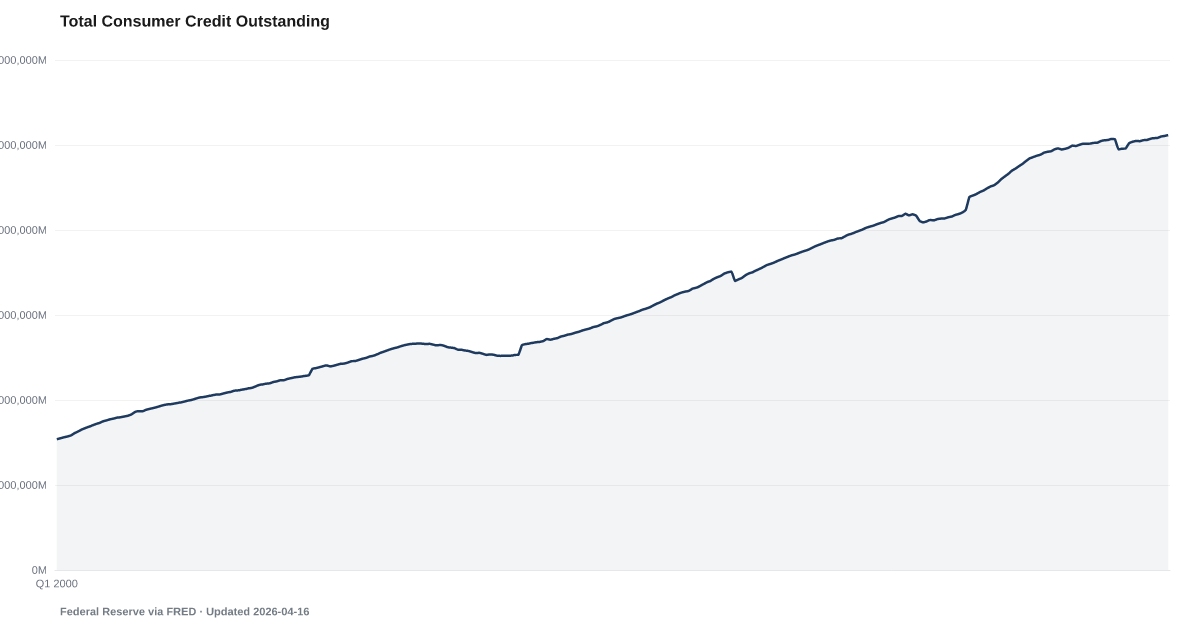
U.S. lenders held $5.19 trillion in consumer credit outstanding in July 2026, according to the Board of Governors of the Federal Reserve System's G.19 release, up from $5.06 trillion a year earlier. The figure covers credit cards, auto loans, student loans and other personal loans, and leaves out mortgages and home equity lines. Source: Federal Reserve G.19 Consumer Credit (July 2026), data retrieved via FRED series TOTALSL.
Consumer credit outstanding was $5.19 trillion in July 2026, up $18.06 billion from June 2026, a record in current dollars for a series that began in 1943.
The Federal Reserve's G.19 release counts $5.19 trillion in consumer credit on lenders' books for July 2026, $130.29 billion more than a year earlier. The seasonally adjusted balance, which removes the usual swings of the calendar, was up $18.06 billion from June 2026.
That is the largest balance in a series that starts in 1943. It is a record in current dollars, not adjusted for inflation or population growth. The newest month is preliminary and is usually revised in the next release.
Consumer credit covers loans to people for household and personal spending that are not secured by real estate. About a quarter is revolving credit, mostly credit cards; the rest is nonrevolving credit such as auto loans, student loans and other installment loans. Mortgages and home equity lines are left out. The Fed adds up balances held by banks, credit unions, finance companies, the federal government's student loan program and nonprofit and educational lenders. It counts dollars on lenders' books, not people, so it does not say how much any one household owes.
Changes on this page are differences between the published monthly balances. When the Fed changes its sources or moves loans from one category to another, the balance can jump or drop with no new borrowing, as it did in December 2024 and March 2025. The Fed's own growth rates leave those steps out, and they are stated at an annual rate, so a month's growth figure in the release is not the same as the change shown here.
A dollar total does not say whether this debt is hard to carry. Revolving credit tracks the card-heavy part on its own, the total delinquency rate tracks the share of household debt balances that are behind on payments, and the personal saving rate tracks how much of their income households save. None of them shows why balances changed.
Explore Further
Total Consumer Credit Outstanding over time: what has changed?

Counties with the highest safety net and buffer scores
These are safety net and buffer scores from our County Distress Index, not county readings of Total Consumer Credit Outstanding.
Explore all 3,144 counties →| Period | Value | YoY Change |
|---|---|---|
| Jul 2026 | $5.19T | +$0.13T |
| Jun 2026 | $5.17T | +$0.13T |
| May 2026 | $5.15T | +$0.1T |
| Apr 2026 | $5.15T | +$0.11T |
| Mar 2026 | $5.13T | +$0.11T |
| Feb 2026 | $5.11T | +$0.15T |
| Jan 2026 | $5.1T | +$0.14T |
| Dec 2025 | $5.1T | +$0.15T |
| Nov 2025 | $5.08T | +$0.01T |
| Oct 2025 | $5.08T | +$0.01T |
| Sep 2025 | $5.07T | +$0.01T |
| Aug 2025 | $5.06T | $0 |
Frequently Asked Questions
How much consumer credit is outstanding in the U.S.?
The Fed put consumer credit outstanding at $5.19 trillion for July 2026, up from $5.06 trillion a year earlier. About a quarter of it is revolving credit, mostly credit cards; the rest is auto, student and other installment loans.
Is consumer credit at a record high?
Yes, in current dollars: the latest balance is the highest of 1,003 monthly readings since 1943, not adjusted for inflation. A dollar record says little on its own, because prices, incomes and the population grow over time, and over the years the Fed has taken some kinds of loans out of the total.
Does consumer credit include mortgages?
No. The G.19 leaves out every loan secured by real estate, including mortgages and home equity lines. The New York Fed's household debt report does include them, so its total is much larger and comes from credit reports rather than lenders' books. The two cannot be compared or combined.
Where does the data come from?
The Federal Reserve Board's G.19 Consumer Credit release, built from bank and credit union call reports, Education Department student loan data and surveys of finance companies. It comes out around the fifth business day of each month and reports the month two months earlier, so each figure is about five weeks old when published.


Quick poll
Is this affecting you or your household?
Discussion
Get the numbers when they move.
New data drops, indicator updates, and American Distress Index changes — delivered when it matters. No spam.
or Create an Account for full access
Loading comments…