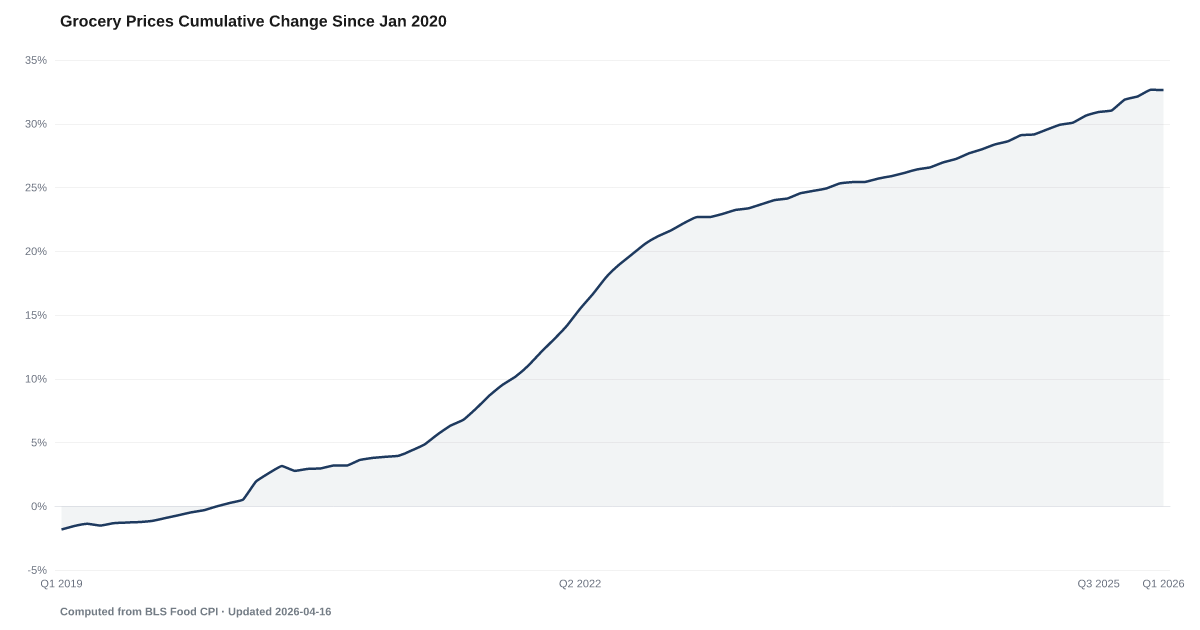
Grocery Prices Cumulative Change Since Jan 2020
Cumulative percentage change in grocery prices since January 2020
What is the current Grocery Prices Cumulative Change Since Jan 2020 reading?
In August 2026, grocery prices were 32% higher than in January 2020, according to the seasonally adjusted U.S. Bureau of Labor Statistics consumer price index for food at home. That is about the same as the 31.9% of July 2026. This is the total change over the period, not a yearly inflation rate, and it covers groceries only, not restaurant meals. Source: BLS CPI (CUSR0000SAF11).
Measurement basis: Cumulative percent change since January 2020 computed from the seasonally adjusted BLS Food-at-Home CPI (CUSR0000SAF11); seasonally adjusted values may be revised
In August 2026, grocery prices were 32% higher than in January 2020, seasonally adjusted.
There is a difference between the inflation rate and the price level. The rate is how much prices changed over the last 12 months. The level is how far prices have gone in total. This page tracks the level: the total change in the Bureau of Labor Statistics food-at-home price index since January 2020.
In August 2026, the seasonally adjusted index was 32% above its January 2020 level. In July 2026 it was 31.9%, about the same.
A lower yearly inflation rate that is still above zero means grocery prices are still going up, just less quickly. It does not mean they have come down; only a rate below zero means that. The total since January 2020 shrinks only in months when grocery prices themselves go down. Food Price Inflation tracks the yearly rate for all food, including restaurant meals, and the grocery affordability gap sets food prices against wages.
This is a price index, not a measure of what households spend: people change what and how much they buy. It covers food bought at grocery and other food stores by urban consumers, who make up over 90 percent of the U.S. population, and leaves out restaurant meals. We build it from the seasonally adjusted index. BLS says the unadjusted index is the one for prices actually paid, and it gives a slightly different total. Seasonally adjusted values from January 2022 on can still be revised each February.
Explore Further
Is this happening to you?
Does your grocery bill still feel higher than it was before 2020?
Grocery Prices Cumulative Change Since Jan 2020 over time: what has changed?

Counties with the highest debt burden scores
These are debt burden scores from our County Distress Index, not county readings of Grocery Prices Cumulative Change Since Jan 2020.
Explore all 3,144 counties →| Period | Value | YoY Change |
|---|---|---|
| Aug 2026 | 32% | +2.8 pp |
| Jul 2026 | 31.9% | +3.3 pp |
| Jun 2026 | 32% | +3.5 pp |
| May 2026 | 31.8% | +3.5 pp |
| Apr 2026 | 31.7% | +3.8 pp |
| Mar 2026 | 30.8% | +2.6 pp |
| Feb 2026 | 31% | +3.3 pp |
| Jan 2026 | 30.4% | +2.8 pp |
| Dec 2025 | 30.2% | +3 pp |
| Nov 2025 | 29.4% | +2.5 pp |
| Sep 2025 | 29.6% | +3.4 pp |
| Aug 2025 | 29.2% | +3.4 pp |
Frequently Asked Questions
How much have grocery prices gone up since January 2020?
In August 2026, grocery prices (food at home) were 32% higher than in January 2020, according to the seasonally adjusted BLS consumer price index series CUSR0000SAF11. The figure compares the index with its January 2020 level. It is the total change over the period, not a yearly rate.
How is this different from the grocery inflation rate?
The inflation rate is the change over the last 12 months. It can get smaller while prices stay far above where they started. A lower rate that is still above zero means prices are going up more slowly, not that they are coming back down; only a rate below zero means they have come down. The total change since a fixed month shows how far prices have gone over the whole period.
Does this mean a dollar buys that much less food?
No. The figure is how much prices rose, not how much a dollar's buying power fell. The fall in buying power is always smaller than the rise in prices: if prices doubled, a dollar would buy half as much food.
Why January 2020, and why seasonally adjusted?
January 2020 is the last month before the pandemic changed prices and price collection. The answer depends on the starting month: food-at-home prices went up sharply between January and April 2020, so a total measured from March or April 2020 is smaller. BLS publishes no official since-2020 figure. We use the seasonally adjusted index; the unadjusted index gives a slightly different total.


Quick poll
Is this affecting you or your household?
Discussion
Get the numbers when they move.
New data drops, indicator updates, and American Distress Index changes — delivered when it matters. No spam.
or Create an Account for full access
Loading comments…