Grocery Affordability Gap
Also tracked as The Grocery Gap
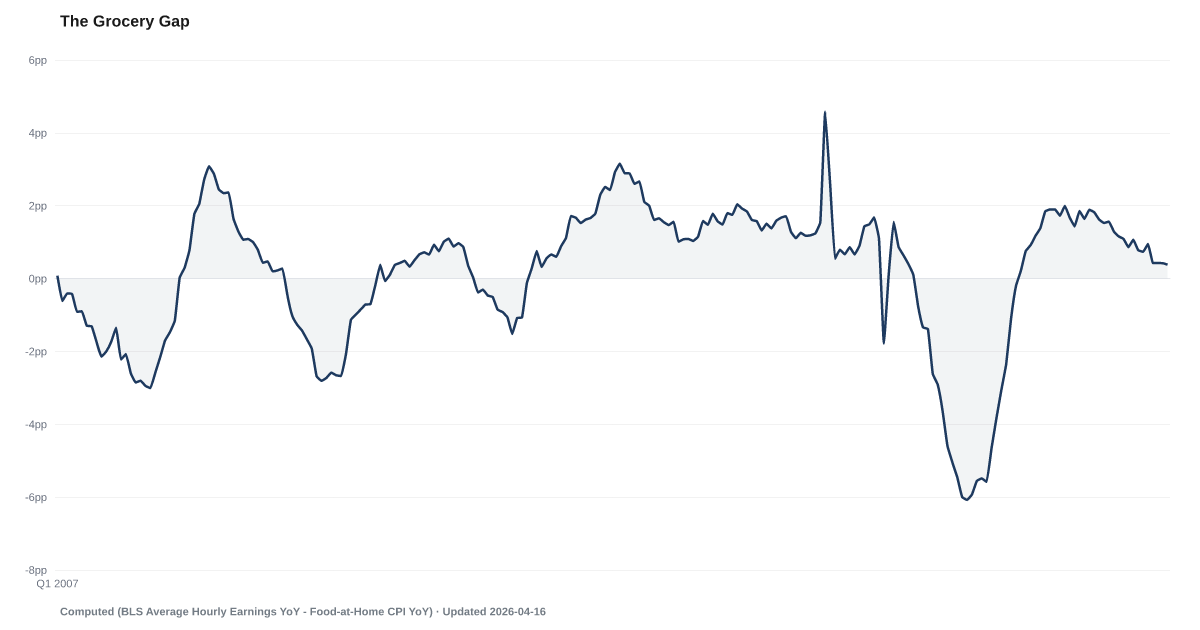
Gap between average hourly earnings growth and Food CPI
What is the current Grocery Affordability Gap reading?
The grocery affordability gap is the yearly change in average hourly earnings for private-sector payroll jobs minus the yearly change in the U.S. Bureau of Labor Statistics food price index, in percentage points. For August 2026 it reads 0.5 percentage points: earnings grew faster than food prices. That reading is about the same as the 0.8 percentage points of August 2025. The food index covers groceries and restaurant meals, and the newest month of earnings is preliminary. Source: BLS Average Hourly Earnings (CES0500000003) and CPI Food (CUSR0000SAF1), seasonally adjusted; gap calculated by American Default Research.
In the 12 months to August 2026, average hourly pay grew 0.5 percentage points faster than food prices.
The grocery affordability gap subtracts the yearly change in the Bureau of Labor Statistics food price index from the yearly change in average hourly earnings on private-sector payrolls. Over the 12 months to August 2026, earnings growth ran 0.5 percentage points ahead of food price growth. The gap is about the same as the 0.8 percentage points of August 2025. A month earlier, in July 2026, it was about the same, at 0.3 percentage points.
A reading above zero means the hourly earnings average grew faster than food prices. The gap is measured in percentage points: it is the difference between two growth rates, not a percent of anyone's pay and not a dollar amount. It compares pay with food prices only, so it does not show whether wages kept up with prices in general.
Despite the name, the price side is the full CPI food index: groceries plus restaurant meals. The BLS food-at-home index, the grocery-only measure, can run at a different rate. The earnings side is total private payroll divided by total hours, so it moves when the mix of higher- and lower-paid jobs changes, not only when pay rates change; it is not the typical worker's raise. Food CPI shows the food price rate on its own, and Grocery Prices Cumulative Change Since Jan 2020 tracks the total change in food prices since January 2020.
BLS publishes both inputs but not this gap; American Default Research computes it from the seasonally adjusted series. The two newest months of earnings are preliminary and BLS revises them twice, and first prints of the yearly earnings change have later been revised by as much as 0.43 point, so we call a move smaller than that about the same. There is no figure for October 2025, when the federal government shutdown stopped price collection, and BLS says the missing data affected November 2025 food prices. The gap is national only.
Explore Further
Is this happening to you?
Are you spending more on groceries even though you're buying less?
Grocery Affordability Gap over time: what has changed?

Counties with the highest debt burden scores
These are debt burden scores from our County Distress Index, not county readings of Grocery Affordability Gap.
Explore all 3,144 counties →| Period | Value | YoY Change |
|---|---|---|
| Aug 2026 | 0.5 pp | -0.3 pp |
| Jul 2026 | 0.3 pp | -0.8 pp |
| Jun 2026 | 0.4 pp | -0.5 pp |
| May 2026 | 0.3 pp | -0.8 pp |
| Apr 2026 | 0.4 pp | -0.8 pp |
| Mar 2026 | 0.7 pp | -0.6 pp |
| Feb 2026 | 0.6 pp | -1 pp |
| Jan 2026 | 0.7 pp | -0.8 pp |
| Dec 2025 | 0.7 pp | -0.9 pp |
| Nov 2025 | 1.3 pp | — |
| Sep 2025 | 0.7 pp | -0.9 pp |
| Aug 2025 | 0.8 pp | -1.1 pp |
Frequently Asked Questions
What is the grocery affordability gap?
It is the yearly change in average hourly earnings minus the yearly change in food prices, both from BLS, in percentage points. The August 2026 reading is 0.5 percentage points above zero, meaning earnings grew faster than food prices. A month earlier, in July 2026, the gap was about the same, at 0.3 percentage points.
Is this the same as grocery inflation?
No. The price side is the CPI food index, which includes restaurant meals as well as groceries. BLS publishes a separate food-at-home index for groceries alone, and it can grow at a different rate from all food.
Does a positive gap mean real wages are rising?
No. The gap compares earnings with food prices only. BLS measures real earnings against the all-items consumer price index, which covers housing, energy and everything else, and the two can point different ways in the same month. The gap also has no household income, hours or spending in it, so it does not show whether a family can afford its food.


Quick poll
Is this affecting you or your household?
Discussion
Get the numbers when they move.
New data drops, indicator updates, and American Distress Index changes — delivered when it matters. No spam.
or Create an Account for full access
Loading comments…