Conference Board Consumer Expectations Index
Also tracked as The Warning Light
Conference Board index of what consumers expect for the next six months
What is the current Conference Board Consumer Expectations Index reading?
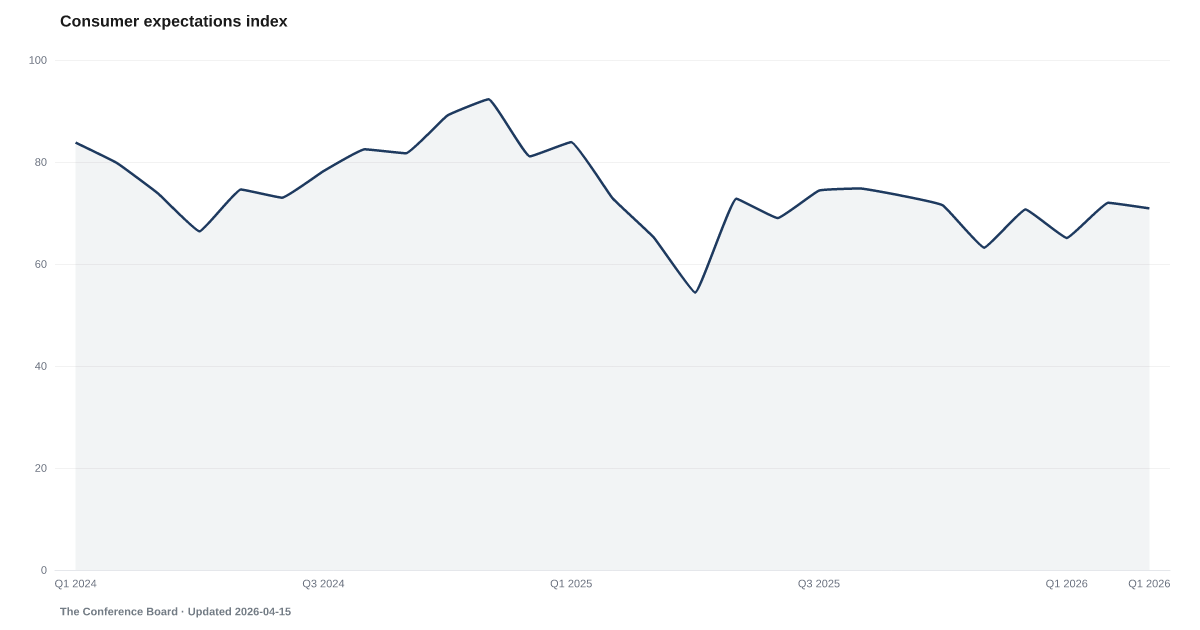
The Conference Board Consumer Expectations Index is 63.6 for September 2026, a preliminary reading. It averages how survey respondents see business conditions, jobs and their family income six months ahead, on a scale where 1985 equals 100. The Board treats readings below 80 as a recession warning. It is an index of survey answers, not a count or share of people. Source: The Conference Board, Consumer Confidence Survey.
Measurement basis: The Conference Board's Consumer Expectations Index, the forward-looking half of its Consumer Confidence Survey, covering how respondents see income, business conditions and employment over the next six months. The Conference Board treats a reading below eighty as signalling a recession ahead within the year; that threshold is the producer's, not ours. It marks elevated risk rather than a timer: the index has run below the line for long stretches without a recession following, including the current run.
The Conference Board's consumer expectations index was 63.6 in September 2026, a preliminary reading, about the same as the 68.2 of August 2026.
The Expectations Index averages three questions from the Conference Board's monthly Consumer Confidence Survey: what respondents expect for business conditions, jobs and their own family income six months from now. It is scaled so that the 1985 average equals 100. The September 2026 reading was 63.6, about the same as the 68.2 of August 2026, and it is preliminary: the Board replaces it with a final figure in next month's release. A year earlier, in September 2025, it was higher, at 73.4.
The Board treats a reading below 80 as a warning sign. Its releases have said such readings usually or historically signal a recession ahead, and the wording about timing has changed from year to year, so the line marks elevated risk rather than a date. The index is not the share of people who expect a recession: that is a separate survey question the Board leaves out of the index.
Preliminary figures can shift. The final figure has differed from the preliminary one by as much as 5.4 points (December 2024), and a July 2024 reading first published under 80 was revised to above it. We call a month-to-month change smaller than 5.4 points about the same. The survey switched from mail to an online panel in 2021, so levels from before and after that change are not strictly comparable.
The index measures expectations, not household finances: the Board's family financial situation questions are not part of it. A separate page tracks the University of Michigan's consumer sentiment survey, which asks different questions on a different scale, so its level cannot be set against this one.
Explore Further
Is this happening to you?
Are you putting off a major purchase because you're unsure about the next six months?
Conference Board Consumer Expectations Index over time: what has changed?

Counties with the highest debt burden scores
These are debt burden scores from our County Distress Index, not county readings of Conference Board Consumer Expectations Index.
Explore all 3,144 counties →| Period | Value | YoY Change |
|---|---|---|
| Sep 2026 | 63.6 | -9.8 |
| Aug 2026 | 68.2 | -6.6 |
| Jul 2026 | 74.7 | +0.3 |
| Jun 2026 | 74.4 | +5.4 |
| May 2026 | 74.4 | +1.6 |
| Apr 2026 | 73.4 | +19 |
| Mar 2026 | 71 | +5.8 |
| Feb 2026 | 72 | -0.9 |
| Jan 2026 | 65.1 | -18.8 |
| Dec 2025 | 70.7 | -10.4 |
| Nov 2025 | 63.2 | -29.1 |
| Oct 2025 | 71.5 | -17.6 |
Frequently Asked Questions
What is the Conference Board Consumer Expectations Index?
It is the forward-looking half of the Conference Board's Consumer Confidence Index: the average of three questions about business conditions, jobs and family income six months ahead. The September 2026 preliminary reading is 63.6. A year earlier, in September 2025, it was higher, at 73.4.
Does a reading below 80 mean a recession is coming?
Not on a set timetable. The Conference Board says readings below 80 usually or historically signal a recession ahead, but its wording on timing has varied, and it has not published a study setting out the evidence for the line. Treat it as the Board's warning level, not a prediction.
Where does the consumer expectations data come from?
The Conference Board publishes it monthly from its Consumer Confidence Survey, an online sample run by Toluna of about 3,000 responses a month under its 2021 design. The preliminary figure comes out on the last Tuesday of the month it covers, and the final figure a month later. Regional and state figures are not seasonally adjusted and there is no county data.


Quick poll
Is this affecting you or your household?
Discussion
Get the numbers when they move.
New data drops, indicator updates, and American Distress Index changes — delivered when it matters. No spam.
or Create an Account for full access
Loading comments…