Senior Loan Officer Survey: Banks Tightening Standards
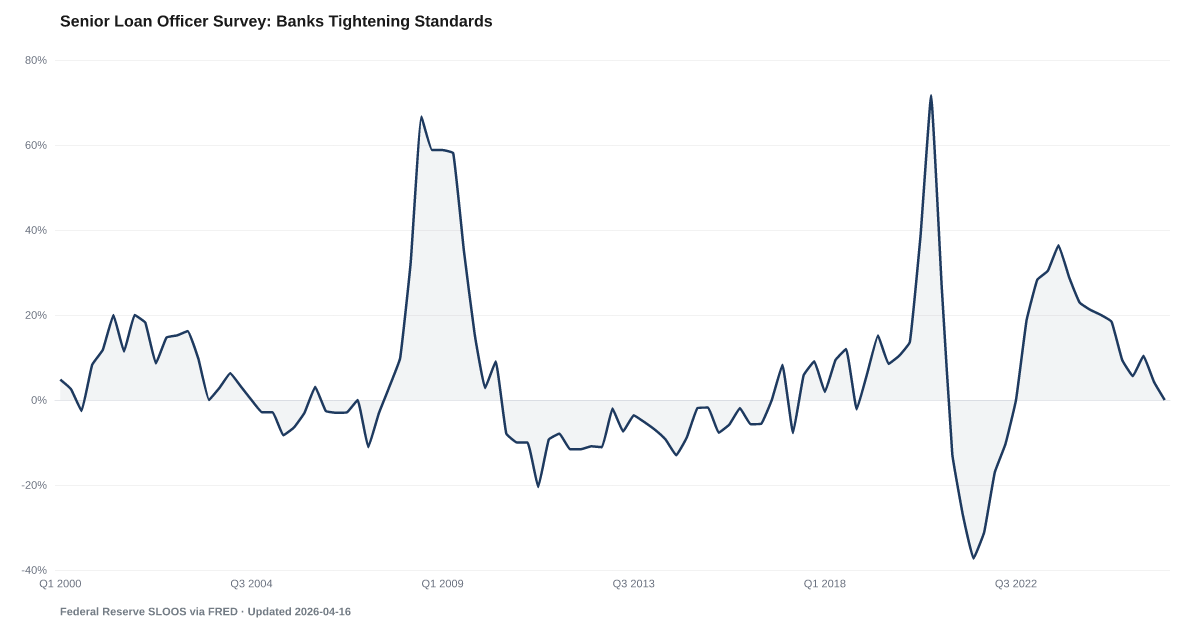
Net percentage of large U.S. banks tightening credit card approval standards
What is the current Senior Loan Officer Survey: Banks Tightening Standards reading?
The Senior Loan Officer Opinion Survey, run by the Board of Governors of the Federal Reserve System, put the net share of banks tightening credit card standards at 6.7% in Q3 2026, down from 10.4% a year earlier. The figure is the share of banks that made card approvals stricter over the prior three months minus the share that loosened them, so a positive reading means stricter standards on net, even when it is smaller than before. Source: Federal Reserve Board SLOOS data retrieved via FRED (DRTSCLCC).
On net, 6.7% of large banks tightened their standards for approving credit cards in the Federal Reserve's Q3 2026 loan officer survey, down from 10.4% a year earlier.
The Fed's Senior Loan Officer Opinion Survey asks banks whether their standards for approving credit card applications changed over the past three months. In the Q3 2026 survey, the share of banks reporting stricter standards minus the share reporting looser ones was 6.7%, so more banks tightened than eased. A year earlier the figure was 10.4%. The previous survey, Q2 2026, read 2%; the series is not adjusted for seasonal patterns, so part of a quarter-to-quarter move can be seasonal. It is the highest net percentage since Q3 2025.
The net percentage has been below its year-earlier reading for 11 quarters in a row.
Each survey asks about change, not about how strict standards are, and banks are told not to report a policy they kept as a change, however strict or loose it is. So a positive number means standards got stricter on net that quarter, even when it is smaller than before; standards loosen on net only when the number is below zero. About 45 banks answer the credit card question, so one bank is worth about 2 points. The Fed describes a net share of 0 to 5 as "basically unchanged," above 5 to 10 as modest, above 10 to 20 as moderate, above 20 and under 50 as significant, and 50 or more as major.
The question covers credit card approvals only. The same survey reports mortgages, auto loans and business loans separately, and asks about card terms such as credit limits and about loan demand in other questions. The panel is up to 80 large domestic banks, weighted toward the biggest, and the Fed added 20 banks to it in May 2012; credit unions and many specialized card issuers are not in it. The survey the Fed labels the third quarter is taken in July and covers roughly the second quarter. Credit card delinquency is tracked on its own page.
Explore Further
Is this happening to you?
Have you been denied credit or offered worse terms than you expected?
Senior Loan Officer Survey: Banks Tightening Standards over time: what has changed?

Counties with the highest debt burden scores
These are debt burden scores from our County Distress Index, not county readings of Senior Loan Officer Survey: Banks Tightening Standards.
Explore all 3,144 counties →| Period | Value | YoY Change |
|---|---|---|
| Q3 2026 | 6.7% | -3.7 pp |
| Q2 2026 | 2% | -3.6 pp |
| Q1 2026 | 0% | -9.4 pp |
| Q4 2025 | 4.2% | -14.2 pp |
| Q3 2025 | 10.4% | -9.6 pp |
| Q2 2025 | 5.6% | -15.6 pp |
| Q1 2025 | 9.4% | -13.5 pp |
| Q4 2024 | 18.4% | -10.5 pp |
| Q3 2024 | 20% | -16.4 pp |
| Q2 2024 | 21.2% | -9.2 pp |
| Q1 2024 | 22.9% | -5.4 pp |
| Q4 2023 | 28.9% | +10.1 pp |
Frequently Asked Questions
What does this survey measure?
It asks senior loan officers at the Fed's panel of large banks whether their standards for approving credit card applications got stricter, looser or stayed the same over the past three months. The number is the share tightening minus the share easing, counted by bank, not by dollars lent or by borrowers.
If the number falls, are banks easing?
Not unless it falls below zero. Each reading is a change over the prior three months, so a positive number, however small, means more banks made standards stricter than looser that quarter. A falling positive number means tightening is less widespread, not that standards got easier.
Where does the data come from, and when is it released?
The Federal Reserve Board runs the survey four times a year and usually releases it on the first Monday after a Federal Open Market Committee meeting, about five weeks after the quarter it covers. It does not report how many people were turned down for credit; consumer surveys, such as the New York Fed's, measure that.


Quick poll
Is this affecting you or your household?
Discussion
Get the numbers when they move.
New data drops, indicator updates, and American Distress Index changes — delivered when it matters. No spam.
or Create an Account for full access
Loading comments…