Motor Vehicle Insurance CPI
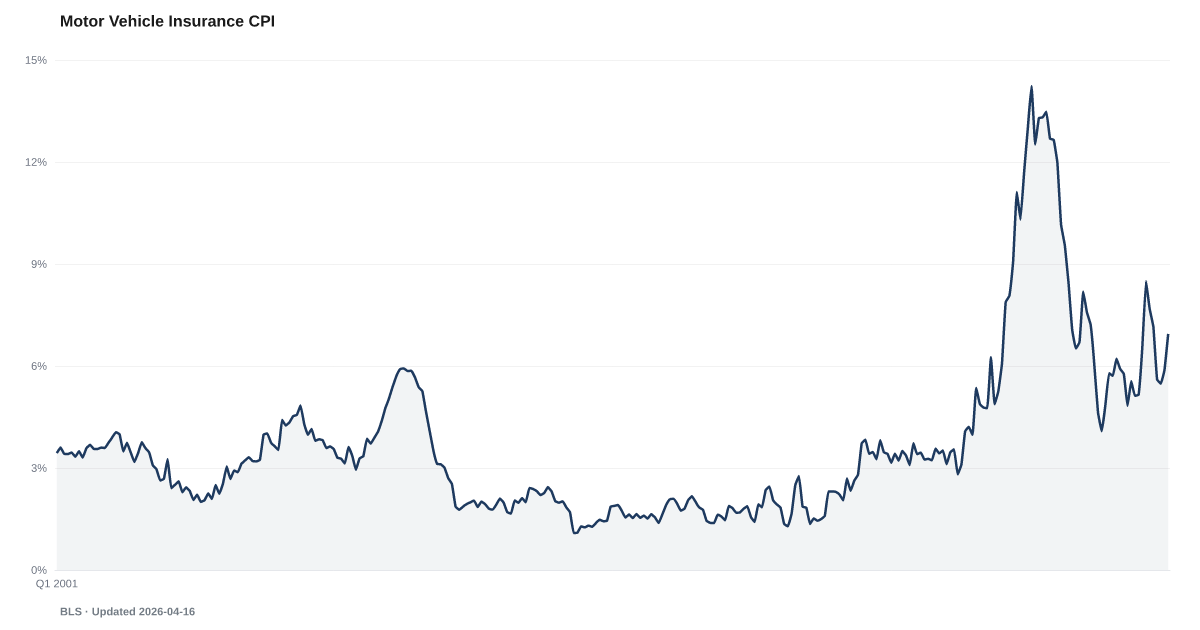
Year-over-year change in motor vehicle insurance prices
What is the current Motor Vehicle Insurance CPI reading?
Motor vehicle insurance prices in the U.S. Bureau of Labor Statistics consumer price index were 5.1% lower than a year earlier in August 2026, down from a 12-month change of 4.6% in August 2025. The index prices the same private car insurance policies each month, with the driver, vehicle and coverage held constant, so a household's own premium can move differently. Source: BLS CPI motor vehicle insurance (CUSR0000SETE), seasonally adjusted; 12-month change calculated by American Default Research.
Measurement basis: Year-over-year percent change computed from the seasonally adjusted Bureau of Labor Statistics Motor Vehicle Insurance CPI (CUSR0000SETE); seasonally adjusted values may be revised
Motor vehicle insurance prices fell 5.1% in the 12 months to August 2026, by our calculation from U.S. Bureau of Labor Statistics data.
The Bureau of Labor Statistics collects premiums from insurance companies each month for a sample of private car insurance policies, and follows the same policies over time. In August 2026 the premiums for those policies were 5.1% lower than a year earlier. On our seasonally adjusted measure, that is the lowest 12-month change since November 2020. The 12-month change is down from 4.6% in August 2025. A month earlier, in July 2026, the 12-month change was -4.5%.
The 12-month change has been below its year-earlier level in 23 monthly readings in a row.
A change below zero means the same policies cost less than they did a year earlier.
For each policy BLS keeps the driver, the car, where it is kept, how far it is driven and the coverage the same, from collision and comprehensive to liability, medical payments, uninsured motorist and personal injury protection. The index therefore tracks the price of the same coverage over time, and a household's own premium can move differently when its car, drivers, record or insurer change. Once a year, usually in October or November, BLS moves each sample car's model year forward by one so its age stays the same, and counts the premium change that follows as a price change. Business vehicles and farm policies are left out, and motorcycle policies are not priced.
We compute the 12-month change from the seasonally adjusted index, meaning BLS has removed the usual calendar swings. BLS headlines the 12-month change from the unadjusted index, so its figure can differ slightly, and it revises seasonally adjusted values for the previous five years each February. BLS published no figure for October or November 2025, the months of the federal government shutdown, so there will be no 12-month change for October or November 2026. The index covers urban consumers, over 90 percent of the U.S. population, and BLS publishes it for the nation only. Auto Insurance Inflation Premium sets this change against CPI Inflation Rate (All Items) month by month.
Explore Further
Motor Vehicle Insurance CPI over time: what has changed?

Counties with the highest debt burden scores
These are debt burden scores from our County Distress Index, not county readings of Motor Vehicle Insurance CPI.
Explore all 3,144 counties →| Period | Value | YoY Change |
|---|---|---|
| Aug 2026 | -5.1% | -9.7 pp |
| Jul 2026 | -4.5% | -9.7 pp |
| Jun 2026 | -4.1% | -10.3 pp |
| May 2026 | -2% | -8.9 pp |
| Apr 2026 | 0.2% | -6.2 pp |
| Mar 2026 | 0.8% | -6.7 pp |
| Feb 2026 | 0.2% | -10.9 pp |
| Jan 2026 | 0.5% | -11.3 pp |
| Dec 2025 | 2.8% | -8.5 pp |
| Sep 2025 | 3.2% | -13.1 pp |
| Aug 2025 | 4.6% | -11.9 pp |
| Jul 2025 | 5.2% | -13.3 pp |
Frequently Asked Questions
Are car insurance prices going up or down?
In August 2026, the BLS motor vehicle insurance index stood 5.1% below its level a year earlier, by our calculation from the seasonally adjusted series (CUSR0000SETE). A month earlier, in July 2026, the 12-month change was -4.5%.
Does this show what I pay for car insurance?
Not directly. The index follows the price of the same policies over time. What a household pays also moves with its own car, drivers, driving record, coverage and insurer, and those changes are left out of the index.
Where does motor vehicle insurance CPI data come from?
The Bureau of Labor Statistics publishes the motor vehicle insurance index every month in its consumer price index report, between the 10th and 14th of the following month. We use the seasonally adjusted series CUSR0000SETE and compute the change from 12 months earlier. The index is a U.S. city average; BLS does not publish it for states or counties, and it is not an input to the American Distress Index.


Quick poll
Is this affecting you or your household?
Discussion
Get the numbers when they move.
New data drops, indicator updates, and American Distress Index changes — delivered when it matters. No spam.
or Create an Account for full access
Loading comments…