Shelter CPI
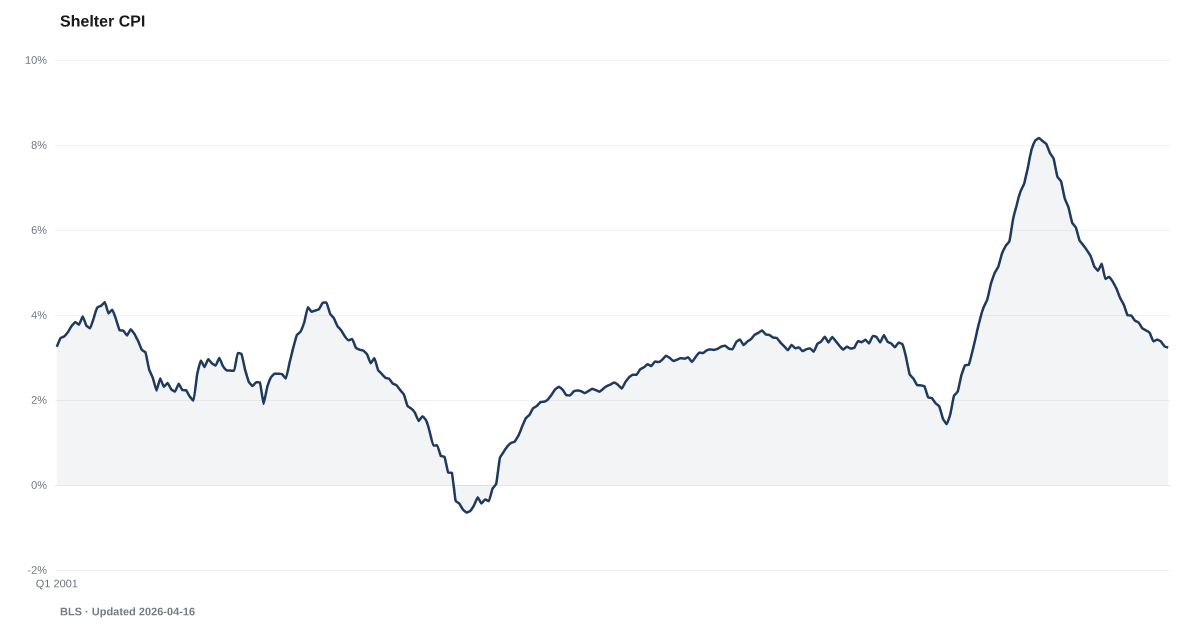
Year-over-year change in the shelter component of the CPI
What is the current Shelter CPI reading?
Shelter prices were 3% higher than a year earlier in August 2026, down from a rate of 3.6% in August 2025, according to the U.S. Bureau of Labor Statistics consumer price index for shelter. Shelter covers rent, the rent-equivalent value of owned homes, hotels and tenants' insurance for urban consumers; it does not include home prices or mortgage payments. Source: BLS CPI (CUSR0000SAH1), seasonally adjusted.
Measurement basis: Year-over-year percent change computed from the seasonally adjusted BLS Shelter CPI (CUSR0000SAH1); seasonally adjusted values may be revised
Shelter prices were 3% higher than a year earlier in August 2026, down from a rate of 3.6% in August 2025.
The Bureau of Labor Statistics shelter index tracks rents and the rent-equivalent value of owned homes for people in cities and suburbs. In August 2026 shelter prices were 3% higher than a year earlier. The yearly rate is down from 3.6% in August 2025. It edged down from 3.2% in July 2026, too small a move to call a turn. It is the lowest rate since August 2021.
A rate above zero means shelter prices are still going up, even when the rate is lower than before. They have not come down. In March 2023 the yearly rate was 8.2%.
Shelter is the largest item in the CPI basket, about 36% of its weight in December 2025. Most of it is owners' equivalent rent: BLS estimates what owned homes would rent for from the rents it collects on rented homes, so no homeowner pays it. Rent of primary residence is about a fifth of shelter; hotels and tenants' insurance make up the rest. The index leaves out home prices, mortgage payments and property taxes; the price of newly built homes is tracked separately in Median Sale Price of New Houses. It measures price change, not what any household pays or how hard it is to pay; a Census survey reports the share of households having difficulty paying usual expenses.
We compute the yearly change from the seasonally adjusted index, so it can differ slightly from the 12-month figure BLS headlines, which uses the unadjusted index. There is no figure for October 2025, when the federal government shutdown stopped data collection. BLS carried rents forward for that month, so the yearly changes for November 2025 through March 2026 understate the true change.
Explore Further
Shelter CPI over time: what has changed?

Counties with the highest debt burden scores
These are debt burden scores from our County Distress Index, not county readings of Shelter CPI.
Explore all 3,144 counties →| Period | Value | YoY Change |
|---|---|---|
| Aug 2026 | 3% | -0.6 pp |
| Jul 2026 | 3.2% | -0.5 pp |
| Jun 2026 | 3.3% | -0.5 pp |
| May 2026 | 3.4% | -0.5 pp |
| Apr 2026 | 3.3% | -0.7 pp |
| Mar 2026 | 3% | — |
| Feb 2026 | 3% | — |
| Jan 2026 | 3% | — |
| Dec 2025 | 3.2% | — |
| Nov 2025 | 3% | — |
| Sep 2025 | 3.6% | -1.2 pp |
| Aug 2025 | 3.6% | -1.6 pp |
Frequently Asked Questions
How fast are shelter prices changing?
Shelter prices were 3% higher than a year earlier in August 2026, down from a rate of 3.6% in August 2025, based on the seasonally adjusted BLS shelter index (CUSR0000SAH1).
Is shelter CPI the same as rent inflation?
No. Rent of primary residence is about a fifth of shelter's weight. Most of shelter is owners' equivalent rent, an estimate of what owned homes would rent for, taken from the rents BLS collects on rented homes. The index covers all leases, not only new ones, so it is not a measure of today's asking rents.
Where does shelter CPI data come from?
The Bureau of Labor Statistics publishes it every month in its consumer price index report. We use the seasonally adjusted series CUSR0000SAH1 and compute the change from a year earlier. BLS prices each sampled rental unit once every six months.


Quick poll
Is this affecting you or your household?
Discussion
Get the numbers when they move.
New data drops, indicator updates, and American Distress Index changes — delivered when it matters. No spam.
or Create an Account for full access
Loading comments…