Difficulty Paying Usual Household Expenses
Also tracked as The Pinch
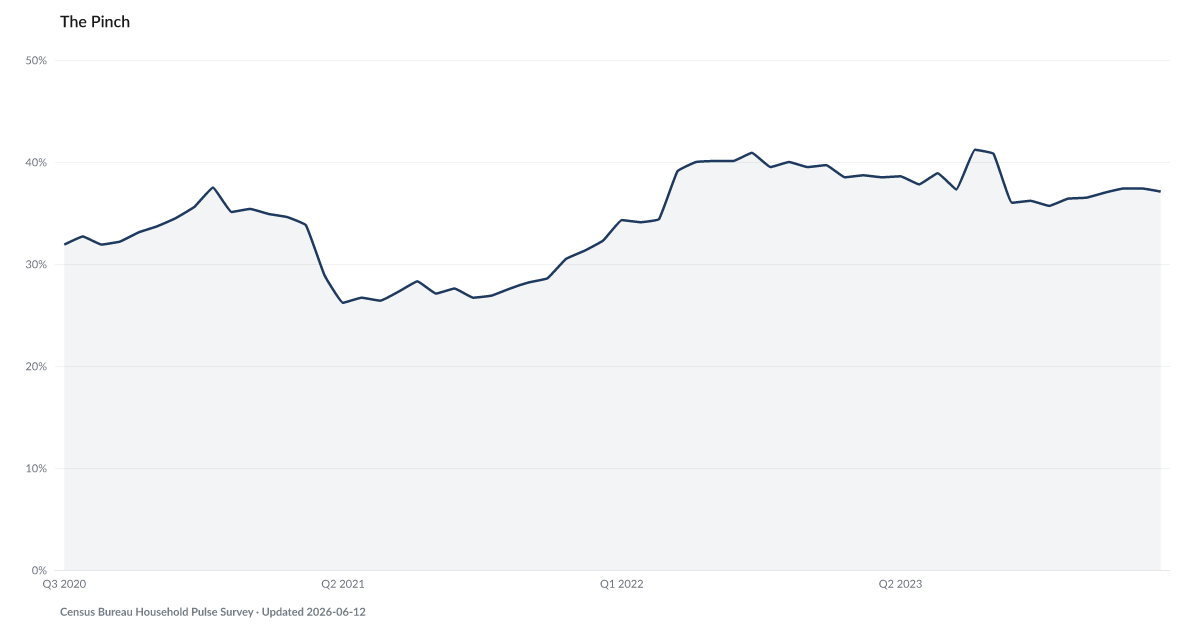
Share of U.S. adults reporting difficulty paying usual household expenses
What is the current Difficulty Paying Usual Household Expenses reading?
21.3% of U.S. adults said it had been somewhat or very difficult for their household to pay usual expenses over the last two months, in the U.S. Census Bureau's August 2026 Household Trends and Outlook Pulse Survey. Census changed the survey design after September 2024 and again in March 2026, so earlier readings are not comparable. The share is our calculation from Census's published counts of adults. Source: Census Bureau Household Pulse Survey.
In Census's August 2026 survey, 21.3% of U.S. adults said it had been somewhat or very difficult for their household to pay usual expenses over the last two months.
The Census Bureau asks adults how difficult it has been for their household to pay usual expenses, such as food, rent or a mortgage, car payments, medical bills and student loans. This page counts those who answered somewhat or very difficult, as a share of adults who answered. Census publishes the counts; the share is our calculation. It was 22.7% in the March 2026 collection, a gap under 2 points that this survey cannot tell apart from sampling error or seasonal swings.
The history behind the current number is three different surveys. Through September 2024 the question ran in the Household Pulse Survey, which asked about the last seven days and drew a fresh sample each time; its last reading was 37.1%. Census then carried the question into the Household Trends and Outlook Pulse Survey, which asks about the last two months and in 2025 followed a panel of the same people; its one published 2025 reading, for June, was 19.8%. In March 2026 Census went back to a fresh sample for each collection. Each change alters what is asked or who answers, so none of these figures can be subtracted from another.
Census asks no reason for the difficulty, so the survey cannot say what caused any change. It counts adults in housing units, each carrying their household's answer, so it is not a count of households. Census calls the survey experimental, and with about 12,500 respondents and a response rate near 10%, it asks users to take care with small differences.
The paycheck-to-paycheck rate and emergency-savings surveys look at household strain through other questions and other samples. They add context; they do not confirm or contradict this figure.
Explore Further
Difficulty Paying Usual Household Expenses over time: what has changed?

Counties with the highest safety net and buffer scores
These are safety net and buffer scores from our County Distress Index, not county readings of Difficulty Paying Usual Household Expenses.
Explore all 3,144 counties →| Period | Value | YoY Change |
|---|---|---|
| Aug 2026 | 21.3% | — |
| Mar 2026 | 22.7% | — |
| Jun 2025 | 19.8% | — |
| Sep 2024 | 37.1% | -0.2 pp |
| Aug 2024 | 37.4% | -1.5 pp |
| Jul 2024 | 37.4% | -0.4 pp |
| Jun 2024 | 37% | -1.6 pp |
| May 2024 | 36.5% | -2 pp |
| Apr 2024 | 36.4% | -2.1 pp |
| Apr 2024 | 35.7% | -3 pp |
| Mar 2024 | 36.2% | -2.3 pp |
| Feb 2024 | 36% | -3.7 pp |
How to read this series
The source changed how it measures this in Jun 2025. The Household Pulse Survey ended in September 2024. Census moved the question into the Household Trends and Outlook Pulse Survey, which followed a panel of the same people and asked about the last two months instead of the last seven days. Readings before and after ask a different question of a different sample. Readings on either side are not directly comparable, so the year-over-year column stays blank where a comparison would cross that date. Source documentation.
The source changed how it measures this in Mar 2026. Census went back to a fresh sample for each collection, after following a panel of the same people in 2025. The question still asks about the last two months, but readings before and after sit on different samples. Readings on either side are not directly comparable, so the year-over-year column stays blank where a comparison would cross that date. Source documentation.
Frequently Asked Questions
What share of Americans have trouble paying usual household expenses?
In the August 2026 collection, 21.3% of adults said paying usual household expenses had been somewhat or very difficult for their household over the last two months. That leaves out adults who said it was a little difficult, so the share reporting any difficulty is larger.
Is household-expense difficulty getting worse?
The current data cannot say yet. The March 2026 collection was the first on the current survey design, and earlier readings came from different questions or samples, so they are not comparable.
Does this count households?
No. Census weights count adults 18 and older in housing units, each carrying their household's answer. A count of adults is not a count of households, and people in group quarters, such as dorms and nursing homes, are outside the survey.
How does Census measure this?
Census mails invitations to a sample of addresses, and most people answer online. Answers are weighted to Census population controls. The Household Pulse Survey ran in weekly, two-week and then four-week cycles from 2020 to September 2024 and asked about the last seven days. The Household Trends and Outlook Pulse Survey asks about the last two months and, in 2026, collects in alternate months. Tables come out on no fixed schedule, and Census re-posts them when it corrects the weights.

Quick poll
Is this affecting you or your household?
Discussion
Get the numbers when they move.
New data drops, indicator updates, and American Distress Index changes — delivered when it matters. No spam.
or Create an Account for full access
Loading comments…