SHED Emergency Savings Survey
Also tracked as The $400 Test
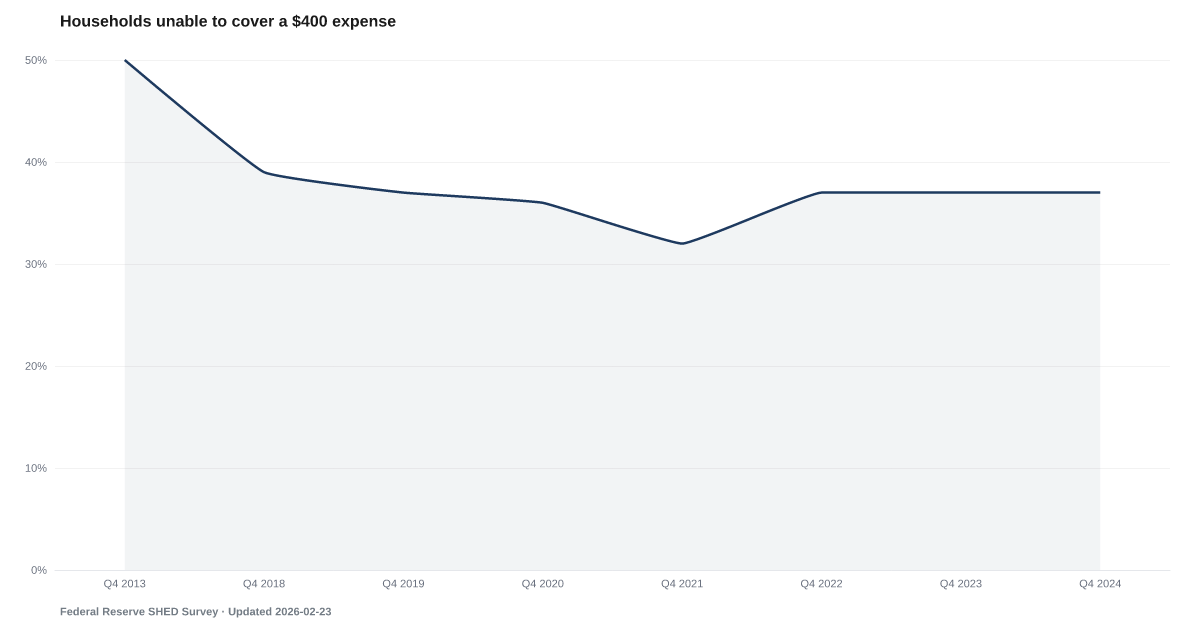
37% in 2025, the same as in 2024
What is the current SHED Emergency Savings Survey reading?
37% of U.S. adults would not pay a $400 emergency expense entirely with cash or its equivalent in the fall 2025 Survey of Household Economics and Decisionmaking (SHED), according to the Board of Governors of the Federal Reserve System. The share was the same in 2024. Most of them said they would pay another way, such as carrying a credit card balance or borrowing; a smaller group said they could not pay at all. Source: Board of Governors of the Federal Reserve System Survey of Household Economics and Decisionmaking (fielded each fall, published the following May).
In the Fed's fall 2025 survey, 37% of U.S. adults would not pay a $400 emergency expense entirely with cash or its equivalent.
The Federal Reserve's Survey of Household Economics and Decisionmaking asks adults how they would pay a hypothetical $400 emergency expense. In the fall 2025 survey, published the following May, 37% chose at least one way other than cash, money in a bank account, or a credit card paid off in full at the next statement. The share was the same in 2024.
The share has been the same as the year before for three years in a row.
The question asks how people would pay, not whether they have $400. Most of the people in this share said they would pay some other way, such as carrying a credit card balance, borrowing from family or friends, or selling something. A smaller group, 12% of adults in the 2025 survey, said they could not pay the expense right now by any means. The $400 amount has not been adjusted for inflation since the Fed first asked in 2013, but a 2022 test that asked some people about $500 instead gave nearly the same answer.
Bankrate's emergency savings survey asks how adults say they would pay a $1,000 emergency. The Fed's SHED survey asks how adults would pay a $400 expense and counts cash or its equivalent. The questions, samples and methods differ, so one survey does not confirm or contradict the other.
Explore Further
Is this happening to you?
Could you handle a $400 unexpected expense right now?
SHED Emergency Savings Survey over time: what has changed?

Counties with the highest safety net and buffer scores
These are safety net and buffer scores from our County Distress Index, not county readings of SHED Emergency Savings Survey.
Explore all 3,144 counties →| Period | Value | YoY Change |
|---|---|---|
| 2025 | 37% | 0 pp |
| 2024 | 37% | 0 pp |
| 2023 | 37% | 0 pp |
| 2022 | 37% | +5 pp |
| 2021 | 32% | -4 pp |
| 2020 | 36% | -1 pp |
| 2019 | 37% | -2 pp |
| 2018 | 39% | — |
| 2013 | 50% | — |
Frequently Asked Questions
What share of U.S. adults would not pay a $400 emergency with cash?
In the Federal Reserve's fall 2025 survey, 37% of U.S. adults would not pay a $400 emergency expense entirely with cash or its equivalent. The share was the same in 2024. This is not the share who cannot pay: most of them said they would pay another way, and 12% of adults in the 2025 survey said they could not pay at all.
Has the $400 figure changed over time?
The Fed has asked the question every year since 2013. The share has been the same as the year before for three years in a row. In 2021 the share was 32%. The Fed says the 2021 reading may reflect improving economic conditions and pandemic relief measures; it does not name a single cause.
What do people say they would do instead of paying with cash?
In the 2025 survey, 15% of all adults said they would put the expense on a credit card and pay it off over time, and 12% said they could not pay it right now. Others would borrow from family or friends, use a bank loan or line of credit, or sell something. People could pick more than one answer, so the shares overlap.
What is the Fed SHED survey?
The Survey of Household Economics and Decisionmaking (SHED) is an annual Federal Reserve survey of U.S. adults about their finances. It is fielded each fall and published the following May. Answers describe conditions at the time of the survey, not a full-year average.


Quick poll
Is this affecting you or your household?
Discussion
Get the numbers when they move.
New data drops, indicator updates, and American Distress Index changes — delivered when it matters. No spam.
or Create an Account for full access
Loading comments…