Vanguard Hardship Withdrawal Rate
Also tracked as The Cannibalization Rate
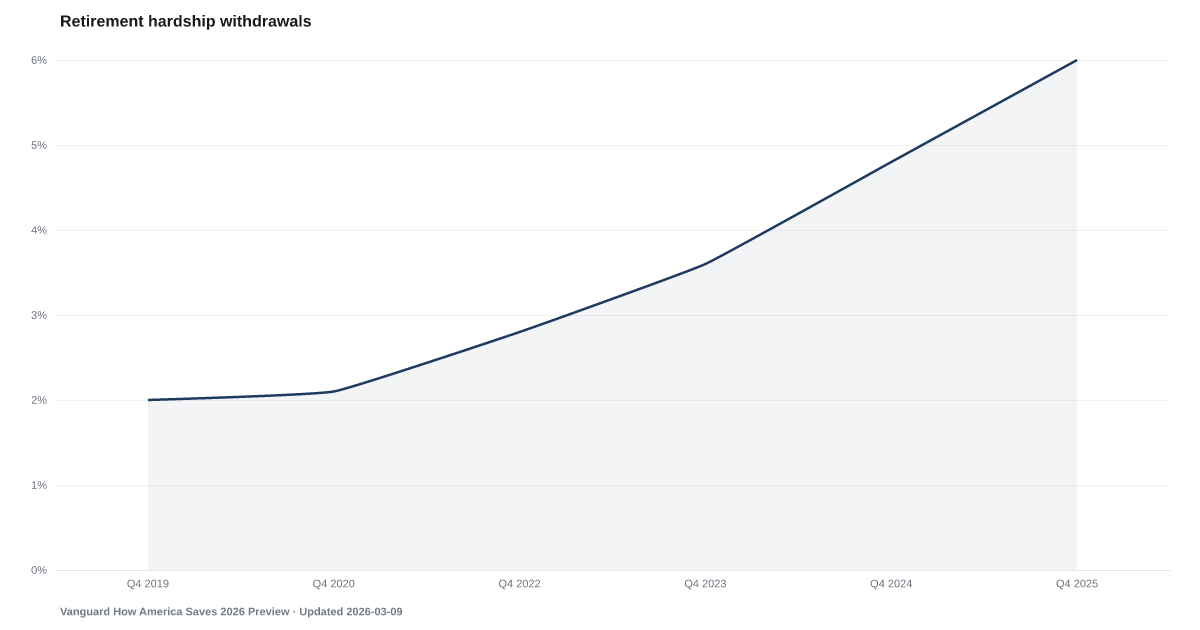
6% in 2025, compared with 5% in 2024
What is the current Vanguard Hardship Withdrawal Rate reading?
6% of participants in Vanguard-administered plans that offer hardship withdrawals took at least one in 2025, according to Vanguard's How America Saves. That is up from 5% in 2024. The rate covers Vanguard's client plans, not all U.S. workers. Source: Vanguard How America Saves.
Measurement basis: Share of participants eligible for a hardship withdrawal who took at least one during the year, in Vanguard-recordkept defined contribution plans, from Vanguard's How America Saves. It counts participants who took a withdrawal rather than the number of withdrawals, and covers the plans Vanguard administers rather than all U.S. retirement savers.
In 2025, 6% of eligible participants in Vanguard-administered retirement plans took at least one hardship withdrawal.
Vanguard's How America Saves reports that 6% of participants in the workplace plans it administers that allow hardship withdrawals took at least one in 2025. That is up from 5% in 2024. It is the highest yearly rate from 2021 on, the years measured under the same rules. Vanguard says plan design, easier administration and federal rule changes, not only household strain, have led to higher rates.
Federal hardship rules changed between 2018 and 2020. Plans no longer had to make participants take a loan first or stop their contributions after a withdrawal, and more Vanguard plans began to offer the option. In 2020, participants could also take separate coronavirus-related distributions instead. So 2021 is the first year that compares like for like with later years, and the comparisons on this page start there.
The rate covers participants in the more than 1,300 plans Vanguard administers that offer hardship withdrawals, not all U.S. workers or 401(k) savers, and that group of plans changes every year. It counts people, not withdrawals or dollars: a participant who took several withdrawals counts once. Each How America Saves edition reports the previous calendar year.
A Bankrate survey reports how adults said they would pay a $1,000 emergency, while a separate page tracks the national personal savings rate. These separate measures give household-finance context, but neither shows what caused hardship withdrawal rates to change.
Explore Further
Is this happening to you?
Have you taken money out of your retirement account to cover a current expense?
Vanguard Hardship Withdrawal Rate over time: what has changed?

Counties with the highest safety net and buffer scores
These are safety net and buffer scores from our County Distress Index, not county readings of Vanguard Hardship Withdrawal Rate.
Explore all 3,144 counties →| Period | Value | YoY Change |
|---|---|---|
| 2025 | 6% | +1 pp |
| 2024 | 5% | +1 pp |
| 2023 | 4% | +1 pp |
| 2022 | 3% | +1 pp |
| 2021 | 2% | — |
| 2020 | 2% | — |
| 2019 | 2.3% | — |
How to read this series
The source changed how it measures this in 2020. Federal hardship-withdrawal rules that dropped the loan-first requirement and the six-month contribution suspension became mandatory for distributions from January 1, 2020, and Vanguard reports that more of its plans offered hardship withdrawals that year, so earlier years were measured under different rules and a different group of plans. Readings on either side are not directly comparable, so the year-over-year column stays blank where a comparison would cross that date. Source documentation.
Frequently Asked Questions
What is the current 401(k) hardship withdrawal rate?
6% of participants in Vanguard-administered plans that offer hardship withdrawals took at least one in 2025, according to Vanguard's How America Saves. That is up from 5% in 2024. It covers Vanguard's client plans, not every 401(k) plan.
What drives hardship withdrawal rates?
Vanguard says plan design, more efficient administrative options and regulatory changes, not only household strain, have led to higher rates, and that inflation and higher interest rates may contribute. It also finds much higher use in plans that let participants self-certify a hardship than in plans that require documents. The series alone does not identify one cause. The IRS hardship-distribution FAQs explain that the Bipartisan Budget Act of 2018 and final hardship regulations changed the federal access rules; the series does not show that either caused the change.
What are the taxes and penalties on a 401(k) hardship withdrawal?
Previously untaxed hardship withdrawals are generally included in income. An additional 10% tax may apply before age 59½ unless an exception applies, and the net amount depends on the participant's circumstances. Unlike a plan loan, a hardship withdrawal cannot be paid back into the account.
Where does the hardship withdrawal data come from?
Vanguard's annual How America Saves report tabulates Vanguard's own recordkeeping data for more than 1,300 plans and nearly 5 million participants. It is not a survey, and it covers Vanguard's clients only. Each edition reports the previous calendar year.


Quick poll
Is this affecting you or your household?
Discussion
Get the numbers when they move.
New data drops, indicator updates, and American Distress Index changes — delivered when it matters. No spam.
or Create an Account for full access
Loading comments…