Personal Saving Rate
Also tracked as The Buffer
Personal saving as a share of disposable personal income
What is the current Personal Saving Rate reading?
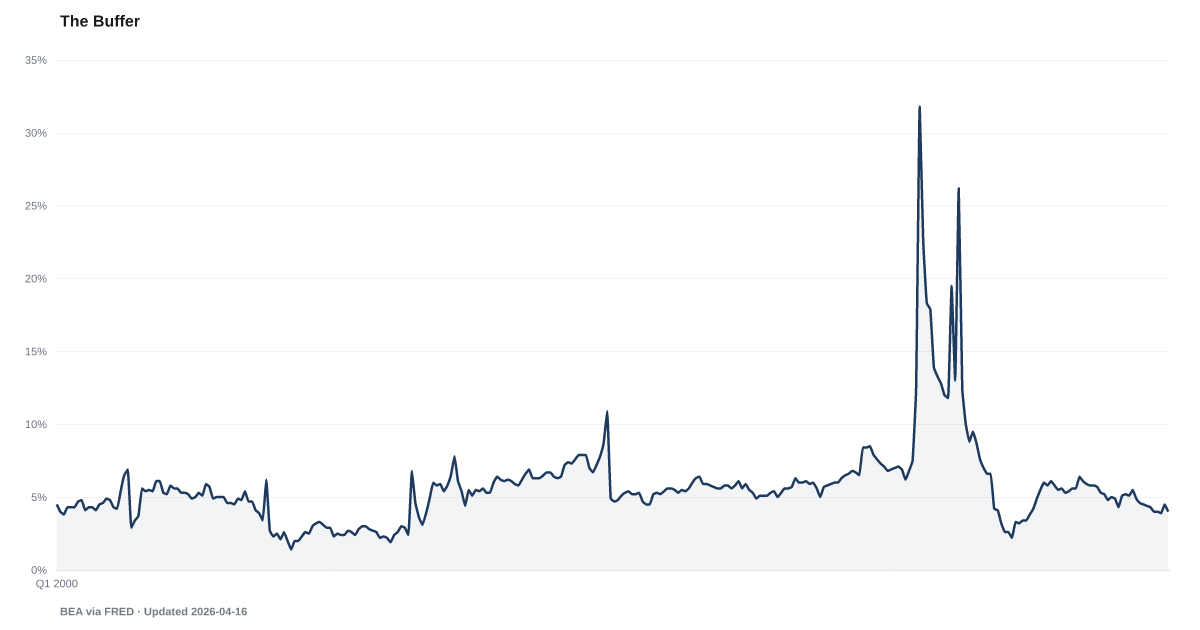
The U.S. personal saving rate was 4.1% of disposable personal income in August 2026, according to the U.S. Bureau of Economic Analysis, down from 5.2% a year earlier. From 2015 through 2019 it averaged 6.1%. Source: BEA Personal Income and Outlays (FRED PSAVERT).
The personal saving rate was 4.1% of disposable personal income in August 2026, down from 5.2% a year earlier.
The Bureau of Economic Analysis put the personal saving rate at 4.1% of disposable personal income in August 2026, down from 4.6% in July 2026. That is lower than a year earlier, when it was 5.2%. It is the lowest rate since November 2022.
From 2015 through 2019 the rate averaged 6.1%. Of the 812 months since 1959, the latest ranks 63rd from the bottom.
The rate is what is left of after-tax income once spending, interest payments and transfers are paid, as a share of that income. It is a monthly flow, not money in the bank, and it is one total for all households and nonprofits, not what a typical family saves. Income here counts wages plus benefits, interest, dividends, rental income and some imputed items, so it is not a share of paychecks. Stock and home-value gains are left out.
BEA revises the rate often. Each monthly release revises recent months, and the September annual update can rewrite the past five years. Some first estimates have later been revised by 2 to 3 percentage points, so the newest month is not settled. Emergency-savings surveys and 401(k) hardship withdrawals track other parts of household finances, with different populations and methods.
Explore Further
Is this happening to you?
How much of your income are you able to save each month?
Personal Saving Rate over time: what has changed?

Counties with the highest safety net and buffer scores
These are safety net and buffer scores from our County Distress Index, not county readings of Personal Saving Rate.
Explore all 3,144 counties →| Period | Value | YoY Change |
|---|---|---|
| Aug 2026 | 4.1% | -1.1 pp |
| Jul 2026 | 4.6% | -0.7 pp |
| Jun 2026 | 4.4% | -1.1 pp |
| May 2026 | 4.4% | -1.3 pp |
| Apr 2026 | 4.4% | -1.8 pp |
| Mar 2026 | 5.1% | -0.6 pp |
| Feb 2026 | 5.3% | -0.4 pp |
| Jan 2026 | 5.6% | -0.1 pp |
| Dec 2025 | 5% | -0.1 pp |
| Nov 2025 | 4.9% | -0.8 pp |
| Oct 2025 | 4.9% | -0.9 pp |
| Sep 2025 | 5.1% | -0.6 pp |
Frequently Asked Questions
What is the current U.S. personal savings rate?
The personal saving rate was 4.1% of disposable personal income in August 2026, according to the Bureau of Economic Analysis, down from 4.6% in July 2026. That is lower than a year earlier, when it was 5.2%. From 2015 through 2019 it averaged 6.1%.
Does the saving rate show how much money Americans have saved?
No. It is the share of this month's after-tax income that was not spent, a flow, not a balance in savings accounts. It is also one total for the whole country, so it says nothing about how saving is spread across households.
How is the personal savings rate used in the American Distress Index?
It is the only member of the Safety Net & Buffer domain, one of five equal-weighted domains. Each quarter is scored as a percentile of the rate's own quarterly history, inverted so that a lower saving rate reads as higher distress.
Where does the personal savings rate data come from?
The Bureau of Economic Analysis publishes it monthly in the Personal Income and Outlays report, about a month after the month ends. We track it through the FRED series PSAVERT. BEA's annual update each September can revise the past five years.


Quick poll
Is this affecting you or your household?
Discussion
Get the numbers when they move.
New data drops, indicator updates, and American Distress Index changes — delivered when it matters. No spam.
or Create an Account for full access
Loading comments…