Top vs Bottom Income Quartile Spending Gap
Also tracked as The Divergence
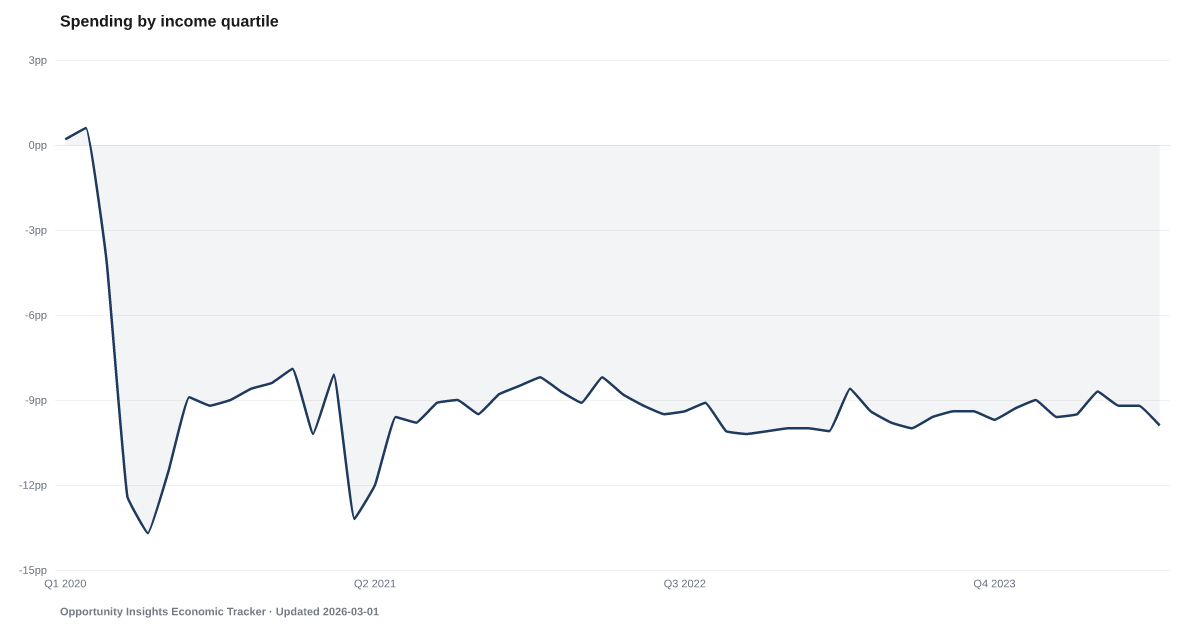
Top-quartile minus bottom-quartile spending growth sits at -13.9 percentage points
What is the current Top vs Bottom Income Quartile Spending Gap reading?
The gap in card spending growth between the top and bottom income-quartile ZIP codes was -13.9 percentage points in June 2026, compared with -10.5 percentage points in June 2025, in Opportunity Insights data. Each group's growth is measured from its own January 2020 level; a negative gap means spending in the bottom-income-quartile ZIP codes has grown more, a positive one the reverse. The groups are ZIP codes, not households, and the data cover card spending only. Source: Opportunity Insights Economic Tracker (Affinity Solutions data), gap calculated by American Default Research.
As of June 2026, card spending in the lowest-income quarter of ZIP codes had grown 13.9 percentage points more since January 2020 than in the highest-income quarter, in Opportunity Insights data.
Opportunity Insights publishes card spending for people in the richest and poorest quarters of U.S. ZIP codes, each measured against its own January 2020 level. Subtracting the bottom quartile's growth from the top quartile's gives -13.9 percentage points for June 2026. A year earlier, in June 2025, the gap was -10.5 percentage points, so it has moved 3.4 percentage points in favor of the lowest-income ZIP codes. The gap was -9.3 percentage points a month earlier; month-to-month moves can include seasonal swings, which is why we compare with a year earlier. The latest month is provisional and is revised at the next update.
The data are credit and debit card purchases from Affinity Solutions, processed by Opportunity Insights. Each cardholder is placed in a quartile by the median household income of the ZIP code where they live, using 2014-2018 Census survey data. The bottom quartile's cut-off is roughly $46,000 a year and the top quartile's roughly $78,000. Each quartile's spending is compared with its own spending from January 6 to February 2, 2020, and adjusted for seasonal patterns against 2019.
A negative gap does not mean people in low-income ZIP codes spend more dollars; each group is measured against its own starting point, and people in high-income ZIP codes spent far more per day at the start. The figures are not adjusted for inflation, leave out spending not made by card, such as rent and car purchases, and do not describe individual households. Opportunity Insights states no cause for the gap, and changes in which card providers are in the sample can move it.
Opportunity Insights rewrites earlier months at each monthly update, and has published this national monthly file only since June 2025. Its older weekly file, which stopped in June 2024, gives different values for the same months, so the two should not be joined. The paycheck-to-paycheck rate looks at household budgets from a different source.
Explore Further
Top vs Bottom Income Quartile Spending Gap over time: what has changed?

Counties with the highest debt burden scores
These are debt burden scores from our County Distress Index, not county readings of Top vs Bottom Income Quartile Spending Gap.
Explore all 3,144 counties →| Period | Value | YoY Change |
|---|---|---|
| Jun 2026 | -13.9 pp | -3.4 pp |
| May 2026 | -9.3 pp | +0.9 pp |
| Apr 2026 | -11.3 pp | -0.2 pp |
| Mar 2026 | -9.8 pp | -0.2 pp |
| Feb 2026 | -10.4 pp | -1.7 pp |
| Jan 2026 | -12.8 pp | -0.5 pp |
| Dec 2025 | -15.3 pp | -1.2 pp |
| Nov 2025 | -9.3 pp | +0.7 pp |
| Oct 2025 | -9.3 pp | -0.8 pp |
| Sep 2025 | -9.9 pp | -2.1 pp |
| Aug 2025 | -9.9 pp | -0.8 pp |
| Jul 2025 | -11.2 pp | -1.7 pp |
Frequently Asked Questions
What does the spending gap measure?
It subtracts one growth figure from another. Opportunity Insights reports how much card spending has grown since January 2020 for people living in the lowest-income and highest-income quarters of ZIP codes. The gap is the top quartile's growth minus the bottom quartile's: -13.9 percentage points in June 2026.
Does a negative gap mean low-income households are spending more?
Not in dollars. Each group is measured against its own spending in early 2020, so a negative gap means spending in low-income ZIP codes has grown more from its own starting point. Incomes are not observed for each cardholder; the groups are ZIP codes, and the figures cover card spending only, not adjusted for inflation.
Where does this data come from?
Opportunity Insights, a research group, publishes the quartile spending series in its Economic Tracker, built from Affinity Solutions card data. The national monthly file has updated about once a month since June 2025, with no fixed schedule, and each update revises earlier months. American Default Research calculates the gap.


Quick poll
Is this affecting you or your household?
Discussion
Get the numbers when they move.
New data drops, indicator updates, and American Distress Index changes — delivered when it matters. No spam.
or Create an Account for full access
Loading comments…