Unbanked Household Rate (FDIC)
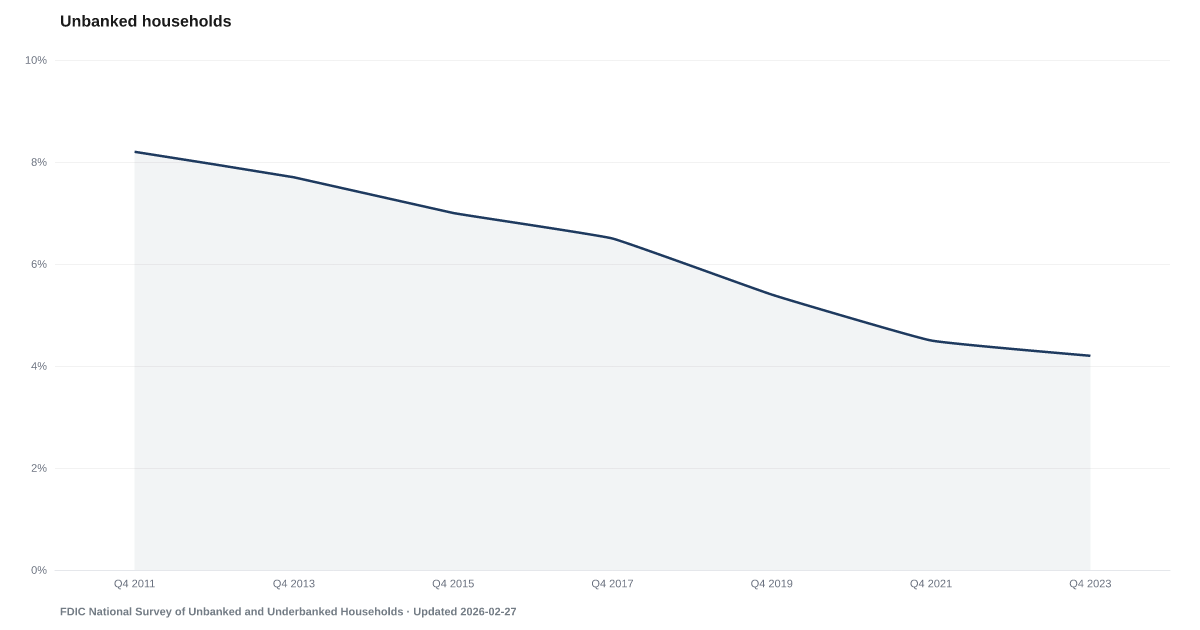
4.2% in 2023, about the same as the 4.5% of 2021
What is the current Unbanked Household Rate (FDIC) reading?
In June 2023, 4.2% of U.S. households had no checking or savings account at a bank or credit union, according to the Federal Deposit Insurance Corporation's National Survey of Unbanked and Underbanked Households. That is about the same as the 4.5% of 2021. The survey runs every two years with the U.S. Census Bureau.
4.2% of U.S. households had no bank account in the FDIC's 2023 survey, the lowest estimate in any survey since 2011.
The FDIC's National Survey of Unbanked and Underbanked Households turns on one question: does anyone in the household have a checking or savings account now? In June 2023, 4.2% of households said no. It was 4.5% in 2021, a difference too small to call a change in this survey.
The rate was 8.2% in 2011. The FDIC says about two-thirds of the drop between 2011 and 2023 was associated with changes in households' socioeconomic circumstances; it does not name a single cause.
The rate counts households, not people. One account held by anyone in the household makes the whole household banked, so adults without an account of their own can live in a banked household. Prepaid cards and payment apps such as PayPal, Venmo or Cash App do not count as bank accounts, and about a third of unbanked households used them. Asked for their main reason, unbanked households most often said they did not have enough money to meet minimum balance requirements; the next most common answer was not trusting banks.
The FDIC also tracks underbanked households: those with an account that used at least one of eight nonbank services, such as a check casher, payday lender or pawn shop, in the past year. That is a separate rate, not part of this series, and the FDIC says it cannot be compared across recent surveys because the questions changed.
Explore Further
Is this happening to you?
Do you or someone you know rely on check-cashing or prepaid cards instead of a bank account?
Unbanked Household Rate (FDIC) over time: what has changed?

Counties with the highest safety net and buffer scores
These are safety net and buffer scores from our County Distress Index, not county readings of Unbanked Household Rate (FDIC).
Explore all 3,144 counties →| Period | Value | YoY Change |
|---|---|---|
| 2023 | 4.2% | — |
| 2021 | 4.5% | — |
| 2019 | 5.4% | — |
| 2017 | 6.5% | — |
| 2015 | 7% | — |
| 2013 | 7.7% | — |
| 2011 | 8.2% | — |
Frequently Asked Questions
How many U.S. households don't have a bank account?
The FDIC's latest survey, from June 2023, puts the share at 4.2% of U.S. households. The rate counts households, not people: if anyone in the home has a checking or savings account, the household counts as banked.
What does 'underbanked' mean?
An underbanked household has a bank account but used at least one of eight nonbank financial services in the past 12 months, such as a check casher, payday lender, pawn shop or rent-to-own store. It is a separate FDIC measure from the unbanked rate on this page.
Is the unbanked rate going down?
The 2023 rate was 4.2%, about the same as the 4.5% of 2021, a difference too small to call a change in this survey. In 2011 it was 8.2%.
Where does the unbanked data come from?
The FDIC runs its National Survey of Unbanked and Underbanked Households every two years as a supplement to the Census Bureau's Current Population Survey. It is fielded in June of odd-numbered years and published in the fall of the following year.


Quick poll
Is this affecting you or your household?
Discussion
Get the numbers when they move.
New data drops, indicator updates, and American Distress Index changes — delivered when it matters. No spam.
or Create an Account for full access
Loading comments…