States with Credit Card Delinquency Above 10%
Also tracked as The Spread
Count of states, plus DC, where credit card delinquency exceeds 10%
What is the current States with Credit Card Delinquency Above 10% reading?
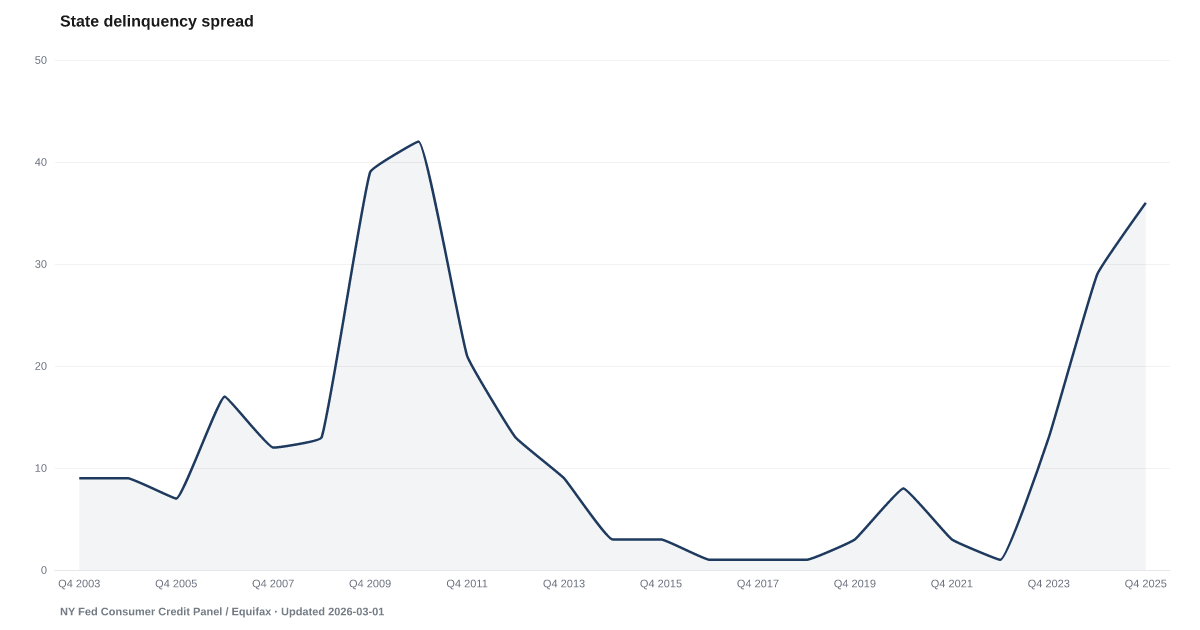
36 states, counting the District of Columbia, had more than 10% of their credit card balances 90 or more days delinquent at the end of 2025, up from 29 a year earlier. American Default Research counts them from the New York Fed's state credit card delinquency data, built from a sample of Equifax credit reports. Source: Federal Reserve Bank of New York Consumer Credit Panel / Equifax.
At the end of 2025, more than 10% of credit card balances were 90 or more days late in 36 states, counting DC, up from 29 a year earlier.
The New York Fed publishes, for each state, the share of credit card balances on credit reports that are 90 or more days late at the end of the year. American Default Research counts how many states, plus the District of Columbia, are above 10%. For 2025 the count was 36, up from 29 in 2024. That is the most since 2010.
The count has been higher than the year before for three years in a row. For comparison, the count was 3 in 2019 and 42 in 2010, when the set also included Puerto Rico.
Each state figure is a stock, meaning it counts every card balance that is 90 or more days late at year end, including charged-off debt that lenders still report. So a higher count does not by itself mean more people are newly missing payments. It is also a share of dollars, not of people or accounts.
The state figures come from a 5% random sample of Equifax credit reports, so they carry sampling error. A state within a few tenths of a point of 10% can land on either side of the line from one year to the next, so this page treats a change of one state as little change.
For card delinquency nationwide, see Credit Card Delinquency, a Federal Reserve measure of bank-held card loans 30 or more days late, and the total delinquency rate for all household debt. Both are measured differently from the state figures here.
Explore Further
States with Credit Card Delinquency Above 10% over time: what has changed?

Counties with the highest safety net and buffer scores
These are safety net and buffer scores from our County Distress Index, not county readings of States with Credit Card Delinquency Above 10%.
Explore all 3,144 counties →| Period | Value | YoY Change |
|---|---|---|
| 2025 | 36 | +7 |
| 2024 | 29 | +16 |
| 2023 | 13 | +12 |
| 2022 | 1 | -2 |
| 2021 | 3 | -5 |
| 2020 | 8 | +5 |
| 2019 | 3 | +2 |
| 2018 | 1 | 0 |
| 2017 | 1 | 0 |
| 2016 | 1 | -2 |
| 2015 | 3 | 0 |
| 2014 | 3 | -6 |
Frequently Asked Questions
How many states have double-digit credit card delinquency?
At the end of 2025, 36, counting the District of Columbia. A state is counted when more than 10% of its credit card balances are 90 or more days late; the New York Fed publishes the state percentages, and the count is American Default's. It ranks third highest among the 23 years since 2003; counts before 2017 also include Puerto Rico.
Is this the share of people behind on their cards?
No. Each state's figure is a share of credit card dollars, not of people, cardholders or accounts, and it includes charged-off card debt that is still on credit reports.
Why can the count change when little else does?
The state percentages come from a sample, so they carry sampling error. States sitting a few tenths of a point from 10% can be counted one year and not the next without much real change.
Where does the state-level delinquency data come from?
From the New York Fed's state-level household credit data, built from its Consumer Credit Panel, a 5% random sample of Equifax credit reports. The count uses year-end figures, which the New York Fed has published between February and May of the following year.


Quick poll
Is this affecting you or your household?
Discussion
Get the numbers when they move.
New data drops, indicator updates, and American Distress Index changes — delivered when it matters. No spam.
or Create an Account for full access
Loading comments…