CPI Inflation Rate (All Items)
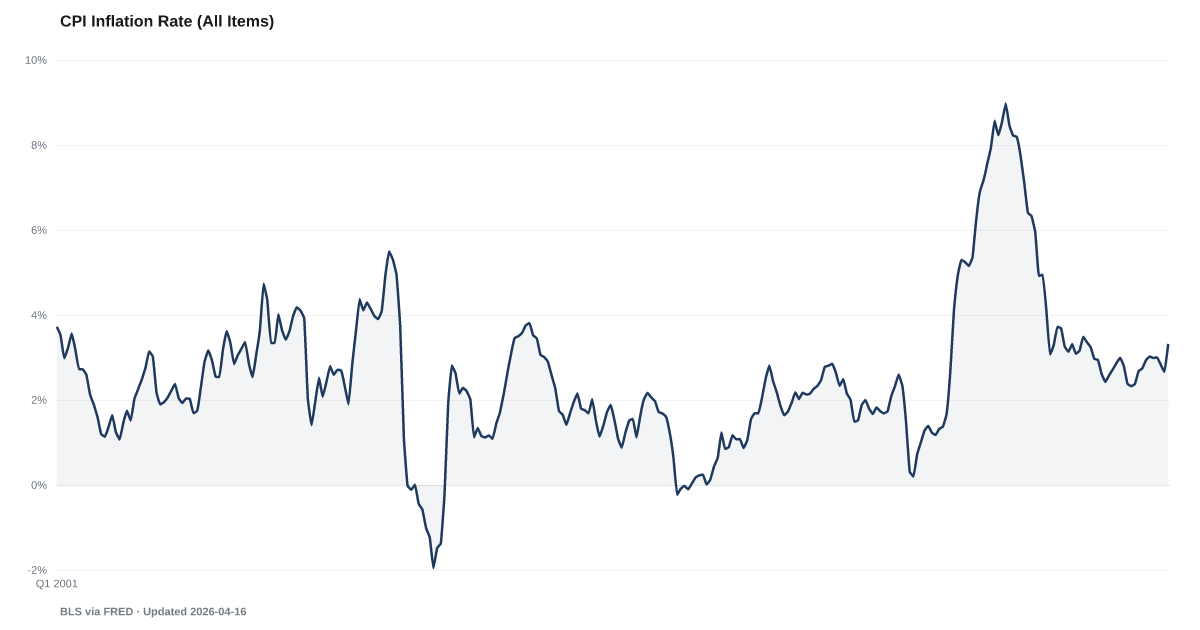
Year-over-year change in consumer prices
What is the current CPI Inflation Rate (All Items) reading?
The U.S. Bureau of Labor Statistics consumer price index for all urban consumers (CPI-U) put prices 3.4% higher than a year earlier in August 2026, by our calculation from the seasonally adjusted index. That rate is up from 2.9% in August 2025. BLS's own headline 12-month figure uses the unadjusted index and can differ slightly. The index covers what urban households pay for goods and services, including sales taxes, but not income taxes or investments. Source: BLS data retrieved via FRED (CPIAUCSL).
Measurement basis: Year-over-year percent change computed from the seasonally adjusted CPI-U all-items index (CPIAUCSL); seasonally adjusted values may be revised when BLS updates seasonal factors
Consumer prices were 3.4% higher than a year earlier in August 2026, up from a rate of 2.9% in August 2025.
The all-items consumer price index follows what people in U.S. cities and suburbs pay for a broad basket of goods and services, from rent and groceries to gasoline and car repairs. Over the 12 months to August 2026, the price of that basket went up 3.4%. The yearly rate is up from 2.9% in August 2025. It edged up from 3.3% in July 2026, too small a move to call a turn.
A rate above zero means the basket still costs more than it did a year earlier, whether the rate is speeding up or slowing down.
The all-items rate sums up the whole basket, and its parts can pull in different directions in the same month. Food CPI, Shelter CPI and Energy CPI show three of them. This is not core inflation, which is a separate BLS index that leaves out food and energy. It is also not the measure behind the Board of Governors of the Federal Reserve System's inflation goal, which the Fed sets for the PCE price index from the U.S. Bureau of Economic Analysis.
We compute the yearly change from the seasonally adjusted index, meaning BLS has removed the usual calendar swings, so our figure can differ by a tenth of a point from the 12-month figure BLS headlines, which uses the unadjusted index. There is no figure for October 2025, when the federal government shutdown stopped data collection. BLS carried some prices and rents forward for that month, so it says the readings from November 2025 through March 2026 were affected. The index covers urban consumers, over 90 percent of the U.S. population, and leaves out rural areas outside metro areas.
Explore Further
CPI Inflation Rate (All Items) over time: what has changed?

Counties with the highest debt burden scores
These are debt burden scores from our County Distress Index, not county readings of CPI Inflation Rate (All Items).
Explore all 3,144 counties →| Period | Value | YoY Change |
|---|---|---|
| Aug 2026 | 3.4% | +0.5 pp |
| Jul 2026 | 3.3% | +0.6 pp |
| Jun 2026 | 3.5% | +0.8 pp |
| May 2026 | 4.2% | +1.8 pp |
| Apr 2026 | 3.8% | +1.5 pp |
| Mar 2026 | 3.3% | — |
| Feb 2026 | 2.4% | — |
| Jan 2026 | 2.4% | — |
| Dec 2025 | 2.7% | — |
| Nov 2025 | 2.7% | — |
| Sep 2025 | 3% | +0.6 pp |
| Aug 2025 | 2.9% | +0.3 pp |
Frequently Asked Questions
What is the current CPI inflation rate?
In August 2026, the all-items CPI stood 3.4% above its level a year earlier. That is our calculation from the seasonally adjusted all-items index (FRED CPIAUCSL). The rate BLS headlines is computed from the unadjusted index, so the two can differ by a tenth of a point.
Is this the same as core inflation or the Fed's target?
No. Core inflation is a separate BLS index that leaves out food and energy, and its rate differs from the all-items rate. The Federal Reserve states its 2 percent goal for the PCE price index from the Bureau of Economic Analysis, which uses different weights and a wider scope than the CPI. The Social Security cost-of-living adjustment uses another index, the CPI-W.
If the inflation rate slows, are prices falling?
No. The rate is the change in prices over 12 months. While it is above zero, prices are still going up; a slower rate only means they are going up less quickly.
Where does CPI data come from?
The Bureau of Labor Statistics publishes the CPI every month, usually within two weeks after the month ends, from prices it collects in urban areas across the country. We use the seasonally adjusted all-items index as published on FRED (CPIAUCSL) and compute the change from 12 months earlier.


Quick poll
Is this affecting you or your household?
Discussion
Get the numbers when they move.
New data drops, indicator updates, and American Distress Index changes — delivered when it matters. No spam.
or Create an Account for full access
Loading comments…