Household Debt Service Ratio
Also tracked as Debt Service
Scheduled household debt payments as a share of disposable personal income
What is the current Household Debt Service Ratio reading?
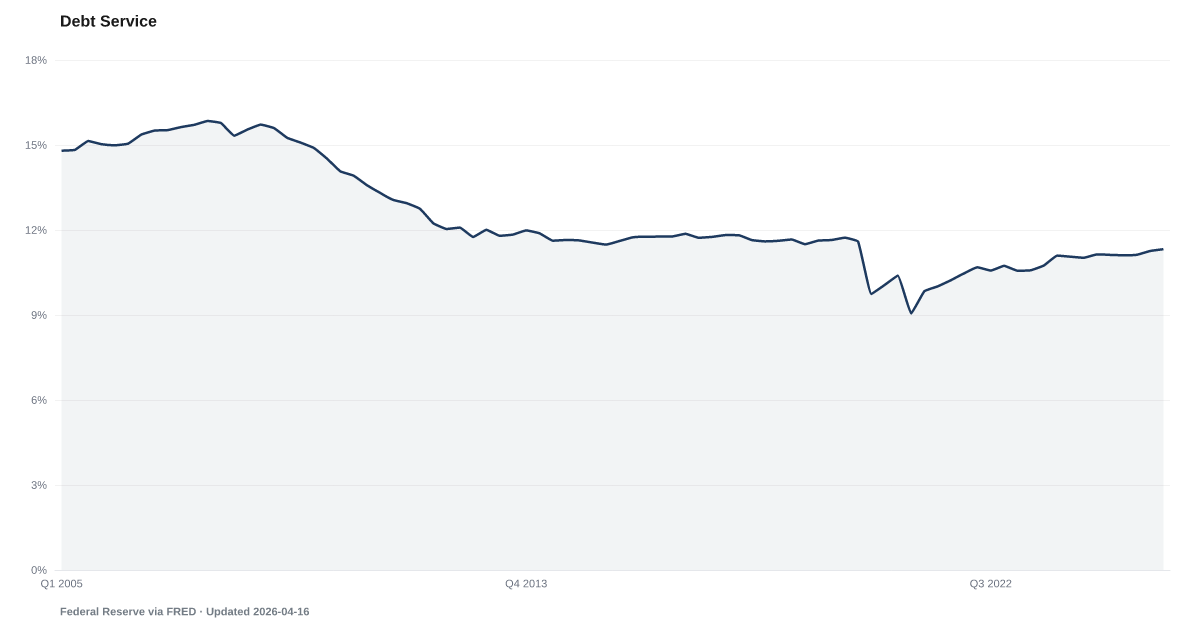
Scheduled household debt payments equaled 11.1% of disposable personal income in Q2 2026, according to the Board of Governors of the Federal Reserve System, little changed from 11.2% in Q1 2026. The ratio counts required payments on mortgages, auto, student and other consumer loans, and credit card minimums, divided by the after-tax income of everyone in the country. Source: Federal Reserve data retrieved via FRED (BOGZ1FL010000346Q + TDSP).
Scheduled household debt payments equaled 11.1% of disposable personal income in Q2 2026, little changed from 11.2% in Q1 2026.
The Federal Reserve Board's household debt service ratio compares the debt payments households are scheduled to make with the disposable personal income of the whole country. In Q2 2026 it was 11.1%, little changed from 11.2% in Q1 2026. That matches the ratio a year earlier. It is the lowest reading since Q1 2025.
The Board's current method starts in 2005. On that basis the ratio was 15.8% in Q4 2007, before the financial crisis, and 9.1% in Q1 2021, during the pandemic. Readings before 2005 come from an older method that ran lower, so we do not compare today's ratio with them.
The payments are the required ones, read from a sample of credit records: mortgages, including escrowed property taxes and insurance, auto and student loans, other consumer loans, and minimum payments on credit cards. Payments on loans that are behind count too, so the ratio measures what is owed, not what was paid or missed. Rent is not included. It is a total across all households, including those with no debt, so it is not the burden on a typical borrower.
The Board revises past quarters, sometimes by several tenths of a point, so a move of a tenth or two can disappear in a later release. The ratio is the only input to the Debt Burden domain of the American Distress Index. Mortgage payments alone are tracked in the Mortgage Debt Service Ratio; the average credit card interest rate and the personal saving rate have their own pages.
Explore Further
Is this happening to you?
What share of your monthly income goes to debt payments?
Household Debt Service Ratio over time: what has changed?

Counties with the highest safety net and buffer scores
These are safety net and buffer scores from our County Distress Index, not county readings of Household Debt Service Ratio.
Explore all 3,144 counties →| Period | Value | YoY Change |
|---|---|---|
| Q2 2026 | 11.1% | 0 pp |
| Q1 2026 | 11.2% | +0.1 pp |
| Q4 2025 | 11.3% | +0.2 pp |
| Q3 2025 | 11.2% | +0.1 pp |
| Q2 2025 | 11.1% | +0.1 pp |
| Q1 2025 | 11.1% | 0 pp |
| Q4 2024 | 11.1% | 0 pp |
| Q3 2024 | 11.1% | +0.4 pp |
| Q2 2024 | 11% | +0.4 pp |
| Q1 2024 | 11.1% | +0.5 pp |
| Q4 2023 | 11.1% | +0.4 pp |
| Q3 2023 | 10.7% | +0.1 pp |
How to read this series
The source changed how it measures this in Q1 2005. Readings from 2005 on use the Federal Reserve Board's current method, which estimates debt payments from scheduled required payments in credit bureau data and includes mortgage escrow for property taxes and insurance. The Board states that quarterly values on the current method are available from 2005 forward. Earlier readings exist only on the previous method, which built payments from estimated balances, interest rates and loan terms. Where both methods cover the same quarters, the gap between them is not constant: about 0.6 to 2.9 percentage points. Readings on either side are not directly comparable, so the year-over-year column stays blank where a comparison would cross that date. Source documentation.
Frequently Asked Questions
What share of income goes to debt payments in the U.S.?
Scheduled debt payments equaled 11.1% of U.S. disposable personal income in Q2 2026, according to the Federal Reserve Board. That covers mortgage payments, including escrowed taxes and insurance, auto and student loan payments, other consumer loans and credit card minimum payments. It is a total for all households, not the share for a typical family.
Is the debt service ratio rising or falling?
It was 11.1% in Q2 2026, little changed from 11.2% in Q1 2026. That matches the ratio a year earlier.
Can today's ratio be compared with the 1980s or with 2008?
Only back to 2005. The Board's current method starts in Q1 2005, and it put the ratio at 15.8% in Q4 2007, before the financial crisis. Figures for earlier years come from an older method that ran lower, so a line from 1980 to today joins two different measures.
Where does the debt service data come from?
The Federal Reserve Board estimates scheduled payments from a random sample of credit records and divides them by disposable personal income from the national accounts. We use the long-history series BOGZ1FL010000346Q from FRED and add newer TDSP quarters when TDSP is published first. The ratio is the only input to the Debt Burden domain of the American Distress Index.


Quick poll
Is this affecting you or your household?
Discussion
Get the numbers when they move.
New data drops, indicator updates, and American Distress Index changes — delivered when it matters. No spam.
or Create an Account for full access
Loading comments…