Delinquency Rate on Single-Family Residential Mortgages, All Commercial Banks
Mortgage loans 30+ days past due or in nonaccrual
What is the current Delinquency Rate on Single-Family Residential Mortgages, All Commercial Banks reading?
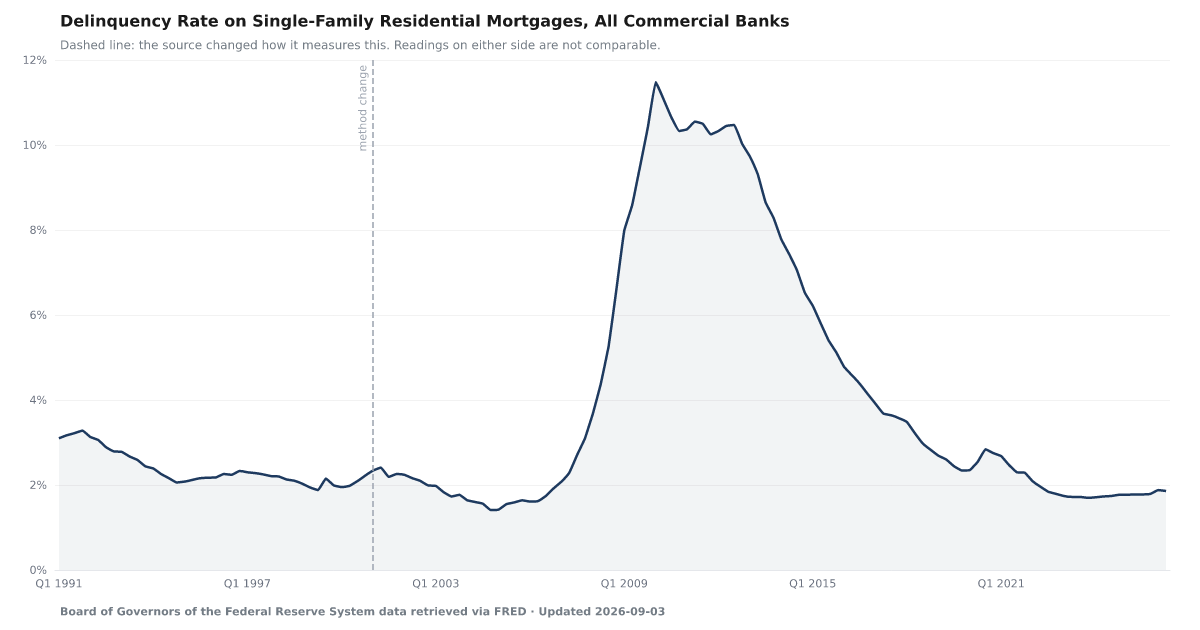
The delinquency rate on single-family residential mortgages at U.S. commercial banks was 1.9% in Q2 2026, up from 1.8% a year earlier, according to the Board of Governors of the Federal Reserve System. It counts loans 30 or more days past due plus loans in nonaccrual status, as a share of mortgage dollars on banks' books, and covers only mortgages held by commercial banks. Source: Federal Reserve Board data retrieved via FRED (DRSFRMACBS).
Measurement basis: 30+ days past due or in nonaccrual status, per the Federal Reserve Board Charge-Off and Delinquency Rates release
Delinquency on single-family mortgages at commercial banks was 1.9% in Q2 2026, up from 1.8% a year earlier.
The Federal Reserve Board put the delinquency rate on one- to four-family residential mortgages at commercial banks at 1.9% in Q2 2026, the same as in Q1 2026. That is higher than a year earlier, when it was 1.8%.
The Fed re-estimates the seasonally adjusted history at almost every release, so the newest quarter can still change.
The rate counts loans 30 or more days past due plus loans in nonaccrual status, as a share of the mortgage dollars on the books of insured U.S.-chartered commercial banks. Single-family here means one- to four-unit properties, and the line includes home equity lines of credit and government-insured FHA and VA loans. It counts dollars, not homeowners or loans, and it leaves out mortgages held outside commercial banks.
In the first quarter of 2010 banks adopted new accounting standards on transferred loans and consolidation, known as FAS 166 and 167, so the comparisons on this page start with 2010. Earlier changes also touched the data: from 2005 banks that service Ginnie Mae pools had to put delinquent pool loans back on their books, and the FAS 159 standard took effect in 2008. In 2020 and 2021, regulators said loans in COVID-19 payment deferrals need not be reported past due because of the deferral; the Fed has not published the size of that effect.
FHA mortgage delinquency comes from the Mortgage Bankers Association's servicer survey, which counts loans rather than dollars, so its level is not comparable with this rate. Cotality's early delinquency rate tracks mortgages moving from current to 30 days late.
Explore Further
Delinquency Rate on Single-Family Residential Mortgages, All Commercial Banks over time: what has changed?

Counties with the highest delinquency scores
These are delinquency scores from our County Distress Index, not county readings of Delinquency Rate on Single-Family Residential Mortgages, All Commercial Banks.
Explore all 3,144 counties →| Period | Value | YoY Change |
|---|---|---|
| Q2 2026 | 1.9% | +0.1 pp |
| Q1 2026 | 1.9% | +0.1 pp |
| Q4 2025 | 1.8% | 0 pp |
| Q3 2025 | 1.8% | +0.1 pp |
| Q2 2025 | 1.8% | +0.1 pp |
| Q1 2025 | 1.8% | +0.1 pp |
| Q4 2024 | 1.8% | +0.1 pp |
| Q3 2024 | 1.7% | 0 pp |
| Q2 2024 | 1.7% | 0 pp |
| Q1 2024 | 1.7% | 0 pp |
| Q4 2023 | 1.7% | -0.1 pp |
| Q3 2023 | 1.7% | -0.1 pp |
How to read this series
The source changed how it measures this in Q1 2001. Readings before the March 2001 Call Report are partly estimated by the Federal Reserve rather than reported in full detail. Smaller banks filed the FFIEC 033 and 034 forms and could report charged-off and delinquent loans under their own loan classifications instead of the regulatory ones, so the Federal Reserve adjusted and allocated those amounts to the published loan categories using estimated ratios that differed by loan category. The Board states that from the March 2001 Call Report the detail reported by all banks eliminated the need for those procedures. In February 2017 it updated the models used to estimate data not reported by small banks that filed the FFIEC 034 form and revised the pre-2001 rates for several series, so values on that side of the boundary have already moved once without any new bank report. Readings on either side are not directly comparable, so the year-over-year column stays blank where a comparison would cross that date. Source documentation.
Frequently Asked Questions
What is the current mortgage delinquency rate at banks?
The delinquency rate on single-family residential mortgages at U.S. commercial banks was 1.9% in Q2 2026, up from 1.8% a year earlier, according to the Federal Reserve Board. It counts loans 30 or more days past due plus loans in nonaccrual status, as a share of mortgage dollars on banks' books, and covers only mortgages held by commercial banks. Source: Federal Reserve Board data retrieved via FRED (DRSFRMACBS).
Does this rate count only loans 90 days late?
No. It counts mortgage balances 30 or more days past due plus balances in nonaccrual status, so it mixes early and late delinquency. It includes home equity lines of credit and FHA and VA loans held by commercial banks.
How does mortgage delinquency connect to the American Distress Index?
Mortgage delinquency is one of four inputs to the American Distress Index's Delinquency domain, alongside credit card, consumer loan and auto loan delinquency. Each input is scored against its own quarterly history.
Where does this data come from?
The Federal Reserve Board compiles it from the Call Reports that commercial banks file and publishes it about two months after each quarter ends. FRED republishes it as DRSFRMACBS.

Quick poll
Is this affecting you or your household?
Discussion
Get the numbers when they move.
New data drops, indicator updates, and American Distress Index changes — delivered when it matters. No spam.
or Create an Account for full access
Loading comments…