University of Michigan Consumer Sentiment Index
Also tracked as The Mood Ring
University of Michigan consumer sentiment survey
What is the current University of Michigan Consumer Sentiment Index reading?
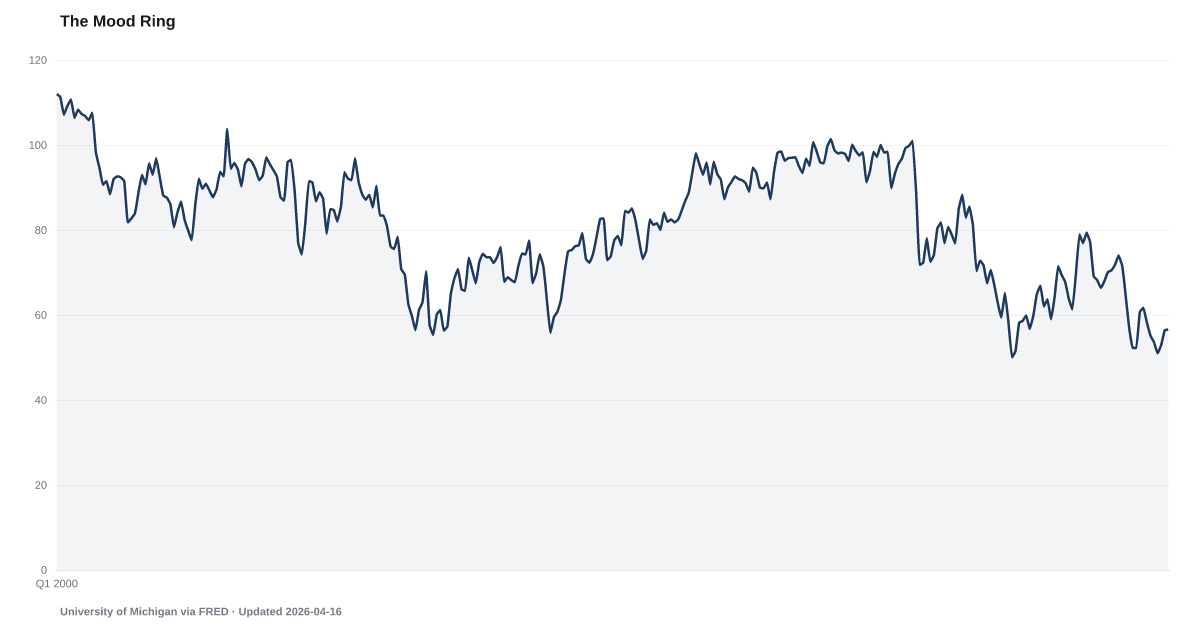
The University of Michigan Index of Consumer Sentiment was 48.1 in September 2026, down from 55.1 in September 2025. The index scores five questions about personal finances, business conditions and buying conditions against a 1966 base of 100; it is not a share of people. It is a national survey, not a Michigan one. Source: University of Michigan Surveys of Consumers.
Consumer sentiment read 48.1 in September 2026, lower than the 55.1 of a year earlier.
The University of Michigan's Index of Consumer Sentiment stood at 48.1 in September 2026. A year before, in September 2025, it was 55.1, so the index is down 7 points. It was 51.7 in August 2026, a move within survey noise and seasonal swings.
Despite the name, this is a national survey: the university's Surveys of Consumers interviews adults across the 48 contiguous states and Washington, D.C. The index combines five questions. Two ask about the respondent's own finances, now and a year ahead. Two ask about business conditions over the next year and the next five years, and one asks whether it is a good time to buy big household items. Each answer is scored as the share of favorable replies minus the share of unfavorable ones, and the total is scaled so the 1966 base equals 100. It is not a percent of people and it is not capped at 100.
Michigan switched from phone to web interviews between April and July 2024, and says readings on either side of the switch can carry method effects. It publishes a preliminary reading mid-month from about 420 interviews and a final one at month's end from about 1,000; we use the final. FRED, our source, shows each final reading one month late at the university's request, so Michigan's own site can be a month ahead of this page. Readings are monthly from 1978; before that the index was taken one to four times a year.
A separate page tracks the Conference Board's expectations index, a different survey with its own panel and a 1985 base, so the two numbers are not interchangeable. The sentiment index records answers to attitude questions; it does not measure spending.
Explore Further
Is this happening to you?
Do you feel more pessimistic about your financial future than you did a year ago?
University of Michigan Consumer Sentiment Index over time: what has changed?

Counties with the highest debt burden scores
These are debt burden scores from our County Distress Index, not county readings of University of Michigan Consumer Sentiment Index.
Explore all 3,144 counties →| Period | Value | YoY Change |
|---|---|---|
| Sep 2026 † | 48.1 | -7 |
| Aug 2026 † | 51.7 | -6.5 |
| Jul 2026 | 55.2 | -6.5 |
| Jun 2026 | 49.5 | -11.2 |
| May 2026 | 44.8 | -7.4 |
| Apr 2026 | 49.8 | -2.4 |
| Mar 2026 | 53.3 | -3.7 |
| Feb 2026 | 56.6 | -8.1 |
| Jan 2026 | 56.4 | -15.3 |
| Dec 2025 | 52.9 | -21.1 |
| Nov 2025 | 51 | -20.8 |
| Oct 2025 | 53.6 | -16.9 |
† Sep 2026: University of Michigan, Surveys of Consumers — final reading, direct from its own release. FRED had not published this month yet.
† Aug 2026: University of Michigan, Surveys of Consumers — final reading, direct from its own release. FRED had not published this month yet.
Frequently Asked Questions
What is the latest consumer sentiment reading?
The final University of Michigan reading for September 2026 was 48.1. It was 51.7 in August 2026, within survey noise and seasonal swings.
Is consumer sentiment the same as consumer confidence?
No. "Consumer confidence" usually means the Conference Board's index, which uses a different online panel and a 1985 base. Michigan's index uses a 1966 base. The same Michigan release also publishes separate current-conditions and expectations indexes built from subsets of the five questions, and a year-ahead inflation expectation that is not part of the sentiment index.
Where does consumer sentiment data come from?
The University of Michigan's Survey Research Center runs the Surveys of Consumers every month, by web since mid-2024, with about 1,000 interviews for the final reading. Some respondents are interviewed again six and twelve months later. The figures are national; the survey does not publish state readings.


Quick poll
Is this affecting you or your household?
Discussion
Get the numbers when they move.
New data drops, indicator updates, and American Distress Index changes — delivered when it matters. No spam.
or Create an Account for full access
Loading comments…