NFCI Non-Financial Leverage Subindex
Also tracked as The Tightening
Chicago Fed measure of growth in household and business debt ratios
What is the current NFCI Non-Financial Leverage Subindex reading?
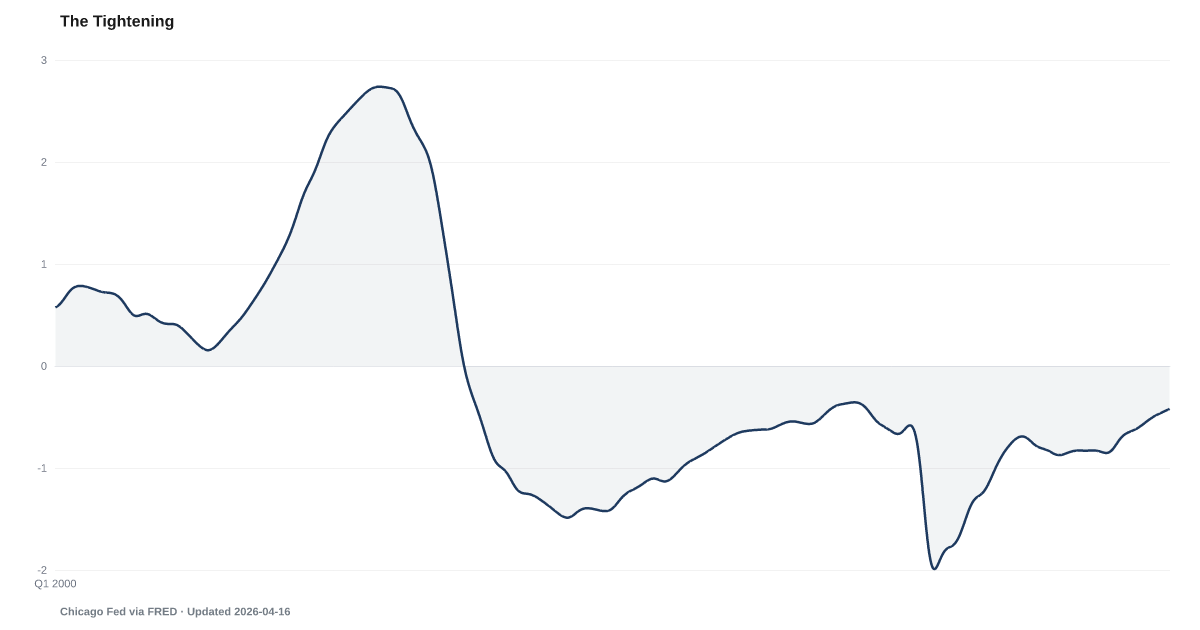
The Federal Reserve Bank of Chicago's NFCI nonfinancial leverage subindex was -0.46 in the week ending Sep 25, 2026, close to the -0.58 of a year earlier. It measures growth in household and business debt relative to spending and GDP, in standard deviations from the average since 1971, so a reading below zero means those ratios are growing more slowly than average. The inputs are quarterly and the history is revised weekly. Source: Federal Reserve Bank of Chicago data retrieved via FRED (NFCINONFINLEVERAGE).
At -0.46 in the week ending Sep 25, 2026, close to the -0.58 of a year earlier, the Chicago Fed's nonfinancial leverage subindex shows household and business debt ratios growing more slowly than their long-run average pace.
The Chicago Fed's nonfinancial leverage subindex read -0.46 in the week ending Sep 25, 2026, below the long-run average of zero. A year earlier it was -0.58, a gap within the size of one week's revision. In the Chicago Fed's current estimates, it is the highest reading since the week ending Mar 29, 2019.
The subindex is built from two ratios. One is nonfinancial business debt compared with GDP. The other is household mortgage and consumer debt compared with spending on durable goods plus home building. It tracks how fast those ratios grow each quarter, scaled so that zero is the average since 1971 and each unit is one standard deviation. A reading above zero means growth in the ratios is above its average; below zero, under it. A reading below zero does not mean debt is being paid down, and a ratio can grow because GDP or spending grows slowly, not only because debt grows.
Both inputs are quarterly, so the weekly number is a model update, not a new measurement of borrowing. The Chicago Fed re-estimates the whole history every week, and past values can shift by more than a tenth of a point. Values before its November 2012 release are estimated history, not readings published at the time. Chicago Fed researchers reported in 2012 that above-average values of this subindex came before most past financial crises and recessions; that is their finding about history, not a forecast.
This is not the NFCI itself, which averages 105 indicators, and not its separate "leverage" subindex, which moves the opposite way. It says nothing about loan terms or interest rates, and it does not measure debt payments against income; the household debt service ratio does that for households.
Explore Further
Is this happening to you?
Has your household taken on more debt than a year ago?
NFCI Non-Financial Leverage Subindex over time: what has changed?

Counties with the highest debt burden scores
These are debt burden scores from our County Distress Index, not county readings of NFCI Non-Financial Leverage Subindex.
Explore all 3,144 counties →| Period | Value | YoY Change |
|---|---|---|
| Sep 25, 2026 | -0.46 | +0.12 |
| Sep 18, 2026 | -0.47 | +0.12 |
| Sep 11, 2026 | -0.47 | +0.12 |
| Sep 4, 2026 | -0.48 | +0.12 |
| Aug 28, 2026 | -0.48 | +0.12 |
| Aug 21, 2026 | -0.49 | +0.11 |
| Aug 14, 2026 | -0.49 | +0.12 |
| Aug 7, 2026 | -0.5 | +0.11 |
| Jul 31, 2026 | -0.51 | +0.1 |
| Jul 24, 2026 | -0.51 | +0.11 |
| Jul 17, 2026 | -0.52 | +0.1 |
| Jul 10, 2026 | -0.52 | +0.1 |
Frequently Asked Questions
What does the NFCI nonfinancial leverage subindex measure?
It measures how fast two debt ratios are growing: business debt compared with GDP, and household mortgage and consumer debt compared with spending on durable goods and home building. The result is in standard deviations from the long-run average, so zero is average, above zero means growth above the average and below zero means growth under it. It is not a percent.
Does this show that credit is getting harder to get?
No. It measures debt growth, not loan terms or interest rates. The Chicago Fed publishes a separate credit subindex for credit conditions, and its overall National Financial Conditions Index combines many more indicators. The Fed's household debt service ratio is the measure of payments against income.
How often is it updated, and does it change?
The Chicago Fed posts it every Wednesday for the week ending the previous Friday. Because the two inputs are quarterly, the weekly value is an estimate between quarterly data, and the Chicago Fed re-estimates past values every week, so earlier readings on this page can change.


Quick poll
Is this affecting you or your household?
Discussion
Get the numbers when they move.
New data drops, indicator updates, and American Distress Index changes — delivered when it matters. No spam.
or Create an Account for full access
Loading comments…