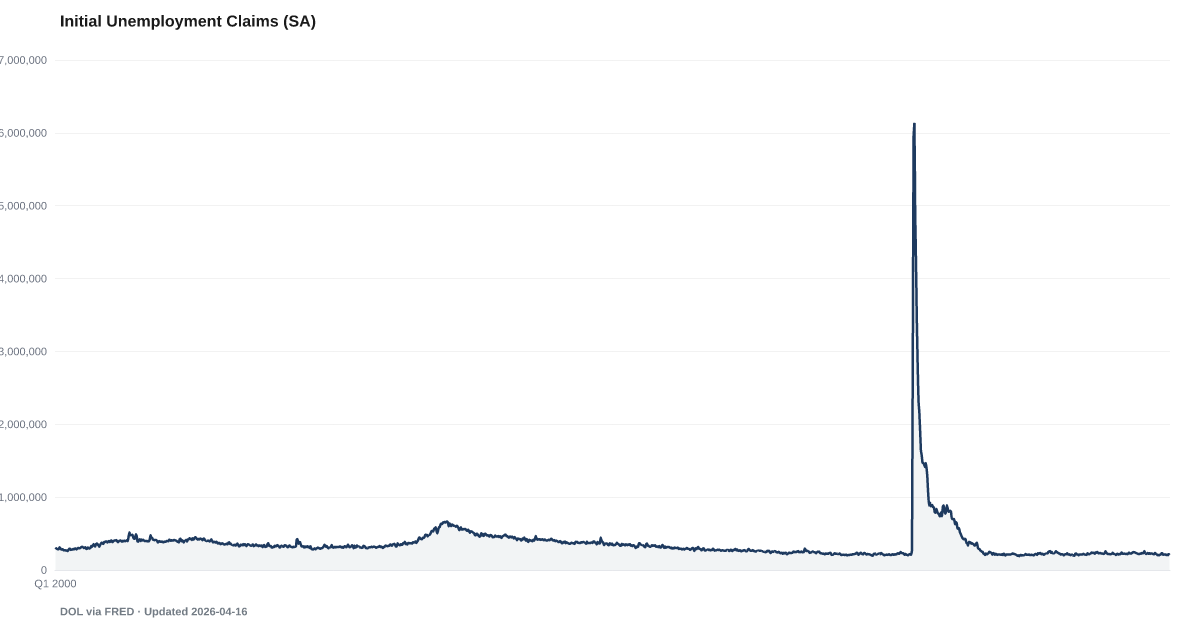
Initial Unemployment Claims (SA)
Weekly new filings for unemployment insurance
In our research, changes in this measure have tended to show up in Unemployment Rate about one quarter later. How we tested this
What is the current Initial Unemployment Claims (SA) reading?
The U.S. Department of Labor counted 197,000 seasonally adjusted initial unemployment claims in the week ending Sep 19, 2026, little changed from 198,000 the week before. Each claim asks a state unemployment insurance program to rule on whether someone who lost a job qualifies for benefits. The count feeds the labor domain of the American Distress Index. Source: U.S. Department of Labor data retrieved via FRED (ICSA).
Initial claims for state unemployment benefits were 197,000 in the week ending Sep 19, 2026.
The Labor Department publishes a first count every Thursday for the week that ended the previous Saturday. The latest count is about the same as the week before, when claims were 198,000; a move that small is the size of a routine revision. A year earlier, in the week ending Sep 20, 2025, claims were 219,000, so this week's count is 22,000 lower.
An initial claim is a request, filed after losing a job, for a ruling on whether the filer qualifies for state unemployment insurance. The count is of claims, not people and not layoffs. Someone already in a benefit year who loses another job files an additional claim, some filers are found ineligible, and the national total includes Puerto Rico and the Virgin Islands. Claims from former federal employees and newly discharged veterans go into a separate federal table and are not in this number.
The headline is seasonally adjusted: DOL strips out the swings that repeat every year, such as holiday layoffs, so one week can be set beside the week before. DOL says weekly claims are hard to adjust and can swing from week to week, so a single week is not a trend. Each week's first figure is revised the following Thursday, usually by 1,000 to 2,000, and each spring new seasonal factors rewrite past weeks. Here, a move of 2,000 or less is called little changed.
Initial claims are one of two inputs to the labor domain of the American Distress Index, beside the Unemployment Rate. DOL calls them a leading economic indicator but gives no lead time. Continued Unemployment Claims counts the weeks of benefits claimed after an initial claim, and the Challenger job-cut tally counts job cuts that employers announce, a separate measure from a private firm.
Explore Further
Initial Unemployment Claims (SA) over time: what has changed?

Counties with the highest labor scores
These are labor scores from our County Distress Index, not county readings of Initial Unemployment Claims (SA).
Explore all 3,144 counties →| Period | Value | YoY Change |
|---|---|---|
| Sep 19, 2026 | 197K | -22K |
| Sep 12, 2026 | 198K | -35K |
| Sep 5, 2026 | 207K | -52K |
| Aug 29, 2026 | 207K | -29K |
| Aug 22, 2026 | 204K | -25K |
| Aug 15, 2026 | 207K | -26K |
| Aug 8, 2026 | 212K | -12K |
| Aug 1, 2026 | 200K | -26K |
| Jul 25, 2026 | 198K | -21K |
| Jul 18, 2026 | 189K | -29K |
| Jul 11, 2026 | 209K | -12K |
| Jul 4, 2026 | 217K | -11K |
Frequently Asked Questions
How many initial jobless claims were filed last week?
DOL's first seasonally adjusted count for the latest week is 197,000, 22,000 fewer than in the same week a year earlier. That is the week ending Sep 19, 2026, and the figure will be revised in the next weekly release.
Is this the number of people laid off?
No. It counts claims filed with state unemployment insurance programs, not layoffs or people. A person can file more than one claim in a benefit year, and a claim is a request for an eligibility ruling, not a benefit paid. Announced job cuts and employer-reported layoffs are separate measures from other sources.
How do initial claims connect to the American Distress Index?
Initial claims are one of the two inputs to the ADI's labor domain, alongside the unemployment rate. The ADI's five domains carry equal weight, so the labor domain is one-fifth of the composite.
When are initial claims released?
Every Thursday at 8:30 a.m. Eastern, for the week that ended the previous Saturday. A holiday can move the day. FRED labels each week by that Saturday, not by the release date. The data start in 1967.


Quick poll
Is this affecting you or your household?
Discussion
Get the numbers when they move.
New data drops, indicator updates, and American Distress Index changes — delivered when it matters. No spam.
or Create an Account for full access
Loading comments…