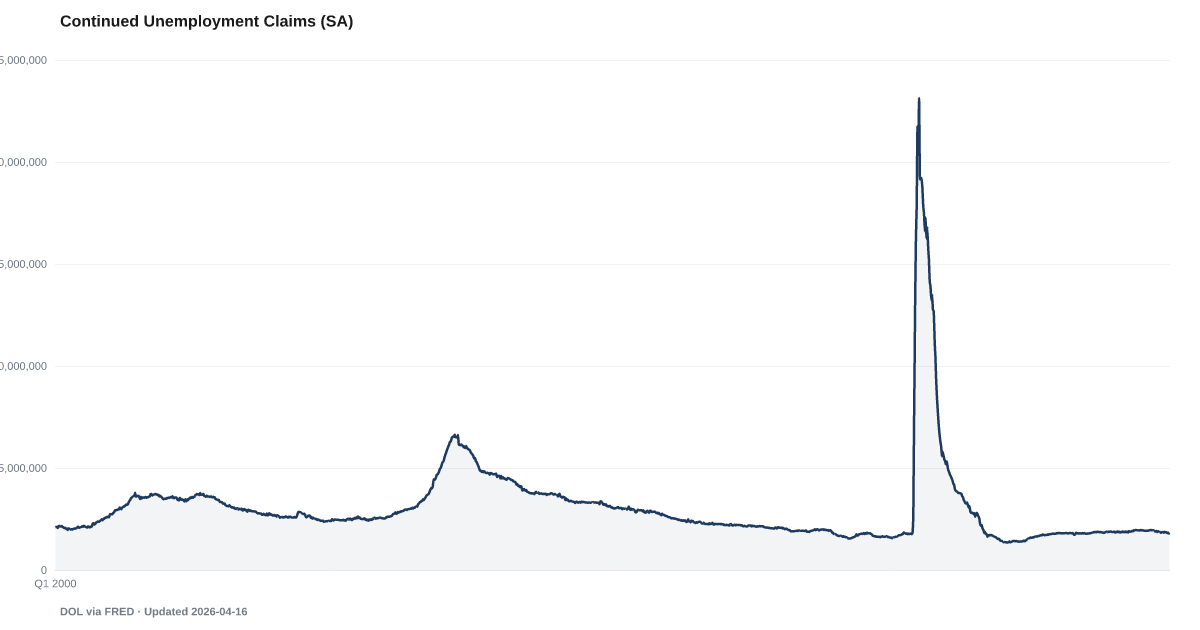
Continued Unemployment Claims (SA)
Ongoing unemployment insurance claims
What is the current Continued Unemployment Claims (SA) reading?
Continued unemployment claims, also called insured unemployment, were 1.72 million in the latest week the U.S. Department of Labor reported, the week ending Sep 12, 2026, the same as the week before. The seasonally adjusted figure counts weeks of benefits claimed in state unemployment insurance programs, not unique people, and runs one week behind initial claims. Source: U.S. Department of Labor data retrieved via FRED (CCSA).
Continued unemployment claims stood at 1.72 million in the week ending Sep 12, 2026, the latest week reported.
The Labor Department reports continued claims every Thursday, one week behind that release's initial claims. The latest count matches the week before. A year earlier, in the week ending Sep 13, 2025, the count was 1.92 million, so it is 197,000 lower now.
A continued claim is filed by someone who has already filed an initial claim, to claim benefits for a week out of work. DOL says the count is of weeks claimed, not unique people, and states count a week even when it was not paid. It covers regular state programs in the 50 states, the District of Columbia, Puerto Rico and the Virgin Islands. People who have used up their benefits, were never eligible or never filed are outside it, so it is not a count of the unemployed; that comes from the household survey behind the Unemployment Rate.
The headline is seasonally adjusted: DOL strips out swings that repeat every year, such as the extra claims filed every January, so one week can be set beside the week before. Each week's first figure is revised a week later, by as much as 13,000 in the releases checked from July 30 to Sept. 17, 2026, and each spring new seasonal factors rewrite past years. Here, a move of 13,000 or less is called little changed. The release gives no reason for a change: the count can drop because people found work or because their benefits ran out.
DOL says continued claims are not a leading indicator: they roughly coincide with the peak of a business cycle and lag at the trough. Initial Unemployment Claims counts the new claims filed each week. The Indeed Job Postings Index and the JOLTS Quits Rate track job postings and quits, other parts of the job market.
Explore Further
Continued Unemployment Claims (SA) over time: what has changed?

Counties with the highest labor scores
These are labor scores from our County Distress Index, not county readings of Continued Unemployment Claims (SA).
Explore all 3,144 counties →| Period | Value | YoY Change |
|---|---|---|
| Sep 12, 2026 | 1.72M | -0.2M |
| Sep 5, 2026 | 1.72M | -0.21M |
| Aug 29, 2026 | 1.77M | -0.16M |
| Aug 22, 2026 | 1.78M | -0.16M |
| Aug 15, 2026 | 1.77M | -0.17M |
| Aug 8, 2026 | 1.8M | -0.16M |
| Aug 1, 2026 | 1.78M | -0.16M |
| Jul 25, 2026 | 1.8M | -0.16M |
| Jul 18, 2026 | 1.78M | -0.16M |
| Jul 11, 2026 | 1.79M | -0.15M |
| Jul 4, 2026 | 1.8M | -0.15M |
| Jun 27, 2026 | 1.82M | -0.13M |
Frequently Asked Questions
How many continued unemployment claims are there?
DOL's first seasonally adjusted count for the latest week is 1.72 million, 197,000 fewer than in the same week a year earlier. That is the week ending Sep 12, 2026, and the figure will be revised a week later.
Is this the number of unemployed people?
No. It counts weeks of state unemployment benefits claimed, not people, and it leaves out jobless people who are not covered, have used up their benefits, were found ineligible or never filed. The number of unemployed people comes from the U.S. Bureau of Labor Statistics' household survey.
How do continued claims differ from initial claims?
An initial claim is filed after a job loss to ask whether the filer qualifies for benefits. Continued claims are filed afterward, week by week, to claim benefits for each week out of work. Each DOL release reports continued claims for the week before its initial-claims week.
Where does this data come from?
State unemployment insurance offices report the counts to the Labor Department, which publishes them every Thursday morning. FRED carries the seasonally adjusted series as CCSA, starting in 1967.


Quick poll
Is this affecting you or your household?
Discussion
Get the numbers when they move.
New data drops, indicator updates, and American Distress Index changes — delivered when it matters. No spam.
or Create an Account for full access
Loading comments…