Serious Delinquency Rate (90+ days, All Loan Types)
All consumer debt 90+ days past due
What is the current Serious Delinquency Rate (90+ days, All Loan Types) reading?
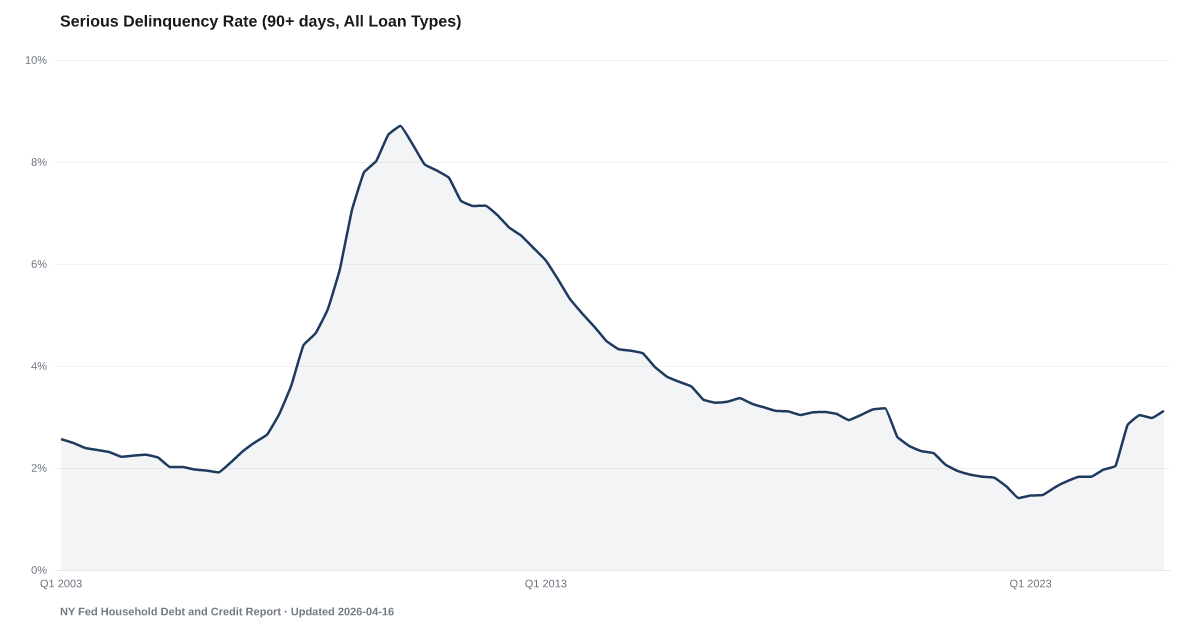
In Q2 2026, 3.31% of all consumer debt balances on credit reports were 90 or more days past due, according to the Federal Reserve Bank of New York, up from 3.04% a year earlier. The measure covers mortgages, home equity lines, auto loans, credit cards, student loans and other consumer loans, and it counts dollars, not people. Source: Federal Reserve Bank of New York Household Debt and Credit Report (Q2 2026).
Measurement basis: Percent of outstanding balances across all loan types that are 90 or more days delinquent, using the "ALL" series in the New York Fed table "Percent of Balance 90+ Days Delinquent by Loan Type" (unit: Percent; source: New York Fed Consumer Credit Panel/Equifax). This is a balance-level rate, not a share of borrowers.
The share of all consumer debt balances 90 or more days late was 3.31% in Q2 2026.
The New York Fed's Household Debt and Credit Report put the share of all consumer debt balances on credit reports that are 90 or more days late at 3.31% in Q2 2026, up from 3.04% a year earlier. The share fell from 3.36% in Q1 2026, but the series is not seasonally adjusted, so a one-quarter move is partly seasonal. Of the 5 quarters since 2025 that compare like for like (the fourth quarter of 2025 is left out), it is the second highest.
Changes in student-loan reporting split this series into separate stretches. In 2012 previously unreported defaulted student loans were added to credit reports. From 2020 the Education Department reported paused federal loans as current, pandemic forbearance typically kept other accounts reported current too, and in late 2022 the Fresh Start program marked defaulted federal loans current. Late federal loans went back on credit reports in the first quarter of 2025, so the comparisons on this page start there. They leave out the fourth quarter of 2025, when the New York Fed carried over the prior quarter's status for about one million student-loan borrowers whose loans were transferred to the Education Department. In August 2026 the New York Fed said re-reporting of defaulted student debt was still distorting student-loan figures.
This is a share of dollar balances, not of people, and it is a stock, not a count of newly late debt. It includes balances marked severely derogatory: tied to a repossession, charge-off or foreclosure that lenders still report. In Q2 2026 those made up about three-fifths of the total, so most of the stock is debt already charged off, repossessed or foreclosed on, not debt about to be. The New York Fed's headline figure for all delinquency counts debt 30 or more days late; this series counts only 90 or more.
Mortgages are about 70% of the balances counted but, in Q2 2026, only about a fifth of the dollars 90 or more days late; student loans and credit cards together were more than half. Related pages track late payments by loan type, from different sources: Credit Card Delinquency, Auto Loan Serious Delinquency, Student Loan Delinquency and Mortgage Delinquency.
Explore Further
Serious Delinquency Rate (90+ days, All Loan Types) over time: what has changed?

Counties with the highest delinquency scores
These are delinquency scores from our County Distress Index, not county readings of Serious Delinquency Rate (90+ days, All Loan Types).
Explore all 3,144 counties →| Period | Value | YoY Change |
|---|---|---|
| Q2 2026 | 3.31% | +0.27 pp |
| Q1 2026 | 3.36% | +0.52 pp |
| Q4 2025 | 3.12% | — |
| Q3 2025 | 2.98% | — |
| Q2 2025 | 3.04% | — |
| Q1 2025 | 2.84% | — |
| Q4 2024 | 2.04% | +0.3 pp |
| Q3 2024 | 1.97% | +0.35 pp |
| Q2 2024 | 1.83% | +0.36 pp |
| Q1 2024 | 1.83% | +0.37 pp |
| Q4 2023 | 1.74% | +0.33 pp |
| Q3 2023 | 1.62% | — |
How to read this series
The source changed how it measures this in Q3 2012. The New York Fed says previously unreported defaulted student loans reappeared on credit reports in the third quarter of 2012, so the student-loan part of this share is not measured the same way on either side of that quarter. Readings on either side are not directly comparable, so the year-over-year column stays blank where a comparison would cross that date. Source documentation.
The source changed how it measures this in Q2 2020. From the second quarter of 2020 federal student loans in the pandemic payment pause were reported as current, and the New York Fed said accounts in forbearance were typically reported current on credit reports. Readings on either side are not directly comparable, so the year-over-year column stays blank where a comparison would cross that date. Source documentation.
The source changed how it measures this in Q4 2022. In the fourth quarter of 2022 the Education Department's Fresh Start program marked more than $34 billion of defaulted federal student loans as current, which the New York Fed tied to that quarter's drop in reported student-loan delinquency. Readings on either side are not directly comparable, so the year-over-year column stays blank where a comparison would cross that date. Source documentation.
The source changed how it measures this in Q1 2025. In the first quarter of 2025 the New York Fed says late federal student loans began appearing on credit reports again after a pause of nearly five years, so readings from then on are not on the same footing as 2020 through 2024. Readings on either side are not directly comparable, so the year-over-year column stays blank where a comparison would cross that date. Source documentation.
Frequently Asked Questions
What is the all-balance serious delinquency rate?
It is the share of dollars owed on credit reports, across all loan types, that is 90 or more days late, including charged-off debts lenders still report. The New York Fed put it at 3.31% in Q2 2026, up from 3.04% a year earlier.
Is this the share of people who are behind?
No. It is a share of dollar balances on credit reports. One large late balance counts more than many small ones, and people without a credit report are outside it.
Why did it jump in early 2025?
In the first quarter of 2025, late federal student loans began appearing on credit reports again after a pause of nearly five years. By our arithmetic from the New York Fed's data, student loans account for most of that jump; the other loan types moved much less.
Where does this data come from?
The Federal Reserve Bank of New York's Quarterly Report on Household Debt and Credit, built from a random sample of anonymized Equifax credit reports. It comes out about six weeks after each quarter ends.

Quick poll
Is this affecting you or your household?
Discussion
Get the numbers when they move.
New data drops, indicator updates, and American Distress Index changes — delivered when it matters. No spam.
or Create an Account for full access
Loading comments…