Bottom-Quartile Wage Growth vs. Inflation
Also tracked as The K-Shape
Bottom-quartile wage growth minus CPI inflation
What is the current Bottom-Quartile Wage Growth vs. Inflation reading?
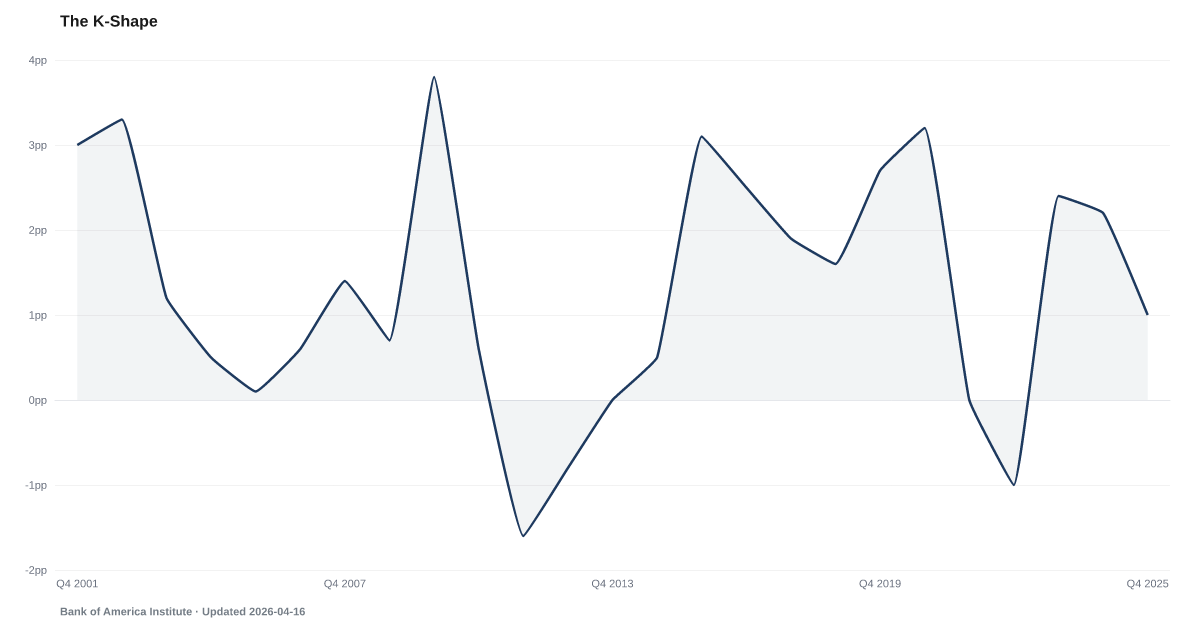
The gap between bottom-quartile wage growth and CPI inflation averaged 1.1 percentage points in 2025, down from 2.2 percentage points in 2024. Wage growth in that group ran ahead of prices. It is the Federal Reserve Bank of Atlanta Wage Growth Tracker for the bottom wage quartile minus the 12-month CPI-U inflation rate, averaged over the year by American Default Research. Source: Federal Reserve Bank of Atlanta and U.S. Bureau of Labor Statistics.
In 2025, median wage growth for U.S. workers in the bottom wage quartile ran 1.1 percentage points ahead of CPI inflation. The gap is the lowest since 2022.
Each month, American Default Research subtracts the 12-month CPI inflation rate from the Atlanta Fed's wage growth figure for the bottom wage quartile, then averages the monthly gaps over the year. For 2025 the average was 1.1 percentage points, down from 2.2 percentage points in 2024. A gap above zero means wage growth ran ahead of prices.
The wage side is the Atlanta Fed Wage Growth Tracker (1st Quartile): the median change in hourly pay for the same wage and salary earners a year apart, as a 12-month average. People are ranked by their own hourly wage, not households by income, and self-employed people and anyone without earnings at both interviews are left out. The price side is the all-items Consumer Price Index for urban consumers, the measure behind CPI Inflation; BLS says it may not match the inflation that particular groups of households face.
Neither the Atlanta Fed nor BLS publishes this gap; the subtraction and the yearly averages are American Default Research's calculation. It uses only the bottom wage quartile, so it does not compare low earners with high earners. It also differs from BLS's Real Earnings series, which adjusts average hourly earnings from the payroll survey for inflation.
Both sources revise their numbers, so published yearly gaps can change. The Atlanta Fed's September 2026 revision shifted the 2022 gap by about 0.2 point, so this page treats a year-to-year change of 0.2 point or less as about the same. The 2025 figure averages 11 months, because October 2025 data were never collected during the federal government shutdown. A Census change to how top earnings are coded entered the wage data in April 2024; the Atlanta Fed judged its effect likely modest.
Explore Further
Is this happening to you?
Has your raise kept up with what you're actually paying for rent, food, and insurance?
Bottom-Quartile Wage Growth vs. Inflation over time: what has changed?

Counties with the highest labor scores
These are labor scores from our County Distress Index, not county readings of Bottom-Quartile Wage Growth vs. Inflation.
Explore all 3,144 counties →| Period | Value | YoY Change |
|---|---|---|
| 2025 | 1.1 pp | -1.1 pp |
| 2024 | 2.2 pp | -0.2 pp |
| 2023 | 2.4 pp | +3.3 pp |
| 2022 | -0.9 pp | -0.8 pp |
| 2021 | -0.1 pp | -3.3 pp |
| 2020 | 3.2 pp | +0.5 pp |
| 2019 | 2.7 pp | +1.2 pp |
| 2018 | 1.5 pp | -0.4 pp |
| 2017 | 1.9 pp | -0.7 pp |
| 2016 | 2.6 pp | -0.5 pp |
| 2015 | 3.1 pp | +2.6 pp |
| 2014 | 0.5 pp | +0.6 pp |
Frequently Asked Questions
Are low-wage workers' raises keeping up with inflation?
By this measure, in 2025 yes: median wage growth in the bottom wage quartile ran 1.1 percentage points ahead of CPI inflation. The measure covers matched wage earners in the bottom wage quartile and all-items urban prices, so it is a rough guide, not any one person's experience.
Does this measure compare low earners with high earners?
No. It is also tracked as The K-Shape, after the idea of a K-shaped economy in which different groups fare differently, but it measures only one arm of it: pay growth in the bottom wage quartile against prices. It does not include pay growth for top earners, so it cannot show a gap between low and high earners.
Where does this data come from?
The wage input is the Atlanta Fed Wage Growth Tracker for the bottom wage quartile (FRED series FRBATLWGT12MMUMHWGWD1WP), built from Current Population Survey data. The price input is the BLS Consumer Price Index for All Urban Consumers (FRED series CPIAUCSL). American Default Research computes the monthly gaps and the yearly averages.


Quick poll
Is this affecting you or your household?
Discussion
Get the numbers when they move.
New data drops, indicator updates, and American Distress Index changes — delivered when it matters. No spam.
or Create an Account for full access
Loading comments…