Wage Growth vs CPI Spread
Difference between wage growth and the overall Consumer Price Index
What is the current Wage Growth vs CPI Spread reading?
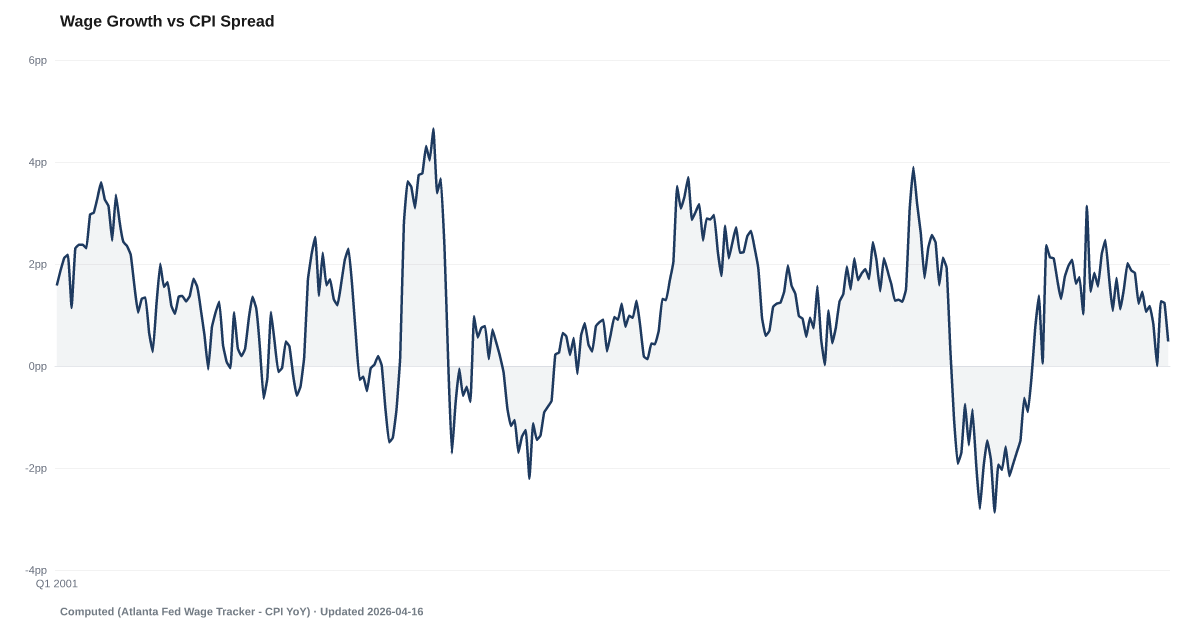
The gap between wage growth and inflation was 0.7 percentage points in August 2026, down from 1.1 percentage points in August 2025. It is the Federal Reserve Bank of Atlanta's median 12-month change in workers' hourly pay minus the 12-month change in the seasonally adjusted CPI-U, calculated by American Default Research; a positive value means the median pay change outpaced prices. It is not the official real earnings figure from the U.S. Bureau of Labor Statistics. Sources: Federal Reserve Bank of Atlanta Wage Growth Tracker and BLS CPI data retrieved via FRED.
The median 12-month change in hourly pay among workers in the Atlanta Fed's tracker ran 0.7 percentage points ahead of consumer price inflation in August 2026, by American Default Research's calculation; a year earlier the spread was 1.1 percentage points.
That is down 0.4 percentage points from a year earlier. The spread was 0.5 percentage points a month earlier, in July 2026; single months are noisy because the wage input is not smoothed.
The spread has been below its year-earlier level for six months in a row.
We build this spread ourselves. The wage side is the Atlanta Fed Wage Growth Tracker's monthly median of individual 12-month hourly pay changes, before the three-month smoothing the Atlanta Fed uses for its published figure. The price side is the 12-month change in the seasonally adjusted consumer price index for urban consumers (CPI-U), which can differ slightly from the unadjusted figure BLS headlines. Neither agency publishes this spread, and it is not the official BLS real earnings series, which uses a different wage measure and can point the other way.
The wage figure covers wage and salary earners interviewed in the Current Population Survey a year apart, on their main job; self-employed people are left out, and the Atlanta Fed says the matched group leans older and more educated. It is the median of individual changes, not the change in the median wage, and it is hourly pay before tax, not take-home pay. The wage input is published to one decimal, so moves of about a tenth of a point are rounding. There is no figure for October 2025, and November and December 2025 rest on a smaller sample. Both inputs are revised, sometimes years back.
The grocery affordability gap sets food prices against wages, and CPI Inflation Rate (All Items) shows the price side on its own.
Explore Further
Is this happening to you?
Is your paycheck keeping up with what you actually spend each month?
Wage Growth vs CPI Spread over time: what has changed?

Counties with the highest debt burden scores
These are debt burden scores from our County Distress Index, not county readings of Wage Growth vs CPI Spread.
Explore all 3,144 counties →| Period | Value | YoY Change |
|---|---|---|
| Aug 2026 | 0.7 pp | -0.4 pp |
| Jul 2026 | 0.5 pp | -1 pp |
| Jun 2026 | 0.8 pp | -0.4 pp |
| May 2026 | -0.8 pp | -2.6 pp |
| Apr 2026 | -0.6 pp | -2.5 pp |
| Mar 2026 | 0.5 pp | -1.5 pp |
| Feb 2026 | 1.5 pp | 0 pp |
| Jan 2026 | 1.7 pp | +0.6 pp |
| Dec 2025 | 0.3 pp | — |
| Nov 2025 | 1.1 pp | — |
| Sep 2025 | 1.3 pp | -1.2 pp |
| Aug 2025 | 1.1 pp | -1.1 pp |
Frequently Asked Questions
What is the wage-CPI spread?
It subtracts the 12-month change in consumer prices from the median 12-month change in hourly pay among workers in the Atlanta Fed's tracker. For August 2026 that left 0.7 percentage points, meaning pay growth was ahead of price growth.
Is this the government's real wage figure?
No. BLS publishes real average hourly earnings, which deflates a different wage measure from its payroll survey and can move the other way. This spread uses the Atlanta Fed's median of individual pay changes, and the subtraction is ours. It describes a median across workers, not any one person's paycheck.
Where does this data come from?
The wage side is the Atlanta Fed Wage Growth Tracker's unsmoothed monthly median (FRED FRBATLWGTUMHWGO), built from U.S. Census Bureau Current Population Survey data. The price side is the BLS consumer price index for urban consumers, seasonally adjusted (FRED CPIAUCSL). A month's spread can be calculated once both are out, usually in the following month.


Quick poll
Is this affecting you or your household?
Discussion
Get the numbers when they move.
New data drops, indicator updates, and American Distress Index changes — delivered when it matters. No spam.
or Create an Account for full access
Loading comments…