Gas Price to Pay Ratio
Also tracked as The Pump Tax
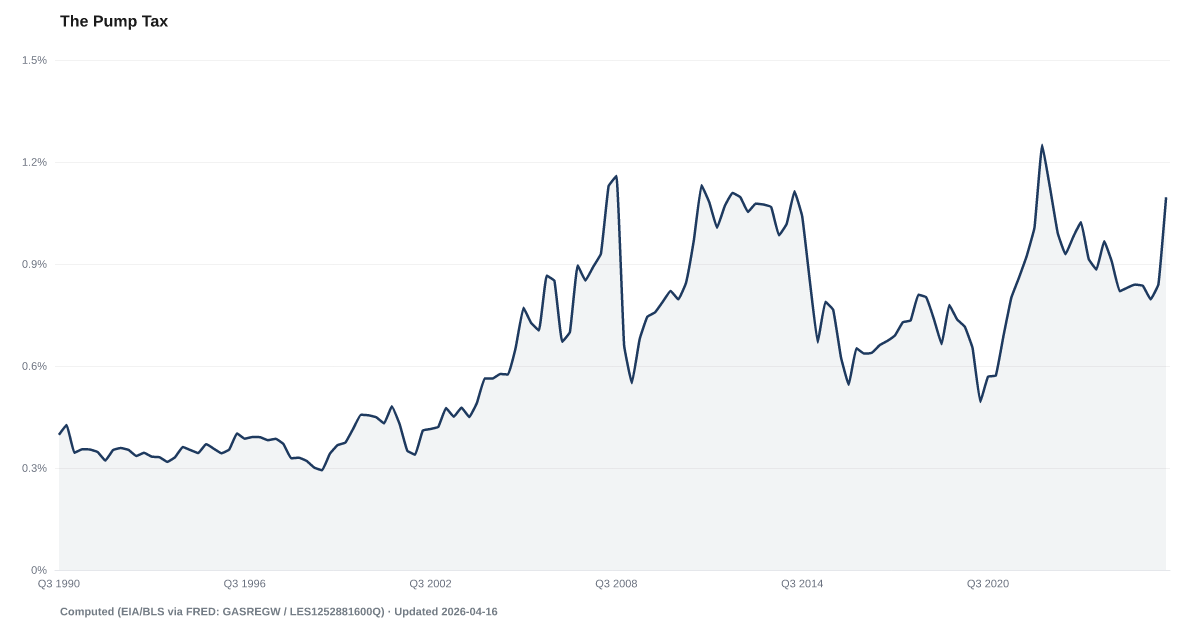
One gallon of regular gas as a share of median weekly earnings
What is the current Gas Price to Pay Ratio reading?
A gallon of regular gas cost 0.33% of the median full-time worker's weekly pay in Q2 2026, up from 0.26% a year earlier. It divides the average U.S. price of a gallon of regular by median weekly earnings of full-time workers, both in today's dollars, times 100. Source: U.S. Energy Information Administration weekly retail gasoline prices and U.S. Bureau of Labor Statistics Usual Weekly Earnings, data retrieved via FRED, computed by American Default (Q2 2026).
Measurement basis: Quarterly average U.S. retail price of a gallon of regular gasoline (EIA, GASREGW) divided by median usual weekly earnings of full-time wage and salary workers in current dollars (BLS, LES1252881500Q), times 100: one gallon as a share of a week's median pay. Both legs are in current dollars.
A gallon of regular gas cost 0.33% of the median full-time worker's weekly pay in Q2 2026, up from 0.26% a year earlier, the highest since Q3 2023.
This measure takes the average U.S. price of a gallon of regular gas over a quarter and divides it by the median weekly earnings of full-time wage and salary workers, then multiplies by 100. Both figures are in today's dollars, so the result is the share of a week's median pay that one gallon costs.
In Q2 2026 a gallon cost 0.33% of a week's median pay, higher than the 0.26% of the same quarter a year earlier. The share was also up from Q1 2026, but gas prices follow a seasonal pattern and usually climb into spring and summer, so the year-earlier comparison is the fairer one.
The share has not been this high since Q3 2023.
The earnings median covers full-time wage and salary workers, not households, part-time workers or the self-employed. The gas price is EIA's Monday pump price for regular, including taxes. EIA changed its outlet sample in May 2018 and says prices on either side are not directly comparable, so records and rankings here start after that change. BLS did not produce earnings for the fourth quarter of 2025, so that quarter has no reading.
For a measure of what the country spends on energy, including gasoline, as a share of after-tax income, see The Energy Squeeze. Neither measure explains why gas prices or pay changed.
Explore Further
Is this happening to you?
Is filling up the tank taking a bigger bite out of your budget than it used to?
Gas Price to Pay Ratio over time: what has changed?

Counties with the highest debt burden scores
These are debt burden scores from our County Distress Index, not county readings of Gas Price to Pay Ratio.
Explore all 3,144 counties →| Period | Value | YoY Change |
|---|---|---|
| Q2 2026 | 0.33% | +0.07 pp |
| Q1 2026 | 0.26% | 0 pp |
| Q3 2025 | 0.26% | -0.03 pp |
| Q2 2025 | 0.26% | -0.05 pp |
| Q1 2025 | 0.26% | -0.02 pp |
| Q4 2024 | 0.26% | -0.04 pp |
| Q3 2024 | 0.29% | -0.04 pp |
| Q2 2024 | 0.31% | -0.01 pp |
| Q1 2024 | 0.28% | -0.03 pp |
| Q4 2023 | 0.3% | -0.03 pp |
| Q3 2023 | 0.33% | -0.05 pp |
| Q2 2023 | 0.32% | -0.11 pp |
How to read this series
The source changed how it measures this in Q2 2018. EIA replaced its retail gasoline price sample, frame, estimation method and city definitions on May 14, 2018 and says estimates on either side are not directly comparable. Readings on either side are not directly comparable, so the year-over-year column stays blank where a comparison would cross that date. Source documentation.
Frequently Asked Questions
What does the gas price to pay ratio measure?
It compares the quarterly average price of a gallon of regular gas with the median weekly pay of full-time wage and salary workers, both in today's dollars. In Q2 2026 one gallon cost 0.33% of a week's median pay. It is the price of one gallon, not a measure of how much anyone spends on gas.
Why doesn't this adjust for inflation?
It doesn't need to. The gas price and the pay figure are both in today's dollars, so general inflation that raises both by the same amount leaves the share unchanged. The share moves when gas prices and pay move at different speeds.
Why compare with a year earlier instead of the last quarter?
Gas prices are not seasonally adjusted and follow a yearly pattern. The ratio rose from the first to the second quarter in 31 of the 35 years from 1991 to 2025, so a spring increase says little on its own.
Where does this data come from?
American Default computes it from two public series on FRED: EIA's weekly U.S. regular gasoline price and BLS median usual weekly earnings of full-time wage and salary workers in current dollars. A new quarter can be computed when BLS publishes its quarterly earnings release, about three weeks after the quarter ends.


Quick poll
Is this affecting you or your household?
Discussion
Get the numbers when they move.
New data drops, indicator updates, and American Distress Index changes — delivered when it matters. No spam.
or Create an Account for full access
Loading comments…