U-6 Underemployment Rate
Broadest measure of labor underutilization
What is the current U-6 Underemployment Rate reading?
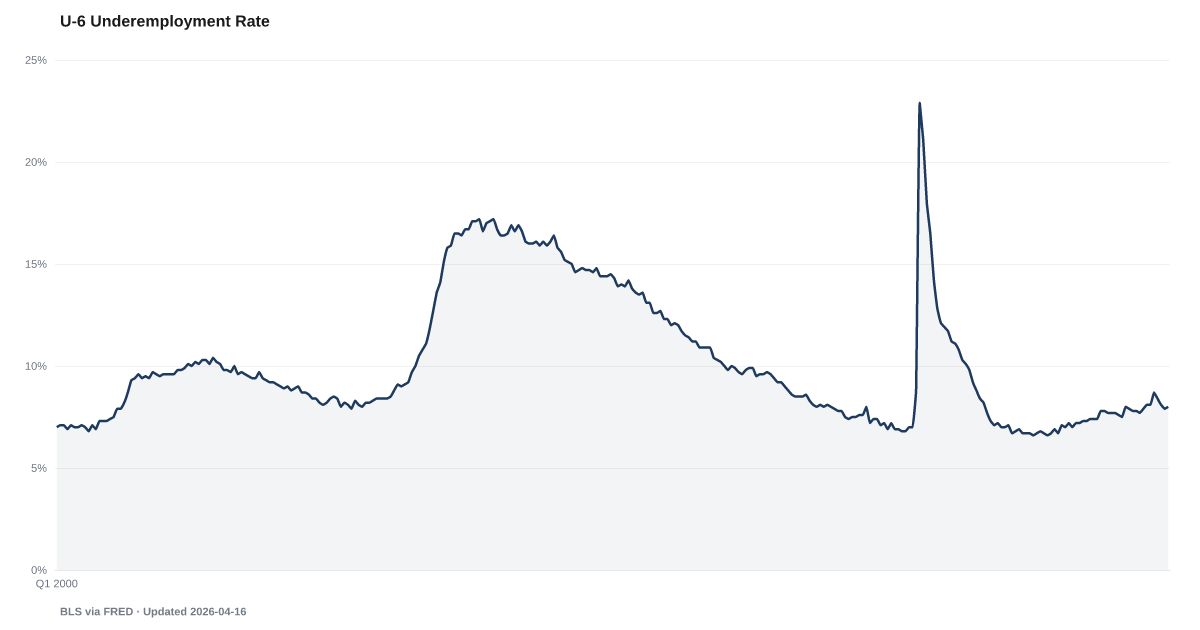
The U-6 underemployment rate was 7.7% in August 2026, little changed from 7.9% in July 2026, according to the U.S. Bureau of Labor Statistics. It counts unemployed people, people marginally attached to the labor force and people working part time for economic reasons, as a share of the labor force plus the marginally attached. Source: BLS Current Population Survey, Table A-15, data retrieved via FRED (U6RATE).
U-6, the broadest BLS measure of labor underutilization, was 7.7% in August 2026, the lowest since June 2025.
The Bureau of Labor Statistics put U-6 at 7.7% for August 2026. That is little changed from 7.9% in July 2026, a move too small to pass BLS's significance test. Over 12 months the rate is down from 8.1%.
U-6 starts from the jobless people counted in the headline Unemployment Rate and adds two groups. One is people marginally attached to the labor force: they want a job and are available for one, and they looked sometime in the past 12 months but not in the past four weeks. Discouraged workers, who stopped looking because they think no jobs exist, are one part of that group. The other is people working part time for economic reasons: they worked 1 to 34 hours in the survey week because their hours were cut or full-time work was not available, and they wanted full-time work. That count has its own page, Part-Time for Economic Reasons.
The rate is a share of the labor force plus the marginally attached, not of all Americans or of all workers. U-3 and U-6 are shares of different bases, and one of the added groups has jobs, so the gap between the two rates is not a count of hidden unemployed people. BLS treats U-3 as the official unemployment rate and publishes U-6 for readers who want a broader definition.
The figures are seasonally adjusted: BLS removes the swings that repeat every year, such as holiday hiring, so one month can be compared with the next. BLS also tests each month's change for sampling error. In August 2026 a one-month move in U-6 needed about 0.3 percentage point, and a 12-month move about 0.4 point, to count as a real change; smaller moves are described here as little changed. The household survey did not run in October 2025, during the federal government shutdown, so there is no U-6 figure for that month.
Explore Further
U-6 Underemployment Rate over time: what has changed?

Counties with the highest labor scores
These are labor scores from our County Distress Index, not county readings of U-6 Underemployment Rate.
Explore all 3,144 counties →| Period | Value | YoY Change |
|---|---|---|
| Aug 2026 | 7.7% | -0.4 pp |
| Jul 2026 | 7.9% | 0 pp |
| Jun 2026 | 7.9% | +0.2 pp |
| May 2026 | 8.1% | +0.3 pp |
| Apr 2026 | 8.2% | +0.4 pp |
| Mar 2026 | 8% | +0.1 pp |
| Feb 2026 | 7.9% | -0.1 pp |
| Jan 2026 | 8.1% | +0.6 pp |
| Dec 2025 | 8.4% | +0.8 pp |
| Nov 2025 | 8.7% | +1 pp |
| Sep 2025 | 8.1% | +0.4 pp |
| Aug 2025 | 8.1% | +0.3 pp |
Frequently Asked Questions
What is the current U-6 underemployment rate?
BLS put it at 7.7% for August 2026. That is lower than a year earlier, when it was 8.1%.
How is U-6 different from the unemployment rate?
The official unemployment rate, U-3, counts people without a job who looked for one in the past four weeks or are waiting to be recalled from a temporary layoff. U-6 adds people marginally attached to the labor force and people working part time who want full-time hours, and it divides by the labor force plus the marginally attached. It is BLS's broadest measure of labor underutilization, not a corrected version of the official rate.
Is there a U-6 rate for my state?
Not a monthly one. BLS publishes state U-6 rates only as averages over four quarters, because state survey samples are small. The national rate covers the 50 states and the District of Columbia, not Puerto Rico or the territories.
Where does U-6 data come from?
BLS publishes U-6 monthly in Table A-15 of The Employment Situation report. It comes from the Current Population Survey, a monthly survey of about 60,000 households run by the Census Bureau for BLS. Seasonally adjusted figures for the past five years are revised each January.


Quick poll
Is this affecting you or your household?
Discussion
Get the numbers when they move.
New data drops, indicator updates, and American Distress Index changes — delivered when it matters. No spam.
or Create an Account for full access
Loading comments…